





In the high-stakes world of industrial fluid power, the ability to monitor hydraulic performance in real-time is often the difference between operational efficiency and catastrophic system failure. Last month, Sun Hydraulics officially launched its QMEH cartridge-style flow meter, a product that aims to democratize high-precision flow measurement. By integrating state-of-the-art, proprietary sensing technology into a compact, cost-effective cartridge form factor, Sun Hydraulics is positioning the QMEH as a foundational tool for the next generation of electrified and automated hydraulic systems.
Main Facts: Innovation in a Compact Package
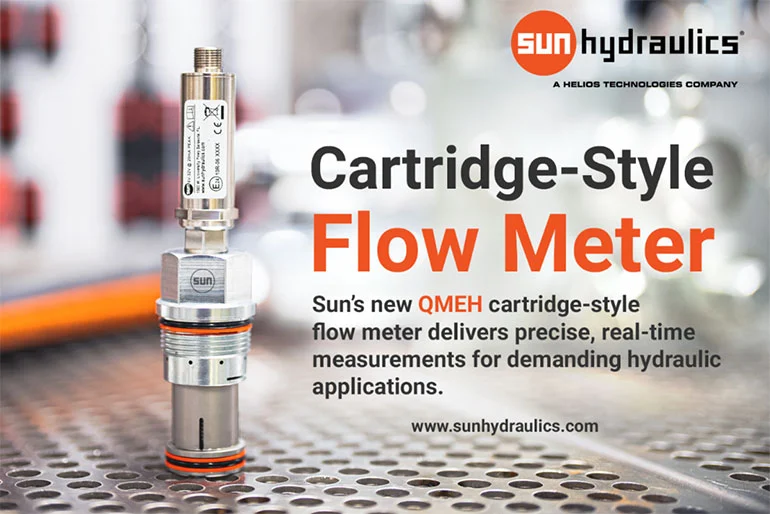
The QMEH is not merely another sensor; it represents a significant departure from traditional flow measurement hardware. Designed to fit into Sun’s standard T-16A cavity, the QMEH is a piston-style flow meter engineered for extreme environments. It supports operating pressures of up to 5,000 psi (350 bar) across all ports, making it suitable for a diverse array of demanding sectors, including aerospace ground support equipment, telehandlers, excavators, and complex hydraulic power units.
At the heart of the device is a custom-built, patent-protected position sensor. Unlike legacy sensors that require bulky external housings, the QMEH utilizes a coiled flexible printed circuit board (PCB) to house its electronics. This architectural choice significantly reduces the physical footprint of the sensor while allowing for on-board signal processing. This onboard capability enables the factory to perform multi-point calibration, ensuring that every unit delivered to the customer provides a linear, highly accurate output signal right out of the box.
A Chronology of Development: From Concept to CONEXPO
The journey of the QMEH from an internal engineering concept to a commercial market leader was marked by a commitment to vertical integration. Several years ago, the team at Sun Hydraulics identified a market gap: engineers were often forced to forgo flow measurement in their designs due to the prohibitive costs and the space constraints of existing external flow meters.
Initial prototypes of the sensor were developed years ago but remained in the "incubation" phase. Rather than outsourcing the sensor component to a third-party manufacturer—a common practice that often leads to compatibility issues and higher costs—Sun’s leadership made the strategic decision to task their internal electronics engineering team with refining the design.
The product received its first public "soft-launch" at the CONEXPO/CON-AGG trade show in Las Vegas in March. The reception at the event underscored the industry’s pent-up demand for a reliable, integrated, and affordable flow measurement solution. Following the positive feedback from industry professionals, Sun finalized the production processes and released the product to the global market late last month.
Supporting Data: Engineering for Reliability
The QMEH is built to thrive in the "electrically noisy" environments typical of modern mobile machinery. One of the most significant technical challenges in integrating electronic sensors into hydraulic circuits is electromagnetic interference (EMI). The QMEH has been rigorously tested and certified to CE standards, including E-mark EMC compliance, ensuring it functions reliably without disrupting other vehicle electronics or being affected by them.
Key Technical Specifications:
- Operating Pressure: Up to 5,000 psi (350 bar) on all ports.
- Form Factor: Compact cartridge design (fits T-16A cavity).
- Sensing Technology: Proprietary position sensor with coiled flexible PCB.
- Calibration: Factory-set multi-point calibration for linear output.
- Compatibility: Designed for use with Sun’s XMD driver for closed-loop control applications.
The piston-style design is a critical differentiator. By utilizing a "closed" position architecture, the QMEH offers superior sensitivity when detecting the presence—or absence—of flow during low-flow conditions. This is essential for diagnostics, where identifying the "start of motion" is critical to preventing damage to hydraulic actuators and pumps.
Official Responses and Strategic Vision
Cory Fisher, Director of Strategic Sales at Sun Hydraulics, highlighted the company’s intent to lower the barrier to entry for advanced hydraulic monitoring.
"Flow measurement is nothing new," Fisher stated during an interview at CONEXPO. "But because the cost of flow meters has historically been very high, many applications that could benefit from flow measurement simply find ways to work around not having it. The QMEH is ideal for those types of applications because you get all of the benefits of having flow measurement at a fraction of the cost."

Fisher emphasized that the QMEH’s versatility allows it to serve multiple roles: system-level flow monitoring, individual function diagnostics, and high-precision closed-loop control. When paired with an XMD valve driver, the QMEH transforms from a simple diagnostic tool into a feedback sensor for sophisticated motion control.
"One of the things that is exciting for me is that the sensor’s new," Fisher noted. "We didn’t want to buy an outside sensor for the design, so we reached out to Sun’s electronic engineering team. It’s patented technology. It has onboard electronics, which means the footprint is smaller, and we can do multi-point calibration directly in the sensor."
Implications for the Industry: The Future of Hydraulics
The introduction of the QMEH has far-reaching implications for the mobile and industrial hydraulic sectors, particularly as the industry moves toward increased electrification and "smart" machinery.
1. Enhanced Diagnostic Capabilities
In the past, diagnostic tools were often retrofitted, creating additional leakage points and maintenance headaches. The QMEH’s integrated, cartridge-style design allows for permanent installation in case drains or critical circuit lines. This enables real-time monitoring, allowing technicians to detect increased flow—often a harbinger of pump wear or internal leakage—before a total system failure occurs.
2. The Rise of Closed-Loop Control
As hydraulic systems become more automated, the need for feedback becomes paramount. The QMEH provides the linear, proportional signal necessary for closed-loop control. By facilitating this, Sun Hydraulics is enabling manufacturers to build more responsive and energy-efficient systems that can automatically adjust to load changes and fluid conditions.
3. Modularity and Scalability
Sun Hydraulics has signaled that the modular position sensor platform powering the QMEH will be deployed across other products in their Motion Control Technology portfolio. This suggests a long-term strategy of standardizing high-performance sensing across their entire product line, which will likely simplify inventory for distributors and design integration for OEMs.
4. Economic Impact
At a list price of $525, the QMEH challenges the status quo of sensor pricing. By bringing high-precision flow measurement into a price range accessible to smaller test stand manufacturers and medium-scale equipment builders, Sun is effectively encouraging a higher standard of performance and safety across the board.
Conclusion: A New Benchmark for Fluid Power
The QMEH cartridge-style flow meter represents a convergence of mechanical reliability and electronic sophistication. By addressing the three primary barriers to widespread sensor adoption—cost, size, and electrical noise immunity—Sun Hydraulics has provided a tool that meets the needs of modern, electrified hydraulic systems.
As manufacturers face increasing pressure to improve the efficiency and diagnostic capabilities of their equipment, the QMEH offers a clear path forward. Whether it is being used to monitor the health of a construction excavator’s hydraulic system or to provide the feedback loop for an aerospace test rig, the QMEH is poised to become a staple component in the fluid power industry. With its combination of patented sensor technology, robust pressure ratings, and ease of integration, Sun Hydraulics has set a new benchmark for what the industry should expect from its measurement hardware.