




Beyond the Surface: Why Ultrasound is the Key to Scalable Tactile Intelligence for Physical AI

As Physical AI transitions from the realm of theoretical digital reasoning into the gritty, unpredictable reality of physical interaction, the robotics industry has reached a critical bottleneck. While modern robots have mastered the art of vision, motion planning, and navigation, they remain remarkably “numb.” To truly function alongside humans—whether in logistics, industrial manufacturing, or dexterous service roles—robots require a sophisticated sense of touch.
For years, the industry has relied on electronic skins—flexible sensing layers embedded with capacitive, piezoresistive, or piezoelectric materials. However, as the demand for high-duty-cycle robotic operation grows, these surface-coupled solutions are showing their age. Enter UltraSense Systems, a company positing that the future of tactile intelligence lies not on the surface, but beneath it, utilizing the precision and durability of ultrasound.
The Scaling Problem: The Vulnerability of Surface-Coupled Sensors
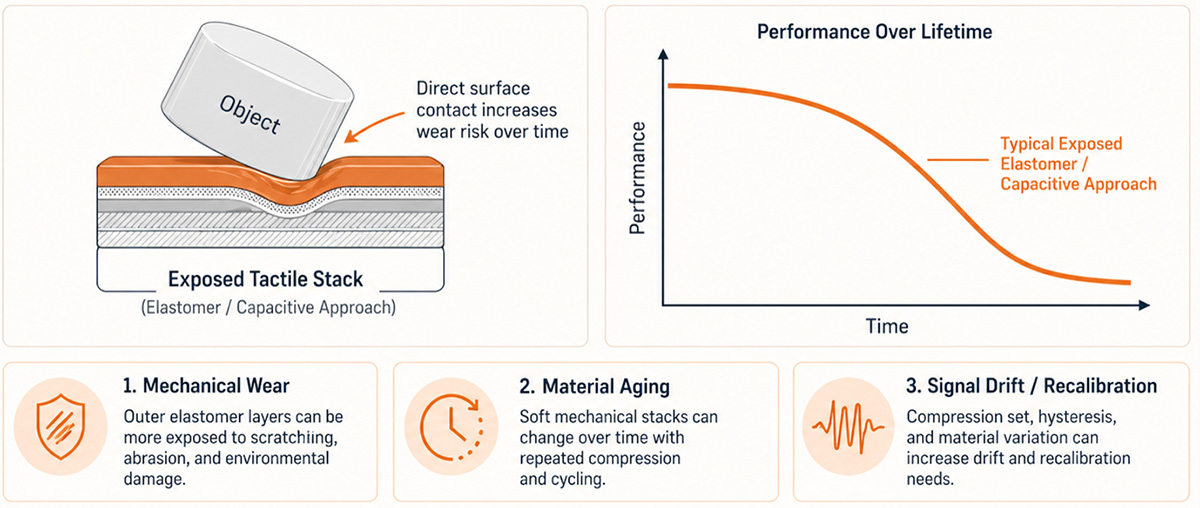
The fundamental challenge in current tactile sensing lies in the environment of the robotic extremity. A humanoid hand or an industrial gripper is subjected to a punishing gauntlet: repeated compression, intense abrasion, constant exposure to contaminants, temperature fluctuations, and the inevitable creep and degradation of materials.
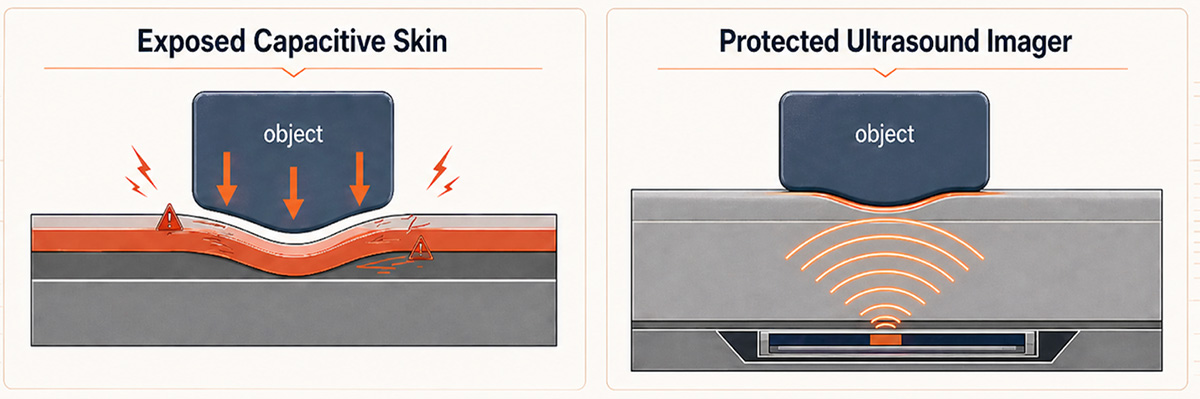
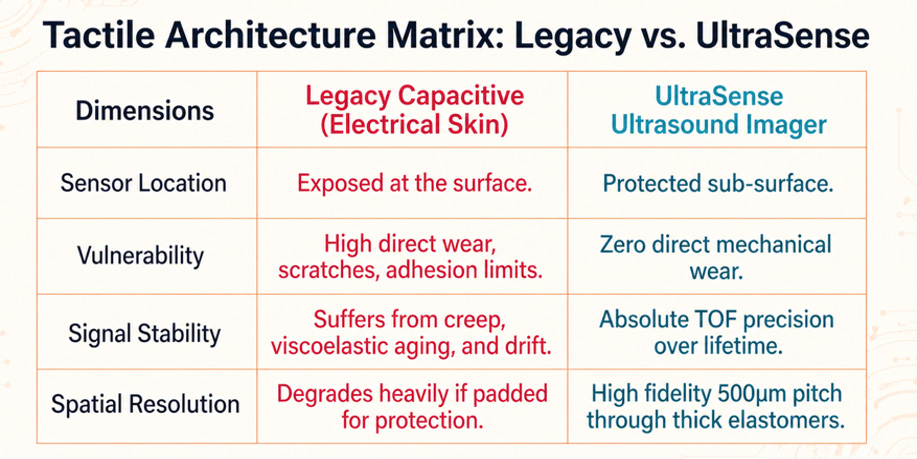
When the primary sensing architecture is integrated into the outer layers of a robotic skin, it becomes a sacrificial component. If the sensing layer is too close to the surface, it is susceptible to mechanical failure and electrical drift. If it is buried beneath protective padding, sensitivity and spatial resolution plummet. This creates a “viability gap.” A sensor that works perfectly in a pristine laboratory environment often fails to maintain calibration or signal integrity after only a few months of commercial operation.
Existing technologies, such as force-sensing resistors, often suffer from drift as conductive networks break down under repeated stress. Capacitive sensors, while highly sensitive, are plagued by parasitic interference and mechanical constraints. For a commercial robot expected to perform millions of contact cycles without constant maintenance, these legacy approaches are proving to be a scaling nightmare.
The Paradigm Shift: Moving Sensing Below the Damage Zone
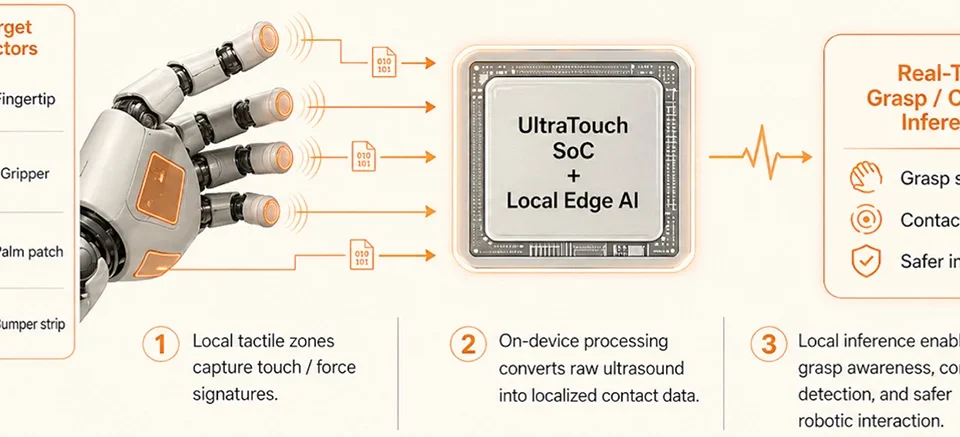
UltraSense proposes a departure from traditional electronic skin, suggesting that the sensing hardware should be physically decoupled from the contact surface. By utilizing ultrasound, the system interrogates the robot’s "skin" from underneath, rather than relying on electrical changes at the point of contact.
How Acoustic Intelligence Works
In this architecture, acoustic waves are propagated through the structural material of the robotic gripper. When an object makes contact with the outer surface, it induces a physical deformation in the stack. This deformation changes the path length, reflection amplitude, and frequency response of the ultrasonic waves. By analyzing these changes—often described as the "acoustic signature"—the system can infer exactly what is happening at the contact interface without the sensor itself ever touching the object being manipulated.
This approach offers two distinct advantages:

- Durability: Because the transducer remains protected, it is immune to the abrasion, moisture, and contamination that destroy exposed electronic skins.
- Material Versatility: Engineers are no longer forced to use specific "sensor-friendly" materials. The ultrasound can "see" through leather, metal, polymer, or fabric, allowing for designs that prioritize friction and durability over electrical compatibility.
Chronology: From Automotive HMI to Robotic Dexterity
The journey of UltraSense into the robotics space is rooted in its extensive history in the automotive and consumer electronics sectors.
- 2018: UltraSense Systems is founded, focusing on Human-Machine Interface (HMI) solutions. The company identifies that consumers demand premium, seamless surfaces (like solid metal or glass) that traditional capacitive touch cannot handle.
- 2019-2023: The company refines its 3D ultrasound technology, focusing on the rigorous reliability requirements of the automotive industry. During this period, UltraSense ships over 4 million units into automotive applications, proving that its acoustic sensing platform can withstand the vibrations, heat, and moisture of an automobile cabin.
- 2024-2025: Leveraging its success in automotive and AI-enabled consumer devices, the company pivots its attention to the burgeoning field of Physical AI. It recognizes that the requirements for a high-end, durable automotive touch button are nearly identical to those required for a long-lasting, dexterous robotic finger.
- 2026: UltraSense officially positions its platform as a foundational layer for Physical AI, aiming to move beyond simple "contact" detection to high-resolution "tactile intelligence."
Supporting Data: Precision and Performance Metrics
One of the most common critiques of "sub-surface" sensing has been the loss of resolution compared to direct-contact sensors. UltraSense has countered this with empirical data that challenges the industry status quo.
According to technical demonstrations provided by the company, their ultrasound platform achieves a 500 µm (0.5 mm) spatial resolution. This is sufficient to resolve fine surface features, such as the ridges on a fingerprint or the texture of a fabric. Furthermore, in terms of force sensitivity, the system has demonstrated a 1.25 mN (millinewton) precision for localized compressive force profiling.
Perhaps most importantly for industrial applications, the company reports a 5 mN noise floor for shear force detection. This capability is critical: in robotic manipulation, detecting the moment a slip begins (micro-slip) is often more important than measuring the total force of the grasp. By tracking lateral displacement within the material stack, the ultrasound system provides a real-time feedback loop that allows the robot to adjust its grip before the object is dropped.
Official Perspectives: The Vision for Physical AI
Mo Maghsoudnia, CEO of UltraSense Systems, emphasizes that the robotics industry is currently treating tactile sensing as a secondary component, whereas it should be treated as a foundational data layer.
"Tactile intelligence is the final frontier for physical AI," says Maghsoudnia. "We aren’t just trying to measure pressure; we are trying to provide a holistic understanding of the contact event. When a robot touches an object, it needs to know: Is it slipping? Is it hard or soft? Is the force distributed evenly? By moving this sensing into the acoustic domain, we are giving robots the ‘nerve endings’ they need to survive in the real world."
Dr. Hao-Yen Tang, CTO of UltraSense, adds that the platform’s strength lies in its use of "multi-parameter" sensing. "Unlike a resistive sensor that gives you a single value, ultrasound gives you a rich set of data: time-of-flight, attenuation, and frequency response. It is effectively a multi-dimensional sensor that treats the entire robotic fingertip as a smart, intelligent interface."
Implications for the Future of Robotics
The shift toward ultrasound-based tactile sensing has profound implications for the robotics industry, extending far beyond the fingertip.
1. Standardization and Manufacturability
By providing a standardized platform—complete with ASIC-based processing and established calibration methods—UltraSense is moving tactile sensing away from "bespoke laboratory art" toward "off-the-shelf industrial component." This allows robotics OEMs to integrate sophisticated touch capabilities without reinventing the wheel for every new gripper design.
2. Intellectual Property and Ecosystem
As the market for humanoid robots matures, the battle for IP will intensify. UltraSense has built a substantial patent portfolio that covers not only the transducer technology but also the unique methods of calibration and data processing required to interpret acoustic data in a noisy environment. This creates a moat for the company and provides a reliable roadmap for integrators who need long-term supply chain security.
3. The "Intelligent Surface" Era
In the coming years, we can expect to see a blurring of lines between the robot’s "body" and its "sensors." If every surface of a robot can be made sensitive to touch—through a combination of durable outer materials and subsurface acoustic sensing—we will see the emergence of robots that can interact with the world with the same level of safety and awareness as a human.
Conclusion: The Path Forward
The "scaling problem" in robotics is not merely about making more robots; it is about making robots that can endure the rigors of the real world. By shifting the paradigm from fragile, surface-exposed sensors to robust, subsurface ultrasonic intelligence, the industry may have finally found a path to the reliable, high-resolution touch that Physical AI desperately needs.
As we look toward the next generation of humanoid hands and industrial grippers, the criteria for success will be defined by longevity, signal integrity, and the ability to distinguish between a gentle touch and a dangerous slip. Ultrasound, backed by a proven track record in demanding automotive environments, is well-positioned to serve as the silent, unseen nervous system for the next generation of machines. Whether in a warehouse, a hospital, or a factory floor, the robots of the future will be defined by their ability to "feel"—and, thanks to innovations in acoustics, they will be able to do so for years to come.