



Revolutionizing the Factory Floor: Visual Components to Showcase Advanced 3D Simulation and Robotics at FABTECH 2026

As the manufacturing landscape undergoes a rapid digital transformation, the demand for agility, precision, and efficiency has never been greater. At the forefront of this industrial evolution, Visual Components, a global leader in 3D manufacturing simulation software, has announced its upcoming participation at FABTECH 2026. Taking place from October 21–23 at the Las Vegas Convention Center, the company is set to demonstrate how its advanced offline robot programming (OLP) and simulation ecosystems are reshaping the future of production.
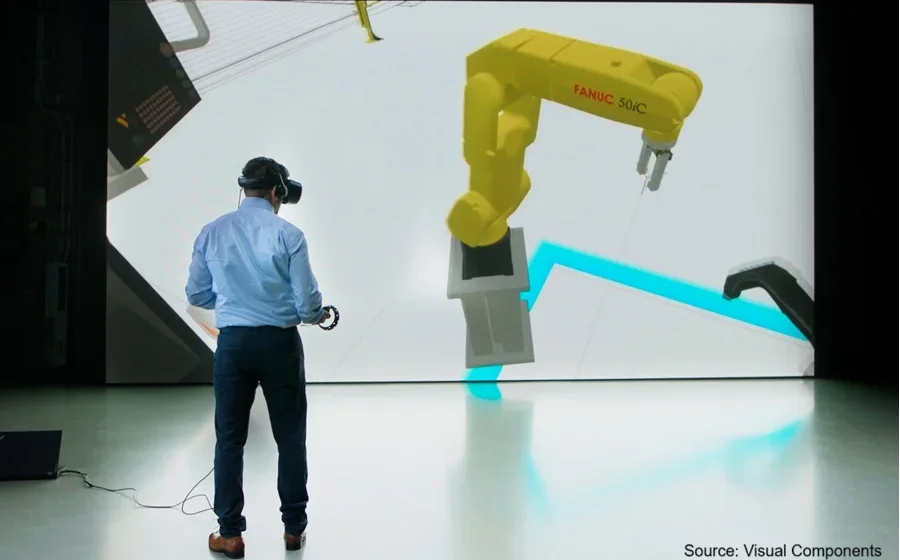
Visitors to booth #S39063 in the South Hall will be invited to transcend the limitations of traditional shop floor planning. Through immersive virtual reality (VR) experiences, attendees can step directly into a simulated production environment, providing a tangible look at how high-fidelity 3D visualization is helping manufacturers optimize complex welding processes and validate systemic workflows long before a single piece of hardware is installed.
The Core Offering: Bridging Simulation and Execution
At the heart of the Visual Components showcase is the promise of “designing for efficiency.” In an era where downtime is the enemy of profitability, the ability to validate a process in a digital twin environment is no longer a luxury—it is a competitive necessity.
The Power of 3D Digital Twins
The Visual Components platform acts as a bridge between conceptual design and physical reality. By creating a 3D digital twin of a factory, engineers can simulate entire production lines, test the logic of automation, and identify bottlenecks. At FABTECH 2026, the company will highlight how these tools specifically benefit the welding sector. For welding professionals, visualizing the reach, motion, and collision risks of a robot—while simultaneously optimizing the weld path—can reduce setup time by weeks, if not months.
Agnostic Compatibility
One of the most significant hurdles in modern manufacturing is the "silo effect" of proprietary hardware. Many manufacturers operate a mixed fleet of robots from various OEMs. Visual Components differentiates itself through its brand-agnostic OLP software. Whether a facility utilizes robots from FANUC, ABB, Yaskawa, or KUKA, the Visual Components software ensures seamless integration. This flexibility allows manufacturers to standardize their programming environment across the entire shop floor, regardless of the individual robot’s brand or specific application complexity.
Chronology: The Evolution of Industrial Simulation
The journey to FABTECH 2026 is built on decades of software refinement. Understanding the progression of Visual Components’ technology reveals how the industry has shifted from manual, trial-and-error physical testing to high-precision virtual modeling.
- The Early Foundations: Decades ago, simulation was largely reserved for high-budget aerospace and automotive giants. Visual Components began its mission by democratizing this technology, making powerful simulation accessible to small-to-medium-sized enterprises (SMEs).
- The Integration of OLP: Recognizing that simulation alone was insufficient, the company integrated Offline Robot Programming (OLP). This transition allowed the simulation model to directly generate code for physical robots, bridging the "gap of implementation."
- The Shift to VR and Immersive Tech: As hardware costs plummeted, Visual Components embraced virtual reality. This allowed non-technical stakeholders—such as plant managers and investors—to "walk" through a proposed factory line, drastically improving communication and project buy-in.
- FABTECH 2026 and Beyond: The upcoming exhibition represents the next phase of this evolution: the move toward cloud-connected, collaborative, and AI-assisted programming that allows for remote updates and global standardization.
Supporting Data: Efficiency, Downtime, and ROI
The value proposition of Visual Components is rooted in measurable metrics. For manufacturers considering the transition to OLP, the data provides a compelling case for adoption.
Increasing Robot Utilization
Traditional robot programming often requires the robot to be taken offline. When a robot is being "taught" via a physical pendant, it is not producing parts—this is known as "non-productive time." Visual Components’ OLP software allows the programming to be performed entirely off-site. By moving the programming burden to the digital realm, utilization rates can increase by as much as 30% to 50%, depending on the complexity of the process.
The Cost of Error Reduction
In high-precision welding, a collision or a misaligned weld path can result in thousands of dollars in scrap material and damaged tooling. Simulation allows for "collision detection" in the virtual space. By simulating the robot’s path through every joint, the software ensures that the physical execution will be error-free.
Institutional Knowledge Preservation
High turnover in skilled labor is a recurring challenge for the welding and manufacturing sectors. Visual Components addresses this by allowing manufacturers to store process knowledge as reusable templates. When an expert welder designs a highly efficient program, it can be saved, categorized, and reused for future projects. This turns "tribal knowledge" into a standardized, company-wide asset, accelerating the onboarding process for new employees.
Official Perspectives: The Strategic Value of Simulation
Industry experts and leadership at Visual Components emphasize that their presence at FABTECH is not just about selling software; it is about promoting a shift in manufacturing philosophy.
"We are moving toward a future where the virtual model is the primary source of truth," says a spokesperson for the company. "When you step into our VR booth at FABTECH, you aren’t just looking at a screen; you are experiencing the efficiency of your future factory. Our software allows the programmer to update and refine processes from anywhere in the world. This remote capability is a game-changer for downtime reduction, as it allows for real-time adjustments while the production line continues to operate."
The company’s focus on "customizable software" is designed to meet the diverse needs of modern industry. Whether a firm is dealing with high-volume, low-mix production (like automotive assembly) or low-volume, high-mix production (like bespoke metal fabrication), the software adapts to the specific constraints of the environment.
Implications: The Future of the Manufacturing Floor
The implications of Visual Components’ display at FABTECH 2026 extend far beyond the three days of the exhibition. The integration of advanced OLP and simulation technologies into the mainstream suggests several trends for the coming decade:
1. The Rise of the "Digital-First" Manufacturer
Manufacturing plants will increasingly be designed in the virtual world before a single brick is laid or a single robot is ordered. This digital-first approach reduces financial risk, as companies can test the ROI of a new line before committing capital.
2. Democratization of Automation
As software becomes more intuitive, the barrier to entry for robot programming is lowering. By using OLP, a manufacturer no longer needs a PhD in robotics to program a sophisticated weld; they need a process expert who understands how to navigate a user-friendly interface. This will empower smaller welding shops to compete on the same level as global conglomerates.
3. Resilience Through Remote Management
The ability to reprogram a robot from a remote location is a significant step toward "resilient manufacturing." In the face of global supply chain disruptions or local labor shortages, the capacity to manage and troubleshoot a shop floor from afar ensures that production remains consistent and adaptable.
4. Standardized Best Practices
The emphasis on "reusable templates" suggests a trend toward industry-wide standardization. As best practices become codified in software, the quality of manufacturing will become more consistent across the globe. This creates a higher baseline for quality, which benefits the entire supply chain, from the raw material supplier to the end-user.
Conclusion: Join the Conversation at FABTECH 2026
As we look toward the future of industrial production, the synthesis of human expertise and machine intelligence is the path forward. Visual Components is inviting all FABTECH 2026 attendees to see this synthesis in action at booth #S39063.
Whether you are a welding specialist looking to optimize your throughput, a plant manager aiming to reduce downtime, or a business owner evaluating the ROI of automation, the immersive experience provided by Visual Components will offer a clear vision of the path ahead. By leveraging 3D simulation and offline programming, manufacturers can finally stop guessing and start knowing.
In a rapidly changing global economy, those who master the digital twin will be the ones who define the future of industry. Visual Components stands ready to help manufacturers make that leap, ensuring that when they step into the future, they do so with precision, confidence, and the most advanced tools available.
For those interested in preserving the insights shared at this year’s event, reprint services and custom documentation of these technical advancements are available through BNP Media. As the industry gathers in Las Vegas this October, the focus remains clear: innovate, simulate, and succeed.