




Unlocking the Quantum Web: Researchers Achieve Milestone in Measuring W-State Entanglement

Quantum entanglement, a phenomenon Albert Einstein famously dubbed "spooky action at a distance," remains one of the most counterintuitive yet foundational pillars of modern physics. It describes a reality where particles—such as photons—become so deeply linked that the state of one is inextricably tied to the state of another, regardless of the distance separating them. In such a system, individual identity dissolves, and the group must be treated as a singular, cohesive entity.
While this concept once challenged the very bedrock of classical physics, it has evolved into the lifeblood of the 21st century’s most ambitious technological frontier: quantum information science. From the promise of unhackable communication networks to the exponential processing power of quantum computers, the ability to manipulate and measure these delicate entangled states is the "holy grail" of the field. Now, a collaborative team of researchers from Kyoto University and Hiroshima University has achieved a significant breakthrough, successfully demonstrating an "entangled measurement" for a specific, highly resilient form of entanglement known as the W state.
The Bottleneck: The Measurement Problem
To build a functional quantum internet or a scalable quantum computer, scientists must move beyond generating simple entangled pairs. They must master multi-photon entangled states. However, creating these states is only half the battle; the other half is verification.
Traditionally, researchers have relied on a technique known as quantum tomography. This process involves performing a massive battery of measurements to reconstruct the state of a system mathematically. While effective for simple systems, tomography suffers from an "exponential wall." As the number of photons increases, the data requirements—and the time required to process them—skyrocket, making the approach increasingly impractical for complex quantum systems.
The alternative is the "entangled measurement," a one-shot diagnostic approach that identifies the state of a system directly, without the need for cumbersome reconstruction. While scientists had previously demonstrated this for the Greenberger-Horne-Zeilinger (GHZ) state—a prominent form of multi-photon entanglement—the W state, which is equally vital for quantum information protocols, remained elusive for over 25 years.
Chronology of a Breakthrough
The journey toward measuring the W state began with a fundamental theoretical question: How do we identify a state that refuses to be measured by traditional means?
- 1990s–2000s: The theoretical framework for GHZ-state measurement was established, providing a roadmap for how to perform direct, single-shot measurements. However, the W state—distinguished by its robustness against particle loss—presented unique mathematical challenges that standard circuits could not resolve.
- The Planning Phase: The Kyoto-Hiroshima collaboration identified that the W state possessed a hidden mathematical property known as "cyclic shift symmetry." By leveraging this symmetry, the researchers hypothesized that they could "rearrange" quantum information in a way that made the W state’s pattern readable.
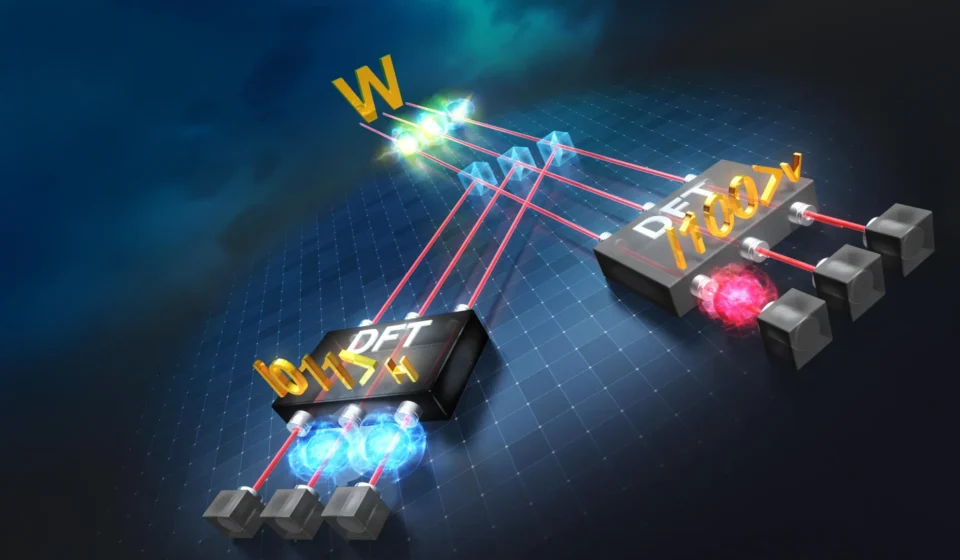
- The Design Phase: The team designed a photonic quantum circuit capable of performing a quantum Fourier transformation. This mathematical operation acts like a prism, separating the complex, overlapping quantum information into distinct, identifiable patterns.
- Experimental Demonstration: Recently, the team constructed a high-stability optical circuit. By sending three polarized photons through this device, they were able to distinguish between different types of three-photon W states, marking the first time this has been experimentally achieved.
Leveraging Symmetry: The Science Behind the Success
The core of this achievement lies in the sophisticated application of cyclic shift symmetry. In the quantum world, the W state is prized because, unlike the GHZ state, if one photon is lost, the remaining photons stay entangled. This makes the W state a "gold standard" for quantum networks that must operate in imperfect, real-world conditions.
The researchers realized that because the W state exhibits symmetry—where the arrangement of photons can be shifted in a cycle without altering the underlying quantum structure—they could create a "filter" that only reacts to the specific geometry of that state.
Their experimental device uses this circuit to "read" the entanglement. When the three photons enter the device, the circuit performs the Fourier transformation, mapping the incoming state to a specific output port. By monitoring which port the photons emerge from, the researchers can identify the state with high fidelity. This high-stability design is particularly noteworthy, as it operates without the need for constant, energy-intensive active calibration, a major hurdle for scaling quantum devices.
Official Perspectives
The implications of this work are being hailed as a significant step forward in the modularity of quantum systems. Corresponding author Shigeki Takeuchi of Kyoto University emphasized the temporal significance of the achievement.
"More than 25 years after the initial proposal concerning the entangled measurement for GHZ states, we have finally obtained the entangled measurement for the W state as well, with genuine experimental demonstration for 3-photon W states," Takeuchi said.
Reflecting on the broader strategy, Takeuchi noted that the team’s success is as much about philosophy as it is about engineering. "In order to accelerate the research and development of quantum technologies, it is crucial to deepen our understanding of basic concepts to come up with innovative ideas," he added. By focusing on the fundamental symmetries of the W state, the team managed to bypass the brute-force complexity that has stalled previous attempts.
Implications for Future Quantum Infrastructure
The ability to perform a one-shot measurement of the W state opens several critical doors for the future of quantum technology:
1. Quantum Teleportation
Quantum teleportation does not move physical matter, but rather the quantum state of information. By using entangled W states as a "bridge," researchers can transfer data across vast distances. This new measurement technique acts as the receiver’s verification, confirming that the information was successfully teleported.
2. Quantum Communication Protocols
In a quantum internet, W states serve as ideal candidates for distributing entanglement across multiple nodes. Because they are resilient to the loss of a single particle, they are far more reliable than GHZ states for long-distance communication. This research provides the necessary "handshake" protocol for devices to confirm they are communicating with the correct entangled partner.
3. Measurement-Based Quantum Computing
In this model of computing, the "hardware" is a large, pre-entangled state, and the computation is performed through a series of measurements. By perfecting the measurement of the W state, researchers have added a new tool to the toolkit of logic gates that can be used to perform calculations on a quantum processor.
Scaling the Technique: The Road Ahead
While the three-photon demonstration is a triumph, the researchers are already looking toward the next horizon. The current device, while highly stable, is a laboratory-scale experiment. The team’s long-term objective is to move this technology onto a "photonic chip."
By integrating these quantum circuits onto silicon chips, the team hopes to achieve a level of miniaturization that makes these systems portable and commercially viable. Furthermore, they are working to generalize the mathematical model to accommodate any number of photons.
"Our goal is to apply this method to larger-scale and more general multi-photon quantum entangled states," the team stated. "If we can scale this to dozens or hundreds of photons, we move from the era of demonstration to the era of application."
As quantum technology transitions from theoretical abstraction to tangible engineering, breakthroughs like the Kyoto-Hiroshima measurement method are the essential scaffolding. By turning the "spooky" behavior of entangled particles into a predictable, measurable, and useful asset, researchers are steadily bringing the quantum internet—and the immense power of quantum computing—out of the laboratory and into the future of global infrastructure.