




The Dawn of the AI-Fabrication Era: Meshy Secures $400 Million to Bridge the Gap Between Prompt and Print

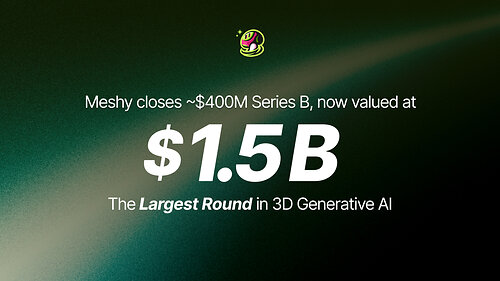
In a watershed moment for the intersection of generative artificial intelligence and physical manufacturing, Meshy—the pioneering platform for AI-driven 3D content generation—has successfully closed a Series B funding round totaling nearly $400 million. This monumental raise, which establishes the company at a $1.5 billion valuation, marks the largest investment ever dedicated specifically to AI 3D generation. More significantly, it represents the first time Meshy has publicly disclosed its valuation, signaling its transition from a high-growth startup to an industry-defining unicorn.
The funding round saw robust participation from the company’s existing investor base, complemented by a roster of new, high-profile global backers. According to company leadership, these fresh capital reserves are earmarked for an aggressive expansion of research and development (R&D) capabilities and a comprehensive push into international markets, aiming to cement Meshy’s status as the foundational layer of the 3D-printing workflow.
The Financial and Operational Engine: A 12x Growth Trajectory
The scale of this Series B is not merely a reflection of the hype surrounding generative AI; it is underpinned by substantial, anomalous commercial traction. As of July 2026, Meshy reported a staggering 12x year-over-year increase in Annual Recurring Revenue (ARR). This financial velocity is bolstered by a massive user ecosystem, with over 12 million registered users having already generated more than 100 million 3D models.
This volume of output suggests that Meshy has successfully moved beyond the "toy" phase of generative AI, finding a home in the professional workflows of creators, designers, and engineers. The company’s ability to convert text or 2D imagery into high-fidelity, production-ready 3D assets in roughly one minute—a process that historically demanded weeks of specialized labor and expensive software suites—has disrupted the traditional CAD-heavy bottleneck of 3D creation.
Chronology: From Research Lab to Industrial Standard
To understand Meshy’s current market position, one must look at the rapid-fire evolution of the company since its inception by MIT PhD Ethan Hu.
- Foundation and Early R&D: Founded on the principle of lowering the barrier to entry for 3D design, the company focused initially on proprietary algorithms capable of parsing complex geometry from single-line text prompts.
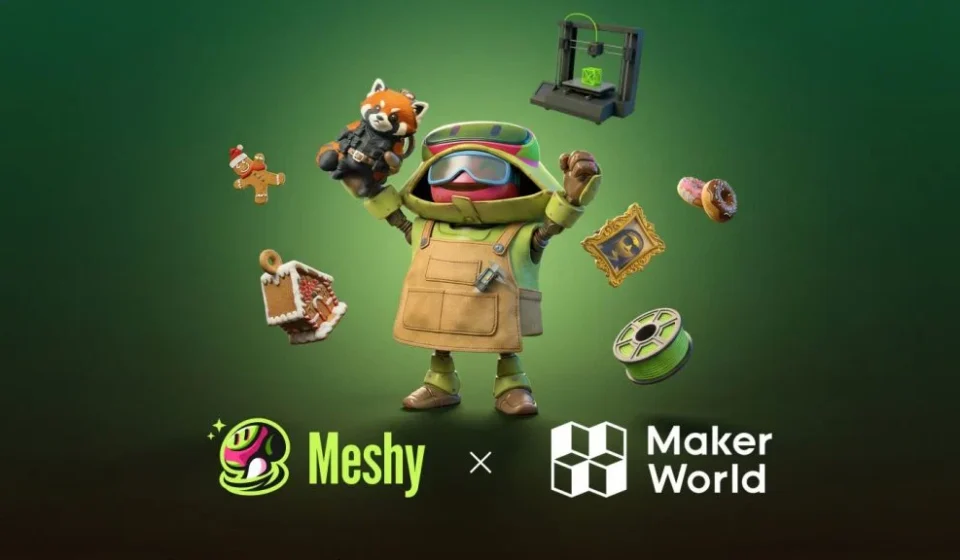
- The Integration Pivot (Early 2026): Recognizing that model generation was only half the battle, Meshy began integrating directly into the hardware ecosystem. In March 2026, the company partnered with Bambu Lab to embed its engine into the MakerWorld platform, effectively placing an AI design studio into the browser of thousands of 3D printer owners.
- The "Print-to-Physical" Milestone (April 2026): Building on the Bambu integration, Meshy partnered with Formlabs to connect its generation pipeline to the Form Now on-demand manufacturing service. This move, debuted at the RAPID + TCT 2026 event, was widely recognized as the first end-to-end pipeline linking AI generation to professional-grade industrial manufacturing.
- The July 2026 Series B: With the infrastructure for physical production secured, the company finalized its $400 million round, shifting focus from "generating models" to "optimizing production workflows."
Four Pillars of Innovation: Updates Aimed at the Print Bed
Simultaneous with the funding announcement, Meshy unveiled four critical product updates designed to solve the "last mile" problem of 3D printing: the transition from a digital file to a physical, functional object.
1. Meshy 3D Agent: The Conversational Architect
The flagship release, the Meshy 3D Agent, is marketed as the industry’s first AI agent dedicated to 3D creation. Unlike standard generative tools that output a single file, the 3D Agent functions as an iterative collaborator. It facilitates a dialogue where users can brainstorm concepts, generate batches of variations, and refine designs before finalizing a single model. Crucially, the Agent ensures the final output is "print-ready," supporting common formats like FBX, OBJ, GLB, and STL with a claimed 97% slicer success rate.
2. Auto Split: Solving the Segmentation Challenge
Perhaps the most significant technical hurdle in 3D printing is taking a complex, non-manifold model and breaking it into printable parts. Auto Split automates this by repairing surfaces, creating watertight solids, and intelligently placing seams along concealed boundaries. By ensuring that parts are not just color-coded for aesthetics—a common failure point in rival tools—but structurally sound for physical assembly, Meshy is attempting to eliminate the "manual repair" stage of the design cycle.
3. Smart Topology and 8K Texturing
To address the needs of the gaming and real-time rendering sectors, Smart Topology provides native, clean geometry in under ten seconds, allowing for user-defined polygon counts (100 to 15,000). Complemented by the upcoming 8K Texture release, these tools ensure that Meshy is as relevant to developers working in Unreal or Unity as it is to hobbyists operating desktop FDM printers.
Strategic Market Adoption: Scaling to the Fortune 10
Meshy’s influence is currently concentrated at the top of the industrial food chain. The company confirms that five of the ten largest technology companies by market capitalization are currently utilizing its tools for internal development. This adoption isn’t limited to tech; it spans a diverse array of sectors, including major gaming studios like Nexon, NetEase, and 37 Interactive Entertainment, as well as consumer brands like Hugo Boss and prestigious design institutions like Sweden’s museum of art and design.
The concentration of printer manufacturers in its partner list—including Bambu Lab, Creality, Elegoo, FlashForge, and xTool—is a deliberate strategic choice. By embedding its technology directly into the hardware ecosystem, Meshy ensures it remains the "default" software experience for the modern maker.
Implications: The Commoditization of Geometry
The implications of Meshy’s success are profound. For decades, the "3D barrier" was defined by a steep learning curve in software like SolidWorks or Blender. Today, that barrier has been reduced to a prompt and roughly a dollar of compute cost. However, as generation becomes a commodity, Meshy’s strategic pivot toward the workflow—specifically the print bed—is a masterstroke.
The market for generative AI in 3D is becoming increasingly crowded. Competitors like Womp are building vertical integration through their own print-on-demand services, while Autodesk is leveraging its legacy "Wonder 3D" tool to keep users within its existing enterprise suites. On the research front, NVIDIA’s PartPacker represents a potent challenge, focusing on the same part-segmentation problem that Auto Split aims to solve.
However, Meshy’s decision to focus on the "physical end-state" differentiates it from those that treat generation as a purely digital endeavor. By prioritizing printability, repair, and assembly, Meshy is positioning itself not just as an image-to-3D converter, but as a digital manufacturing platform.
A New Era for Additive Manufacturing
As the industry looks toward the remainder of 2026, the question is no longer whether AI can create 3D models, but whether it can sustain the industrialization of additive manufacturing. With $400 million in capital, Meshy has effectively bought itself the time and resources to attempt the integration of the entire value chain—from the first spark of an idea in a chat window to the final part emerging from a print bed.
For the engineering and design communities, this represents a fundamental shift in labor. The specialist skills once required to model complex geometry are being replaced by the ability to curate, iterate, and validate. As Meshy continues to refine its "AI-to-Physical" pipeline, it is rapidly turning the dream of "prompt-to-part" into an everyday reality for millions of users worldwide.
For more information on the evolving landscape of 3D printing, including insights into industrial qualification and supply chain integration, industry practitioners are encouraged to participate in the upcoming 2026 Additive Manufacturing Applications (AMA) series.