
Amazon Doubles Down on Automation: $100 Million Robotics Hub to Rise in Indiana

GREENWOOD, IN – Amazon has officially set its sights on the American Midwest for its latest strategic expansion in the robotics sector. The e-commerce giant announced this week a $100 million investment to construct a massive, 585,000-square-foot advanced manufacturing facility in Greenwood, Indiana. This project, slated for completion by 2028, represents a significant escalation in Amazon’s effort to localize the production of the robotic systems that underpin its global fulfillment network.
The facility is expected to serve as a cornerstone of the company’s domestic supply chain, creating 300 high-skilled jobs ranging from robotics engineering to specialized manufacturing roles. By bringing fabrication, robotic welding, and automated assembly under one roof, Amazon aims to streamline the production of its proprietary fulfillment technologies, further insulating its operations from global supply chain volatility.
A Strategic Expansion of the Robotics Ecosystem
The selection of Greenwood, Indiana, was not a matter of chance. Amazon executives noted that the state’s robust logistics infrastructure, highly skilled manufacturing workforce, and business-friendly regulatory environment made it an ideal candidate. This decision mirrors a broader trend within the company to move manufacturing closer to its primary centers of consumption.
This announcement follows closely on the heels of a similar commitment made in August regarding a new robotics manufacturing hub in Texas. Together, these sites form the next phase of Amazon’s strategy to scale its hardware production beyond its long-standing operations in Massachusetts, which have already produced more than one million robots deployed across the company’s global network.
The Technological Backbone of Modern Fulfillment
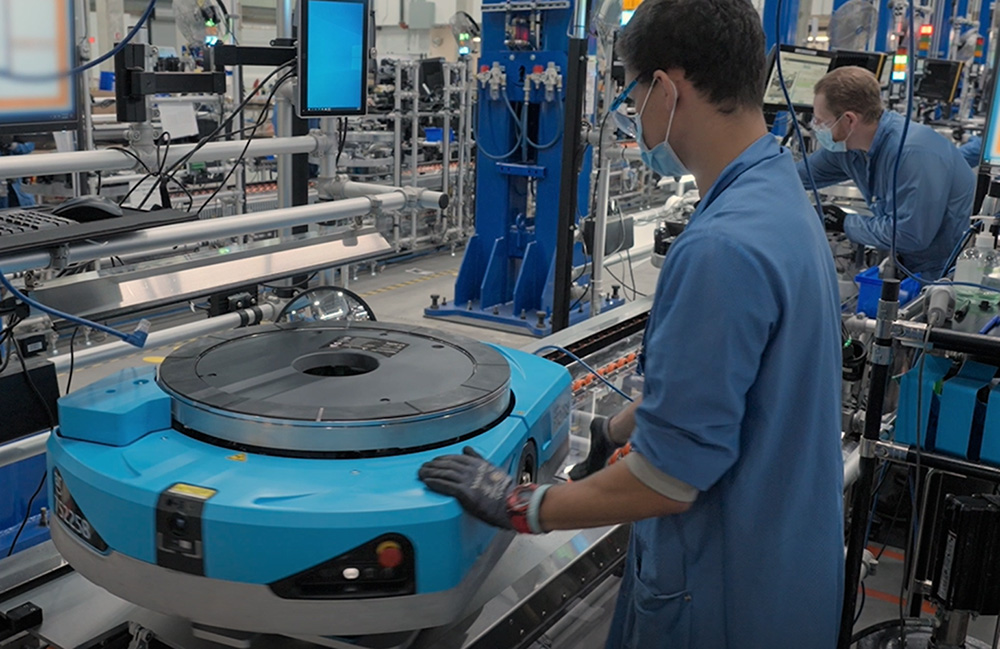
The new Indiana facility will be more than just a production plant; it will be a showcase for the "factory of the future." The site will integrate AWS-powered artificial intelligence, real-time analytics, and advanced smart-manufacturing systems to oversee the production line. These systems are critical for maintaining the high precision required for the sophisticated robots, such as the "Proteus" mobile fleet, that help process 75% of Amazon’s customer orders globally.
The integration of automated powder coating and advanced fabrication techniques ensures that the facility can maintain the rigorous quality standards necessary for industrial-grade robotics. By utilizing its own internal suite of AI and robotics, Amazon is effectively using its own factories as a proving ground for the same technologies it provides to its logistics centers.
Chronology: Building an Empire of Automation
To understand the weight of this $100 million investment, one must look at the trajectory of Amazon’s robotics integration over the last decade:
- 2012: Amazon acquires Kiva Systems for $775 million, setting the foundation for its modern fulfillment robotics program.
- 2014-2020: Rapid deployment of "Drive" units across global fulfillment centers, fundamentally changing how inventory is stowed and picked.
- 2022: Amazon sunsets its "Scout" delivery robot program, pivoting toward new, more versatile designs and strategies.
- 2024: Jeff Bezos, via Bezos Expeditions, supports a $22 million seed round for RIVR, a developer of quadrupedal wheeled robots, signaling a renewed interest in last-mile automation.
- 2025: Amazon accelerates its expansion into domestic manufacturing with a new site in Texas.
- 2026 (September): The company announces the $100 million Greenwood, Indiana facility, marking a pivot toward regionalized robotics production.
- 2026 (Ongoing): Prime Air services are slated for a massive expansion, targeting 500 cities and towns in the U.S. by year-end.
- 2028: Projected completion and operational launch of the Greenwood facility.
Supporting Data and Industry Impact
The scale of Amazon’s robotics operations is unprecedented. With over one million robots currently active in its facilities, the company has effectively shifted the paradigm of human-machine collaboration in the workplace. These machines handle the most strenuous and repetitive tasks—stowing, sorting, and intra-facility transport—thereby allowing human workers to transition into supervisory, maintenance, and complex engineering roles.
The financial commitment is equally significant. With more than $100 million directed at this single facility, Amazon is demonstrating that the "hidden cost" of e-commerce—logistics and supply chain management—is best mitigated by owning the means of production for the robots that power the network. The move is expected to improve the company’s long-term operating margins by reducing the cost of shipping hardware components from overseas, instead relying on a resilient, U.S.-based manufacturing chain.
Implications for the Future of Robotics
The establishment of the Greenwood hub has profound implications for both the local economy and the robotics industry at large.
Economic Impact on Indiana
For Greenwood, the 300 skilled jobs represent a significant boost to the local economy. The demand for specialized technicians, software engineers, and automation experts will likely encourage regional educational institutions to align their curricula with the needs of the robotics sector. Furthermore, the presence of such a high-tech facility often creates a "cluster effect," drawing in secondary suppliers, software developers, and maintenance services that contribute to a regional tech ecosystem.
The Shift Toward "Last-Mile" and Autonomous Delivery
Amazon’s ongoing investment in robotics extends well beyond the warehouse walls. The recent acquisition of RIVR and the ambitious expansion of the Prime Air drone delivery program indicate that the company is refining its approach to the "last mile." While the internal robots at the Indiana facility build the infrastructure, the RIVR acquisition suggests that Amazon is preparing for the next frontier: autonomous doorstep delivery.
By consolidating its manufacturing capabilities, Amazon is also building the internal muscle to iterate on these delivery platforms faster than ever before. If the company can manufacture its own delivery robots at scale, it could effectively lower the barrier to entry for widespread autonomous delivery, a goal that has remained elusive for many competitors.
Expert Insight: The Road Ahead
Industry experts point to the upcoming RoboBusiness conference in Santa Clara as a pivotal moment for understanding this shift. Bhavana Chandrashekhar, a senior manager of applied science at Amazon Robotics, is scheduled to lead a keynote titled "Beyond the Demo: AI in Production Robots." Her participation underscores the company’s transition from experimental robotics to industrial-scale, AI-driven production.
As Amazon prepares to celebrate 20 years of robotic innovation in the industry, the Indiana facility serves as a testament to the company’s evolution. It is no longer just a retailer that uses robots; it is now a robotics manufacturer that happens to power the world’s largest retail engine.
Conclusion: A New Standard for Logistics
The $100 million investment in Greenwood, Indiana, is more than a line item on a corporate balance sheet; it is a clear signal that the future of logistics is being built domestically. As Amazon continues to integrate AI, advanced welding, and robotic assembly, it is setting a high bar for the rest of the industry.
By 2028, when the Greenwood site becomes operational, the landscape of U.S. manufacturing will look considerably different. With a robust pipeline of domestic production, a commitment to high-skilled job creation, and a relentless focus on integrating AI into the physical world, Amazon is positioning itself to remain at the vanguard of the global automation revolution for decades to come. As the company expands its Prime Air reach and integrates new robotic technologies into its fulfillment network, the Greenwood facility will stand as the engine room of a new, highly automated American industrial age.