

Mind Over Machine: Inside Igus’s Human-Centric Engineering Philosophy at IMTS 2026

CHICAGO — As the manufacturing sector accelerates its headlong rush into artificial intelligence, machine learning, and hyper-automated smart factories, a counter-narrative is quietly taking root on the exhibition floor. At the International Manufacturing Technology Show (IMTS) 2026, industry leaders are pausing to ask a fundamental question: When the algorithms fail, the power goes out, or the digital twin diverges from physical reality, what is left?
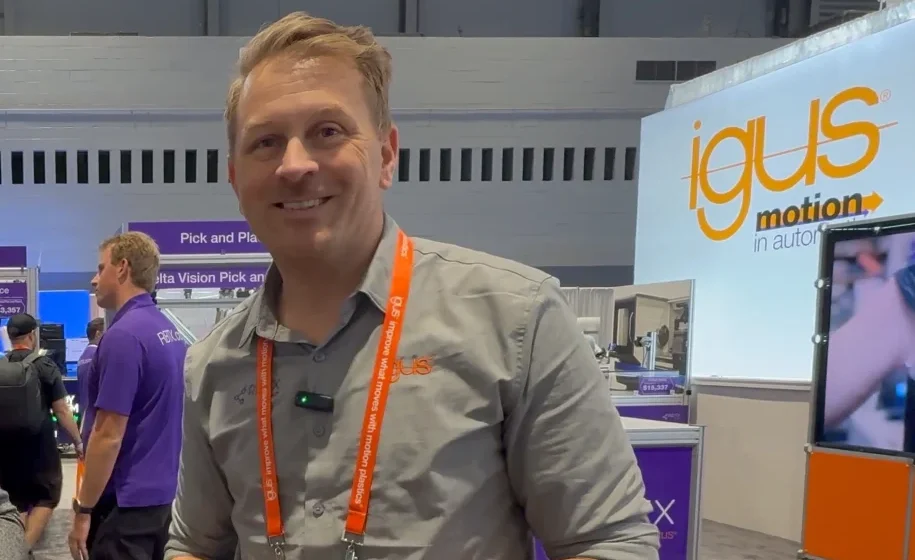
In this special live edition of Mind over Machine, Design World Managing Editor Mike Santora sat down with Felix Brockmeyer, CEO of Igus, to cut through the industry hype surrounding AI. Eschewing the predictable tech-sector talking points about neural networks and predictive algorithms, Brockmeyer posed a refreshingly grounded perspective on engineering problem-solving—one that relies not on silicon chips, but on physical intuition, tactile prototyping, and good old-fashioned human brainpower.
Main Facts: The Human Element in an Automated World
The conversation between Santora and Brockmeyer at IMTS 2026 serves as a timely anchor for an industry undergoing tectonic shifts. While digital tools dominate modern engineering portfolios, the core thesis of their discussion is that foundational problem-solving remains stubbornly human.
- The Event: Filmed live at IMTS 2026 in Chicago, this installment of Mind over Machine focuses on the intersection of modern industrial challenges and traditional engineering methodologies.
- The Key Participants: Mike Santora, Managing Editor of Design World, interviewing Felix Brockmeyer, CEO of Igus.
- The Core Question: How do engineers solve complex manufacturing and design challenges using pure human ingenuity rather than leaning immediately on artificial intelligence?
- The Case Study: Brockmeyer draws upon his formative years as a lean manufacturing engineer, highlighting a low-tech, high-impact solution involving physical cardboard mockups.
- The Sponsor/Subject: Igus, a global leader in motion plastics, known for developing high-performance polymer components such as energy chain systems and plain bearings.
Despite Igus being at the forefront of digital integration—frequently utilizing smart sensors, IoT-enabled predictive maintenance, and advanced CAD/CAM environments—Brockmeyer’s reflection serves as a reminder that the genesis of efficient manufacturing lies in understanding physical space, human movement, and mechanical flow before writing a single line of code or deploying an algorithm.
Chronology: From Cardboard Mockups to Global Leadership
To understand Brockmeyer’s philosophy on engineering leadership, one must retrace his professional trajectory. The journey from a hands-on lean engineer optimizing shop-floor cells to the chief executive officer of an international motion plastics powerhouse provides a unique lens through which to view modern industrial evolution.
Phase 1: The Lean Engineering Trenches
Early in his career, long before generative AI, machine learning models, and complex digital twins became standard industrial buzzwords, Brockmeyer operated in the trenches of lean manufacturing. Tasked with improving throughput, reducing waste, and optimizing ergonomic safety in assembly lines, he faced physical constraints that could not be solved by computational brute force.
During this period, Brockmeyer relied on rapid physical prototyping. Instead of spinning up a multi-gigabyte simulation software package, he turned to corrugated cardboard, utility knives, and hot glue. By building life-sized, physical mockups of manufacturing cells, he could physically walk through the processes operators would perform.
Phase 2: Validating Operator Flow and Ergonomics
The cardboard prototyping method was not merely about spatial layout; it was an empathetic exercise in human-machine interaction. By constructing tangible environments, Brockmeyer and his teams could:
- Observe natural human movement and reach envelopes.
- Identify bottlenecks in material staging before capital was spent on tooling or heavy machinery.
- Conduct precise time studies by physically timing mock operations with a stopwatch.
- Gather immediate, qualitative feedback from shop-floor workers who could physically touch, modify, and critique the workspace design.
Phase 3: Scaling Up to Executive Leadership
As Brockmeyer transitioned into broader operational and executive roles—ultimately ascending to the CEO position at Igus—he carried these lessons forward. While the scale of operations changed dramatically, the underlying principle remained constant: technology should amplify human capability, not replace the foundational understanding of physical mechanics. Today, under his leadership, Igus balances cutting-edge digital service tools with a deep-rooted commitment to physical testing, empirical data, and customer-centric mechanical innovation.
Supporting Data: The Balance Between AI and Empirical Engineering
To contextualize Brockmeyer’s insights, it is vital to examine the current landscape of manufacturing technology. According to recent industry analyses, capital expenditure on artificial intelligence and machine learning within discrete manufacturing has grown exponentially over the past five years. Organizations are investing heavily in predictive maintenance, generative design software, and automated quality control vision systems.
However, industry data also reveals a persistent gap between software implementation and operational execution:
- Implementation Friction: Studies from industrial automation consultancies indicate that nearly 40% of early-stage AI integration projects in manufacturing fail to meet their initial ROI projections, often due to a lack of foundational process standardization (the very lean principles Brockmeyer champions).
- The Testing Paradigm: Igus itself operates one of the largest private testing laboratories in its industry—a massive 3,800-square-meter facility dedicated entirely to physical wear and friction testing. Even in the digital age, Igus runs thousands of physical test cycles annually on motion plastics, accumulating over 2 billion test cycles per year.
- Empirical vs. Simulated Data: While algorithms can predict service life based on historical parameters, Igus’s engineering philosophy underscores that physical testing under real-world loads, temperatures, and contamination levels remains irreplaceable for high-reliability components.
This dual approach—leveraging physical testing laboratories while simultaneously offering digital configuration tools—highlights a balanced industry trajectory where human intellect dictates the parameters that algorithms eventually optimize.
Official Responses and Industry Perspectives
The Mind over Machine series is specifically designed to strip away corporate marketing talking points and extract authentic engineering philosophies from industry leaders. When asked the signature question—"What’s a challenge you’ve tackled with good old-fashioned brainpower rather than artificial intelligence?"—Brockmeyer’s response resonated deeply with the IMTS 2026 audience.
"We often look to technology to provide the shortcut," Brockmeyer noted during the live discussion. "We want the algorithm to tell us the optimal layout, the fastest cycle time, the perfect design. But when you build a cell out of cardboard, you are forced to confront the physical reality of the human body, gravity, and spatial friction in a way a screen simply cannot replicate. Brainpower isn’t about how much compute power you have access to; it’s about how deeply you understand the physical problem you are trying to solve."
Industry observers at IMTS 2026 praised the candid nature of the interview. In an exhibition hall crowded with booths promising total automated autonomy, the reminder that foundational spatial reasoning and hands-on prototyping remain the bedrock of engineering excellence provided a welcome breath of fresh air.
Design World Managing Editor Mike Santora emphasized the broader takeaway for engineers watching the broadcast: "Felix’s story reminds us that tools evolve, but the engineering mindset remains constant. Whether it’s a cardboard box in a lean cell or a high-performance polymer in a multi-axis robot, the best solutions come from engineers who aren’t afraid to get their hands dirty and think critically about the physical world."
Implications: What This Means for the Future of Engineering
As manufacturers look toward the horizon of Industry 5.0—which emphasizes a collaborative, human-centric approach rather than pure, unbridled automation—the insights shared by Felix Brockmeyer carry profound implications for the engineering profession.
1. The Renaissance of Tactile Prototyping
While digital twins and CAD simulations will continue to advance, the human brain processes spatial relationships and ergonomic friction exceptionally well through tactile interaction. The cardboard mockup technique is not obsolete; rather, it is a rapid, zero-cost validation tool that precedes expensive digital modeling. Expect forward-thinking engineering firms to encourage hybrid workflows where physical ideation coexists with computational refinement.
2. Combating "Algorithmic Complacency"
A growing concern among engineering educators and technical directors is "algorithmic complacency"—the dangerous tendency for junior engineers to accept software outputs blindly without questioning underlying assumptions. By grounding problem-solving in physical experimentation and first-principles thinking, leaders like Brockmeyer model a critical-thinking framework that prevents costly design errors born of over-reliance on black-box AI models.
3. The Human-Centric Focus of Motion Plastics
At Igus, where products like energy chains and dry-running polymer bearings are designed to keep complex machinery moving smoothly across diverse environments, the focus remains firmly on application reality. Machines operate in the physical world—amid dust, heat, vibration, and mechanical stress. Solutions designed purely in digital isolation often falter when introduced to harsh shop-floor realities. Human intuition bridges that gap.
Conclusion
The Mind over Machine special edition at IMTS 2026 successfully reframed the discourse around modern engineering. Artificial intelligence and machine learning are undoubtedly powerful instruments in the modern engineer’s toolkit, but they are instruments directed by human intent. As Felix Brockmeyer demonstrated, the most sophisticated tool in any manufacturing facility remains the human brain, guided by curiosity, physical intuition, and a willingness to roll up one’s sleeves—even if it just starts with a cardboard box and a pair of scissors.
To watch the full interview between Mike Santora and Felix Brockmeyer, visit the official Design World YouTube channel or explore further resources at Igus.