ROSEMONT, Ill. — As the manufacturing sector stands on the precipice of a technological revolution, the dialogue surrounding artificial intelligence has shifted rapidly from speculative potential to practical integration. Industry leaders are no longer asking if AI will transform the factory floor, but how it will be managed, scaled, and harmonized with traditional methodologies like Lean manufacturing.
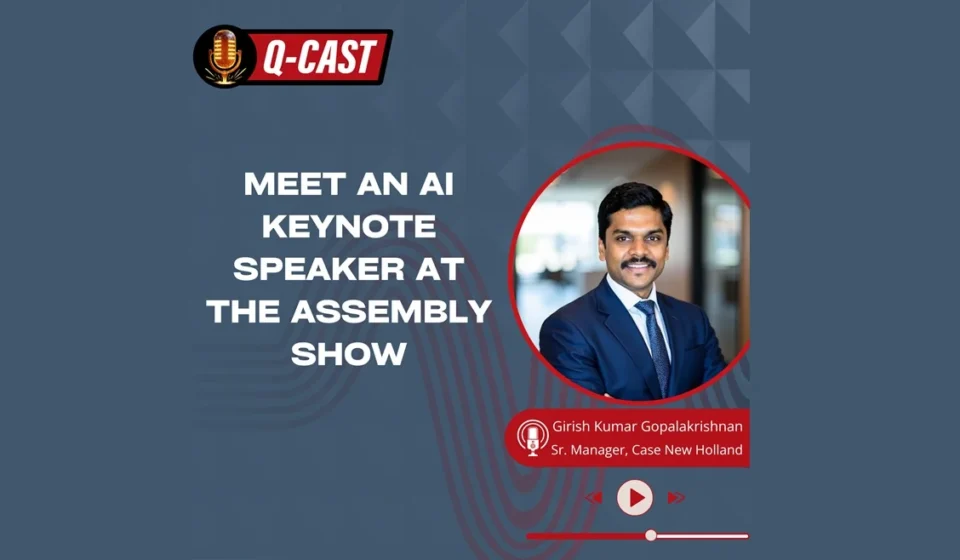
At the vanguard of this transition is Girish Kumar Gopalakrishnan, North America Continuous Improvement Senior Manager at Case New Holland (CNH). With two decades of rich, cross-functional experience spanning manufacturing, logistics, and healthcare—bolstered by prestigious credentials including the American Society for Quality (ASQ) Certified Master Black Belt—Gopalakrishnan offers a seasoned perspective on operational excellence.
This October, Gopalakrishnan is set to take center stage at The Assembly Show. His extensive lineup includes participating in the marquee "AI in Manufacturing" keynote panel, leading a conference session dedicated to the future of Lean, and delivering a forward-looking presentation on the intersection of quantum-powered AI and industrial production.
In an exclusive interview, Gopalakrishnan sat down to discuss the driving forces behind his upcoming presentations, the delicate balance between technological enthusiasm and operational caution, and his early hands-on experiences deploying machine learning on the shop floor.
Main Facts: The Intersection of AI, Lean, and Governance
The modern manufacturing landscape is defined by an unprecedented appetite for technological advancement. However, this enthusiasm comes paired with a distinct sense of urgency regarding risk management. According to Gopalakrishnan, the industry’s current trajectory is characterized by several core dynamics:
The Industry "Hunger" for AI: Manufacturers across North America are actively seeking out artificial intelligence tools to optimize workflows, reduce downtime, and drive predictive maintenance.
The Need for Caution and Governance: While the allure of AI is powerful, Gopalakrishnan emphasizes that organizations must avoid the trap of implementing technology simply for its own sake. Proper governance frameworks are critical to managing AI projects effectively.
The Human Element: Beyond algorithms and data pipelines lies a profound human dimension. Whether examining the psychological impact on workers or the practical frameworks required for operational change management, the human side of AI remains critically under-explored.
The Evolution of Continuous Improvement: Traditional methodologies such as Lean manufacturing and Six Sigma are not being replaced by AI; rather, they are being supercharged by it.
Chronology: From Traditional Continuous Improvement to AI-Driven Operations
To understand where manufacturing is headed, it is instructive to examine how industry leaders like Gopalakrishnan arrived at the intersection of Lean principles and artificial intelligence.
Phase One: Foundations in Manufacturing and Healthcare (Early 2000s)
Gopalakrishnan’s career began two decades ago, built on a foundation of rigorous process optimization. Working across diverse sectors—including manufacturing, supply chain logistics, and healthcare—he cultivated a deep understanding of standard work, waste reduction, and quality control. Earning credentials such as the ASQ Certified Master Black Belt, he spent years refining physical processes using established statistical tools.
Phase Two: The Digital Awakening and Beta-Level AI Experiments (Mid-2010s)
As Industry 4.0 concepts began to materialize, forward-thinking organizations started looking at how digital data could augment physical manufacturing processes. Recognizing that continuous improvement methodologies relied heavily on repetitive human auditing, Gopalakrishnan and his teams began exploring how machine learning could assist with routine tasks.
One of their earliest and most successful beta-level applications focused on the fundamentals of the 5S methodology (Sort, Set in order, Shine, Standardize, Sustain). By applying basic AI and machine learning tools to 5S audits, CNH sought to remove human fatigue from routine compliance checks, ensuring a consistent baseline of shop-floor organization.
Phase Three: Scaling Up and Industry Thought Leadership (Present Day)
Today, Gopalakrishnan manages continuous improvement strategies across North America for CNH, balancing legacy operational excellence frameworks with cutting-edge technological solutions. His upcoming appearances at major industry forums like The Assembly Show mark a transition from internal experimentation to external thought leadership, guiding the broader manufacturing community through the complexities of AI integration.
Supporting Data and Industry Insights: The Dual Nature of Industrial AI
The manufacturing sector is currently experiencing a massive influx of capital into smart factory initiatives. According to various industrial research reports, the global market for artificial intelligence in manufacturing is projected to scale exponentially over the next decade, driven by demands for greater supply chain resilience and labor efficiency.
However, data from industrial implementation projects reveals a recurring bottleneck: project failure often stems from a lack of governance rather than technological inadequacy.
Why Governance Matters
When organizations rush to deploy AI without a structured framework, they frequently encounter:
Data Silos: Incompatible legacy systems that prevent machine learning models from gathering clean, actionable data.
Scope Creep: Implementing complex generative or predictive models for problems that could easily be solved using basic Lean tools like Pareto charts or standard work instructions.
Cultural Resistance: Frontline workers rejecting tools that feel opaque, punitive, or disconnected from daily reality.
Gopalakrishnan’s focus on governance directly addresses these data-backed pain points. By establishing clear guardrails, manufacturing organizations can ensure that AI projects deliver measurable Return on Investment (ROI) while maintaining compliance and safety standards.
Official Responses and Perspectives: The Interview Breakdown
During his conversation, Gopalakrishnan elaborated on the philosophy driving his conference sessions. His insights offer a masterclass in pragmatic technological adoption.
The Spark: Recognizing the Industry’s Insatiable Appetite
When asked what prompted him to focus heavily on AI governance and the human element at this year’s conference, Gopalakrishnan pointed directly to the current mood of the industrial sector.
"This seems very relevant in the current industry," Gopalakrishnan noted. "So really, there is a growing, I would say, hunger for AI tools. And I think there’s also that people have to be a little bit more cautious about going into solving projects with this tool in mind."
Rather than letting the technology dictate the problem—a common pitfall in corporate digital transformation initiatives—Gopalakrishnan advocates for a problem-first approach.
"That’s why I think that’s the space I really want to explore. That’s why the governance topic and how some of these applications can be managed. That’s where I felt there’s a lot more conversation to happen that could happen."
Centering the Human Workforce
A recurring theme in Gopalakrishnan’s philosophy is that technology serves the worker, not the other way around. In an era where automation is frequently viewed through the lens of labor replacement, he emphasizes the symbiotic relationship between human expertise and machine intelligence.
"There is a heavy human side to the technology and the AI that certainly needs to get explored and discussed a lot more, whether it’s in terms of research or in terms of practical applications in the industry. So, I think that’s another opportunity for me to share my insights."
Practical Application: The 5S Machine Learning Experiment
To illustrate that AI does not always need to be hyper-complex to be effective, Gopalakrishnan shared a real-world example from his own experience experimenting with machine learning tools.
"There is always a need for AI. I still remember that one of our fundamental applications that we have certainly explored into the basic 5S and how do we understand auditing in different areas for 5S."
Auditing cleanliness, organization, and standardization across massive manufacturing plants is notoriously labor-intensive and prone to subjective bias. By introducing computer vision and machine learning concepts to automate aspects of the 5S audit process, CNH found a way to streamline a redundant task.
"Basically, I want to say, yeah, that’s a very basic level tool, but how can we try to improve the process and make sure that it’s done with a certain level of consistency. And that’s where it’s a perfect opportunity for the AI tools to come into play."
He continued, highlighting the long-term utility of starting small:
"And it’s somewhat of a redundant activity. So, if we teach the tool like machine learning and try to help. So that’s one experience. Maybe a couple years ago, we started doing that at a beta level and worked out pretty good. It’s been a pretty good tool in our back pocket to put it in use."
Implications: The Future of Lean and Quantum-Powered Manufacturing
As manufacturing enterprises look toward the horizon, the implications of Gopalakrishnan’s work—and the broader discussions taking place at industry forums—point toward a profound transformation of operational roles.
1. The Modernization of Lean Six Sigma
For decades, Lean manufacturing has relied on human observation, time studies, and manual data collection (such as spaghetti diagrams and value stream mapping). The integration of AI does not render these principles obsolete; instead, it accelerates them. Machine learning can process millions of data points from IoT sensors on the assembly line in real-time, instantly identifying bottlenecks that might take a human continuous improvement engineer weeks to uncover.
2. Preparing for Quantum-Powered AI
Looking even further ahead, Gopalakrishnan’s upcoming presentation on quantum-powered AI highlights the necessity for manufacturers to future-proof their technological architectures. While quantum computing is still in its nascent stages for industrial applications, its potential to solve complex supply chain routing, materials science, and multi-variable optimization problems in fractions of a second will fundamentally rewrite the rules of global manufacturing competitiveness.
3. Upskilling the Workforce
Ultimately, the successful deployment of AI in manufacturing hinges on workforce development. As redundant tasks like basic 5S audits or routine data entry are handed over to machine learning models, shop-floor personnel and engineers alike must be upskilled to interpret AI outputs, govern algorithmic decision-making, and focus on higher-order problem-solving.
Conclusion
Girish Kumar Gopalakrishnan’s insights serve as both a roadmap and a cautionary tale for the modern manufacturing executive. As the industry descends upon Rosemont for The Assembly Show, the discussions surrounding AI governance, human-centric technology integration, and the evolution of Lean will undoubtedly shape operational strategies for years to come.
By grounding advanced technologies like machine learning in the practical, daily realities of the factory floor—while never losing sight of the human beings who operate them—leaders like Gopalakrishnan are proving that the future of manufacturing is not just automated; it is intelligent, structured, and profoundly human.