



Solukon Redefines Post-Processing: Launching SPR-Pathfinder PRO to Solve Additive Manufacturing’s "Hidden" Challenge

In the industrialization of additive manufacturing (AM), the focus has historically been on the build—the laser, the powder, and the geometry. However, as manufacturers increasingly push the boundaries of complex, lightweight, and high-performance components, a new bottleneck has emerged: the post-process. Specifically, the challenge of reliably removing trapped, unfused powder from intricate internal geometries.
German engineering firm Solukon, a global leader in automated depowdering systems, has taken a significant step toward solving this hurdle with the launch of its upgraded software suite, SPR-Pathfinder PRO. Designed to move beyond simple automation into the realm of predictive digital simulation, the PRO edition marks a shift in how engineers approach "Design for Depowdering," effectively turning a post-build frustration into a manageable design-stage parameter.
The Core Innovation: Moving Beyond Voxel Limitations
For years, the industry relied on software that treated depowdering as an afterthought. Solukon’s previous iteration of SPR-Pathfinder provided a solid foundation for automating the rotation and vibration cycles of their depowdering machines. However, as geometries became more organic—featuring cooling channels, lattice structures, and intricate heat exchangers—the software’s technical ceiling began to show.
The previous version was capped at 2.4 million voxels, a constraint that prevented the software from accurately modeling sub-millimeter channels or dense, high-surface-area components. The new SPR-Pathfinder PRO removes this voxel ceiling entirely. By leveraging high-performance computing, the software allows for an unprecedented level of detail, enabling the simulation of up to one million powder particles—a twenty-fold increase over the previous limit of 50,000.
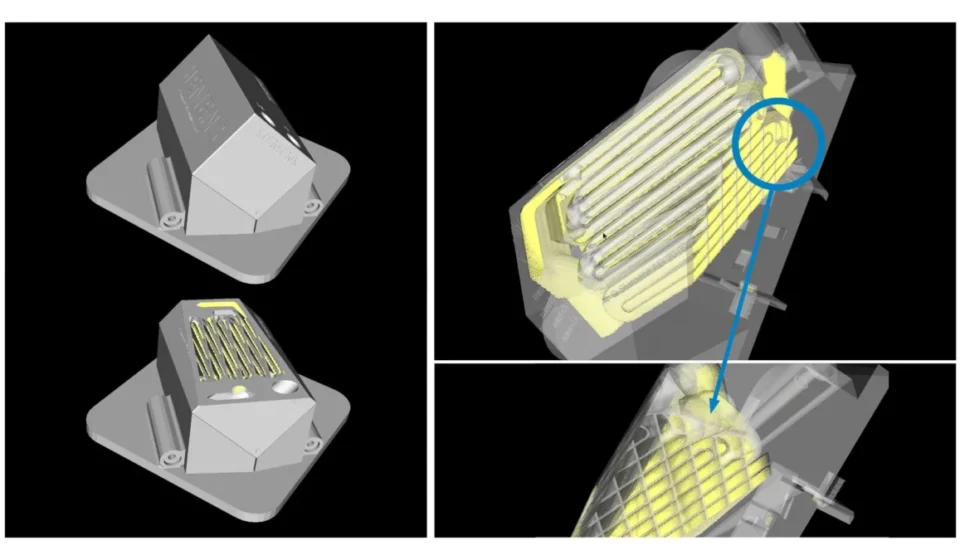
This leap in processing power is not merely a quantitative upgrade; it is a qualitative shift. By increasing the simulation depth, engineers can now observe how powder flows through narrow, labyrinthine internal routes, identifying clumping, stagnation, or areas where physical access is mathematically impossible before a single gram of metal is printed.
Chronology of Development: A Response to Industrial Demand
The evolution of SPR-Pathfinder is deeply rooted in the real-world feedback of Solukon’s customer base. According to Andreas Hartmann, CEO and CTO of Solukon, the push for the PRO edition was driven directly by the limitations encountered by users in aerospace, automotive, and medical sectors.
- Early 2024: As adoption of the SFM-AT series of depowdering machines grew, users began reporting that their most complex, large-format parts were exceeding the simulation capabilities of the standard software.
- Late 2025: High-profile installations, such as the one at the Nikon AM Technology Center in Japan, underscored the need for tighter integration between digital twin simulation and physical hardware. The ability to calculate paths for parts weighing up to 800 kg required a more robust, scalable software environment.
- Mid-2026: Solukon officially launched the dual-tier model. Recognizing that not every user requires high-fidelity simulations for simple geometries, they introduced SPR-Pathfinder BASIC alongside the PRO version to provide a scalable entry point for mid-tier complexity.
This roadmap reflects a broader industry trend: the transition from "black box" additive manufacturing to a transparent, data-driven workflow where software predictability is as critical as hardware reliability.
Supporting Data and Technical Capabilities
The distinction between the BASIC and PRO editions is designed to cater to different operational needs. While both run on standard Windows-based servers and integrate seamlessly with Solukon’s hardware—including the SFM-AT350, AT800-S, AT1000-S, and AT1500-S—the feature sets are tailored for distinct workflows.
SPR-Pathfinder BASIC
Designed for moderately complex parts, the BASIC edition serves as a powerful automation tool. It removes the burden of manual rotation programming, allowing operators to input basic parameters that the system translates into optimized, repeatable movement cycles.
SPR-Pathfinder PRO: The Power User’s Suite
The PRO edition introduces several key technical capabilities that define its "Professional" designation:

- Cross-Sectional Inspection: Users can now perform "digital dissections" along X, Y, and Z axes. With adjustable model transparency, engineers can peer inside a component to identify bottlenecks or trapped powder pockets.
- Predictive Process Planning: The software calculates the estimated time for both the movement programming and the physical depowdering process. This allows production managers to accurately schedule machine utilization and forecast build-to-ship lead times.
- Advanced Connectivity: Through OPC UA integration, the software feeds data back into the factory’s broader production management systems. This ensures that the process is not only repeatable but also fully traceable, which is essential for industries with strict regulatory requirements like aerospace or medical implants.
Official Perspectives: The Philosophy of "Design for Depowdering"
Hemank Raj, Product Owner for SPR-Pathfinder, emphasizes that the software is designed to change the fundamental mindset of the design engineer. "Manufacturers have historically discovered inaccessible channels only after the production phase," Raj notes. "Our goal is to shift that discovery to the design stage."
This is the embodiment of "Design for Depowdering." In traditional Design for Additive Manufacturing (DfAM), the primary concern is printability: Can this geometry be built? With Solukon’s latest tools, the question expands to: Can this geometry be cleared of waste?
By identifying potential failure points—such as narrow outlets or sharp internal corners where powder may sinter—engineers can modify the CAD file before it ever hits the printer. This reduces scrap rates, saves expensive material, and minimizes the time lost to failed post-processing.
Implications for the Broader Additive Manufacturing Ecosystem
The launch of SPR-Pathfinder PRO arrives at a critical juncture for the AM industry. As production volumes rise, the "hidden" costs of post-processing are becoming the primary barrier to the total industrialization of metal 3D printing.
Integrating with Advanced Chemical Processes
While software-driven simulation is a massive leap forward, it is not a panacea for all forms of contamination. Recent developments in the industry, such as those presented by REM Surface Engineering in April 2026, suggest that software and chemistry must work in tandem. While SPR-Pathfinder PRO is excellent at removing loose, unfused powder through mechanical movement, some fully enclosed, complex passages may contain partially sintered material that requires chemical or electrochemical intervention.
The industry is moving toward a hybrid model:
- Simulation: Using SPR-Pathfinder PRO to ensure the geometry is optimized for mechanical depowdering.
- Mechanical Removal: Using Solukon’s automated systems to clear the bulk of the material.
- Chemical/Surface Finishing: Utilizing secondary processes for final surface refinement and the removal of stubborn, sintered particles in inaccessible voids.
The Role of Traceability
The inclusion of OPC UA connectivity in the PRO package is a nod to the "Industry 4.0" requirement for digital threads. In a modern factory, the ability to record exactly how a part was tilted, rotated, and shaken during depowdering—and to correlate that with its structural integrity—is the holy grail of qualification. Solukon’s decision to integrate this data flow ensures that their software remains a cornerstone of a compliant, high-quality production environment.
Conclusion: A New Standard for Post-Processing
Solukon’s introduction of the SPR-Pathfinder PRO is more than just a software update; it is a declaration that the post-processing phase of additive manufacturing is finally maturing. By providing the tools to simulate, predict, and inspect before a build begins, Solukon is helping manufacturers move away from trial-and-error methodologies.
For users already integrated into the Solukon ecosystem, the 30-day free trial of the PRO edition offers a low-risk opportunity to test the software’s capability against their most challenging parts. As the industry continues to push toward higher levels of complexity, the ability to visualize and optimize the "unseen" interior of a part will likely become the decisive factor in who succeeds in the competitive world of high-end metal manufacturing.
As the industry looks toward 2027 and beyond, it is clear that the companies that win will be those that treat the digital simulation of post-processing as an essential, rather than optional, component of the product lifecycle. With SPR-Pathfinder PRO, Solukon has provided the tools to make that vision a reality.