The Great Automotive Pivot: How Leapmotor Outpaced Legacy Japanese Brands as Stellantis Forges a New Sino-European Blueprint

By Stewart Burnett
The global automotive landscape is undergoing a tectonic realignment, characterized by the rapid ascent of agile Chinese electric vehicle (EV) disruptors and the corresponding retreat of legacy stalwarts. In a historic milestone that underscores this shifting paradigm, Chinese EV start-up Leapmotor outsold both Subaru and Mitsubishi Motors in global vehicle sales for the first time during the second quarter of 2026.
Delivering a record-shattering 240,000 vehicles—representing an 84% year-over-year surge—Leapmotor comfortably eclipsed Subaru’s 230,000 units and Mitsubishi’s 170,000 units. This meteoric rise occurs against a backdrop of stagnation for traditional global heavyweights, with market leaders Toyota and Volkswagen posting respective volume declines of 4% (2.71 million units) and 9% (2.07 million units) over the same comparative period.
The feat is not merely a statistical anomaly of a single strong quarter. It is the culmination of a deliberate, highly calculated global expansion strategy, accelerated by deep structural partnerships, localized manufacturing, and an aggressive cost-advantage model that traditional automakers are struggling to counter.
Main Facts: The New Global Hierarchy
The Q2 2026 sales figures mark a watershed moment for the automotive industry. For decades, mid-tier Japanese manufacturers like Subaru and Mitsubishi enjoyed stable global positions anchored by regional strongholds in North America and Southeast Asia. However, their sluggish pivot toward electrification, combined with a catastrophic loss of market share in China, has left them vulnerable to the aggressive offensive mounted by Chinese EV entrants.
Leapmotor’s explosive growth is heavily underpinned by surging European demand. Overseas markets accounted for approximately 20% of the company’s total sales in the second quarter—a dramatic leap from just 6% during the same period a year prior. Crucially, over 80% of that international volume was generated within Europe.
The brand’s penetration into key European markets has caught legacy competitors flat-footed. In Italy, for instance, Leapmotor’s sales skyrocketed thirteenfold year-on-year, reaching 24,450 vehicles between January and August 2026. This performance allowed the newcomer to capture an astonishing 27% of Italy’s domestic EV market, vastly outperforming early pioneer Tesla, which languished at 9% over the same timeframe.
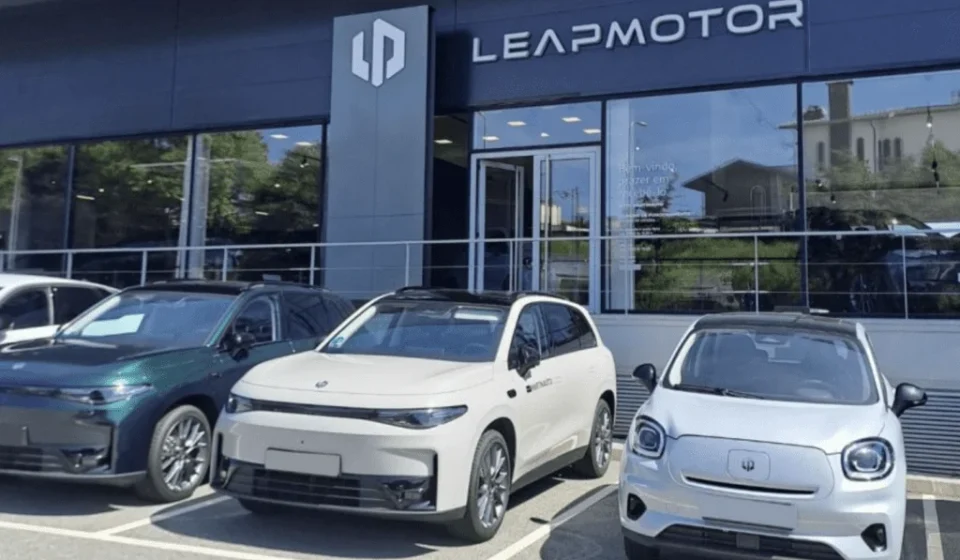
While brands like BYD and Nio have spent years and billions of dollars attempting to construct proprietary sales and service networks across Europe, Leapmotor bypassed this friction point entirely through its strategic partnership with legacy giant Stellantis.
Chronology of an Alliance: The Stellantis-Leapmotor Synergy
The rapid scaling of Leapmotor’s international footprint can be traced through a series of foundational corporate maneuvers that established a blueprint for Sino-Western automotive collaboration:
- The Joint Venture Inception: Stellantis acquired a strategic 21% equity stake in Leapmotor’s parent company, alongside the creation of Leapmotor International—a joint venture structured with a 51% majority stake for Stellantis and 49% for Leapmotor.
- Immediate Market Access: Through the Stellantis umbrella, Leapmotor gained instant access to more than 850 established points of sale across Europe, effectively neutralizing the multi-year distribution bottleneck that typically plagues foreign entrants.
- Tariff Insulation and Localized Production (2026): To navigate the European Union’s stringent anti-subsidy import tariffs on Chinese-built EVs, Stellantis integrated Leapmotor production into its existing European industrial footprint. The production of the Leapmotor B10 was slated for Stellantis’s Zaragoza plant in Spain during the second half of 2026.
- Future-Proofing the Supply Chain (2028): Plans were finalized to transfer ownership of the Villaverde plant in Madrid to Leapmotor International, designated for the assembly of a new model starting in the first half of 2028. These moves are meticulously engineered to satisfy the EU’s forthcoming "Made in Europe" content thresholds.
Following the success of the Leapmotor formula, Stellantis has moved quickly to replicate the underutilized-plant, Chinese-partner model elsewhere. A non-binding agreement was struck to manufacture Dongfeng’s Voyah crossover at Stellantis’s Rennes plant in France, absorbing roughly 40,000 units of spare annual capacity under the same 51-49 ownership split. Concurrently, a revived Dongfeng-Peugeot-Citroën joint venture in China will commence production of new Peugeot and Jeep models from a Wuhan facility starting in 2027, backed by a combined €1 billion investment, to which Stellantis is contributing a modest €130 million.
Supporting Data: Vertical Integration and Cost Advantage
Leapmotor’s market competitiveness is not solely a product of clever distribution and tariff avoidance; it is fundamentally anchored in severe structural cost advantages derived from extreme vertical integration.
Unlike many traditional automakers and EV start-ups that rely heavily on tier-one external suppliers for critical powertrain components, Leapmotor develops approximately 65% of its vehicle components entirely in-house. This proprietary ecosystem encompasses core hardware systems, including battery packs, drive units, and advanced electronic architecture. According to company disclosures, this localized development strategy yields roughly a 10% per-vehicle cost advantage over competitors dependent on outsourced components.
This cost efficiency translates directly into highly competitive retail pricing that appeals to cost-conscious European consumers grappling with broader inflationary pressures. In Italy, the ultra-compact Leapmotor T03 remains a volume driver, retailing for approximately €15,900 (US$18,300). Meanwhile, the newer A10 model has rapidly gained traction, emerging as an incremental volume pillar across multiple Western markets.
Conversely, the data reflecting legacy Japanese manufacturers paints a starkly contrasting picture of retrenchment:
- Subaru: Absorbed a massive ¥57.8 billion (US$363 million) impairment on its electrification assets. The company has delayed four in-house EV models indefinitely and reversed course on a dedicated EV factory, retrofitting it back to internal combustion engine (ICE) production.
- Mitsubishi: Paused its proprietary EV development pipeline entirely. Both Subaru and Mitsubishi now rely almost exclusively on external partnerships for electrification technology—such as Subaru’s Solterra, which shares its core platform with Toyota.
- The China Collapse: Both brands have endured a near-total collapse in the world’s largest automotive market. Subaru’s monthly sales volume in China has plummeted to an estimated 100 units per month.
Official Responses and Industry Reactions
The shifting fortunes of legacy automakers and Chinese disruptors have prompted candid internal reassessments across the global C-suite. Executives at traditional Japanese firms have openly acknowledged the severe friction of pivoting legacy operational models toward software-defined electric architectures.
Speaking on condition of anonymity, senior strategy planners within Japanese manufacturing conglomerates noted that the sunk capital costs of transitioning legacy manufacturing bases have created an institutional inertia. While companies like Toyota and Volkswagen continue to command massive absolute volumes—shipping 2.71 million and 2.07 million units respectively in Q2—their leadership teams have conceded that defending legacy profit pools while funding high-risk EV transitions has strained capital allocation.
On the other side of the partnership, Stellantis leadership has defended its unconventional deployment of Chinese joint ventures as a pragmatic necessity for survival in a protectionist, high-stakes regulatory environment. By monetizing underutilized European factory capacity—such as the Zaragoza and Rennes facilities—Stellantis secures union backing, preserves local employment, and captures a revenue stream from the booming EV segment without bearing the full R&D burden of battery technology from scratch.
Leapmotor executives, meanwhile, maintain an aggressive posture regarding global scaling. However, corporate communications have balanced their outward optimism with pragmatic admissions regarding macroeconomic volatility and regulatory headwinds in overseas territories.
Implications: The High Bar of 2026 and Beyond
Despite shattering corporate sales records and humiliating legacy rivals in key European battlegrounds, Leapmotor faces an uphill battle in achieving its most aggressive internal milestones.
The company entered the second half of 2026 sitting at roughly 35.6% to 45.8% of its ambitious annual target of 1 million global unit sales. Reaching that ceiling by December requires an exponential acceleration in manufacturing output and retail absorption that remains statistically improbable under current market conditions. Furthermore, Leapmotor’s projected 2027 overseas target of 350,000 to 400,000 units is precariously dependent on European consumer demand remaining stable in the face of ongoing economic uncertainty, potential regulatory shifts, and protectionist counter-measures from national governments.
For legacy brands like Subaru and Mitsubishi, the implications are existential. Their retreat from China—coupled with the abandonment of proprietary EV platforms—illustrates the fatal cost of hesitation in a fast-moving technological cycle. Brands that fail to achieve vertical integration, scale through strategic alliances, or adapt to local manufacturing mandates risk being permanently relegated to regional niche players.
Ultimately, Leapmotor’s rise over heritage names serves as a definitive turning point for the global automotive industry. It demonstrates that the future belongs not to those who cling to historical prestige, but to those who can effectively fuse high-in-house component integration, agile cross-border partnerships, and tariff-evading localized manufacturing into a single, unstoppable commercial engine.