

Edge Computing and Industrial PCs Redefine Motion Control and Discrete Automation

INDUSTRIAL AUTOMATION — The architecture of industrial automation is undergoing a fundamental decentralization. For decades, machine control relied almost exclusively on a centralized philosophy: powerful programmable logic controllers (PLCs) or industrial PCs (IPCs) sat inside control cabinets, pulling raw data from sensors, running complex deterministic loops, and issuing commands back down to actuators and drives.
Today, the rise of advanced edge-computing hardware, multicore x86 and ARM processors, and smart servo amplifiers is turning that paradigm on its head. By pushing intelligence directly to the network edge—whether embedded inside multi-core industrial PCs running real-time kernels or integrated directly into cabinet-free servo drives—engineers are unlocking unprecedented levels of precision, diagnostic capability, and system efficiency.
Main Facts: The Anatomy of Modern Edge Control
At the core of this transformation are multicore industrial PCs (IPCs) and intelligent motion components designed to handle deterministic control and general-purpose operating systems simultaneously on the same silicon.
In high-performance discrete automation, these edge architectures rely on industrial Ethernet protocols—such as SERCOS III, EtherCAT, PROFINET, or EtherNet/IP—to manage deterministic traffic. Cyclic control tasks execute on dedicated cores governed by a real-time kernel, demanding jitter tolerances within the microgram or microsecond range for advanced motion-control applications. Simultaneously, non-deterministic functions (such as HMI rendering, database logging, or remote monitoring) run on separate, unallocated cores.
This hardware model transforms how machines ingest and process data. Multi-axis servodrives, IO-Link primaries, and physical sensors sample mechanical components interacting with workpieces. Because these data streams are timestamped to a distributed clock, edge platforms can seamlessly correlate variables like motor current, positioning error, torque, temperature, and vibration with the exact machine state at the moment of capture.
Furthermore, edge filtering prevents processing cores from choking on extraneous communications. By stripping out redundant or low-priority telemetry locally, edge devices maximize communications efficiency regardless of the industrial protocol or network speed in play.
Chronology: From Isolated Drives to Cabinet-Free Edge Integration
Phase 1: The Centralized Era
Historically, drives were treated strictly as slave actuators. Although they closed high-frequency control loops on current, velocity, and position, and continuously monitored phase current, rotor position, bus voltage, and winding temperature, this rich telemetry largely went to waste. Between fieldbus communication cycles, the data evaporated, leaving central controllers blind to micro-events happening at the mechanical shaft.
Phase 2: The Shift Toward Smart Amplifiers
In recent years, motion-component manufacturers began integrating edge-computing functions directly into servo amplifiers. Recognizing that drives are inherently the best-instrumented components on a machine, engineers enabled these amplifiers to process local data without relying on a central controller.
Phase 3: The Modern Distributed Paradigm
Today, modern motion systems can communicate machine status in microseconds. Depending on the industrial Ethernet protocol utilized, these decentralized systems act instantly on localized data to prevent mechanical jams, misfeeds, and catastrophic crashes. Concurrently, they feed higher-level operational systems with near-real-time health status.
Moreover, safety functions have migrated to the edge. Certified features like Safe Torque Off (STO), safe stops, and dynamic motion limits now execute directly within the drive, effectively replacing traditional safety relays, physical contactors, and hardwired stop circuits.
Supporting Data: Benefits and Real-World Use Cases
The physical and operational advantages of migrating intelligence to the machine edge are profound, particularly when deploying cabinet-free or distributed architectures.

The Advantages of Drive-Level Edge Computing
- Reduced Cabling: Moving amplifiers out of central cabinets and onto the machine chassis drastically cuts down on copper wiring and complex cable trays, substituting them with streamlined hybrid cabling.
- Energy Management: Distributed drives frequently incorporate regenerative energy functions, feeding braking energy back into the DC bus or grid.
- Enhanced Diagnostics: Addressable hardware simplifies troubleshooting, giving technicians granular insight into specific machine nodes.
- Lightning-Fast Response: Eliminating network latency between the sensor, controller, and actuator yields immediate control adjustments.
Use Case: Intelligent Conveyance Systems
Consider an industrial conveyor. While basic conveyors operate as simple single-speed systems, advanced networked conveyors rely heavily on sensors, encoders, and coordinated servodrives to manipulate and inspect workpieces dynamically.
Sensors track workpiece orientation, surface quality, weight, and lot numbers to enrich database records. Simultaneously, sensors monitoring belt tensions, bearing temperatures, and frame vibrations populate machine-health files. Because a unified fieldbus clock timestamps all conveyor events, plant engineers can precisely reconstruct plant conditions leading up to any anomalous event.
Operational benefits of this approach include:
- Zero-Pressure Accumulation: Managing gapping, merging, and diverting on the fly.
- Multi-Robot Coordination: Allowing multiple robotic arms to interface seamlessly with a single conveyor, picking, sorting, or ejecting workpieces based on real-time position data.
- Predictive Condition Monitoring: Utilizing motor-torque signature analysis to spot belt mistracking or accumulation pressures that signal an impending jam. Incremental increases in motor current, paired with creeping operating temperatures, immediately flag bearing or seal wear.
- Regulatory Traceability: Providing immutable tracking logs critical for pharmaceutical, medical, and food-processing facilities.
Edge Computing in Simpler Motion Systems
Edge computing is not reserved exclusively for high-end, networked multi-axis servocontrols. Simpler, single-axis machines—employing pneumatic indexers, VFD-driven conveyors, gearmotors, and cam-actuated mechanisms—also benefit immensely from smart edge devices.
Even without closed-loop servocontrol, basic machines generate valuable operational signals. Programmable edge devices can terminate binary and analog signals locally, executing debounce, scaling, thresholding, timestamping, and feature extraction. Instead of flooding wireless or modest Ethernet links with raw data, these devices transmit only pre-summarized information and critical events.
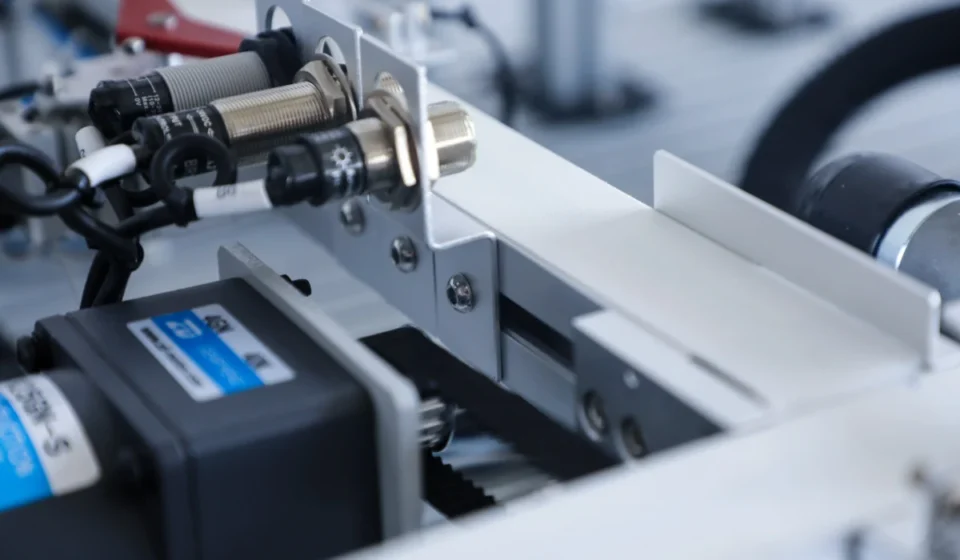
- Limit and Proximity Switches: Yield vital data on strokes, cycles, and dwells, prompting maintenance long before a mechanical failure occurs.
- Current Transducers: Provide 4-20 mA outputs that feed basic motor-current signature analysis to catch mechanical binding or electrical degradation.
- Accelerometers: Mounted on couplings and gearboxes, these sensors flag peak threshold violations for early wear trending without requiring full spectral condition monitoring.
- Variable Frequency Drives (VFDs): Directly act as data-generating edge devices using their speed references to communicate diagnostics over open-loop networks.
Commercial hardware supporting these applications includes programmable edge controllers with built-in digital and analog I/O terminals capable of executing local code and publishing data via MQTT or OPC UA protocols. Other motion controllers rely on wireless pairing with sensor nodes wired directly to the machine infrastructure.
Official Responses and Industry Perspective
Automation architects and motion-control manufacturers view the decentralization of edge computing as a natural evolution driven by the demands of Industry 4.0 and smart manufacturing.
Industry stakeholders emphasize that as machines grow more complex, the bottleneck has shifted from raw processing power to communication bandwidth and latency. By decentralizing control—pushing real-time determinism to multicore IPC cores and safety/logic tasks down to individual servo drives—automation suppliers are effectively stripping weight and complexity out of central control panels.
Furthermore, system integrators note that maintenance teams increasingly demand plug-and-play transparency. The ability of edge devices to pre-process raw telemetry locally and transmit clean, actionable metrics via standard industrial IoT protocols (like MQTT) bridges the historic chasm between operational technology (OT) and information technology (IT).
Implications for the Future of Industrial Automation
The widespread adoption of edge-computing hardware in industrial PCs and motion drives carries profound implications for machine builders, plant operators, and maintenance engineers alike.
- Smaller Footprints, Lower Installation Costs: Cabinet-free architectures reduce the physical footprint of control gear on the factory floor. Eliminating massive wiring harnesses translates directly into reduced material and labor costs during machine commissioning.
- Shift Toward Predictive Maintenance: As drive-level analytics and sensor-fusion techniques become standard, reactive maintenance models will largely disappear. Machines will self-diagnose mechanical wear, micro-jams, and thermal anomalies, scheduling interventions proactively.
- Standardization of Protocols: The convergence of deterministic industrial Ethernet (such as EtherCAT and PROFINET) with lightweight IT protocols (such as OPC UA and MQTT) at the edge ensures that machine data is no longer trapped in proprietary silos.
Ultimately, edge computing redefines the role of the machine itself. No longer merely a mechanical executor of blind commands, the modern automated workcell is an autonomous, self-monitoring node capable of thinking, reacting, and communicating in real-time.