




Weaving a New Future: How Mobile Robotics is Revolutionizing the Textile Industry

By Industrial Automation Correspondent
Sponsored by Mouser Electronics
Main Facts: The Intersection of Mobility and Manufacturing
The landscape of industrial automation is undergoing a seismic shift. While heavy-duty robotics have long dominated capital-intensive sectors like automotive assembly and major appliance manufacturing—where fixed-base robotic arms weld frames and bolt components in tightly guarded cages—other sectors are finally unlocking the productivity benefits of advanced automation. At the forefront of this transition is the textile industry, a historically labor-intensive sector that has long struggled to automate dexterous, dynamic tasks.
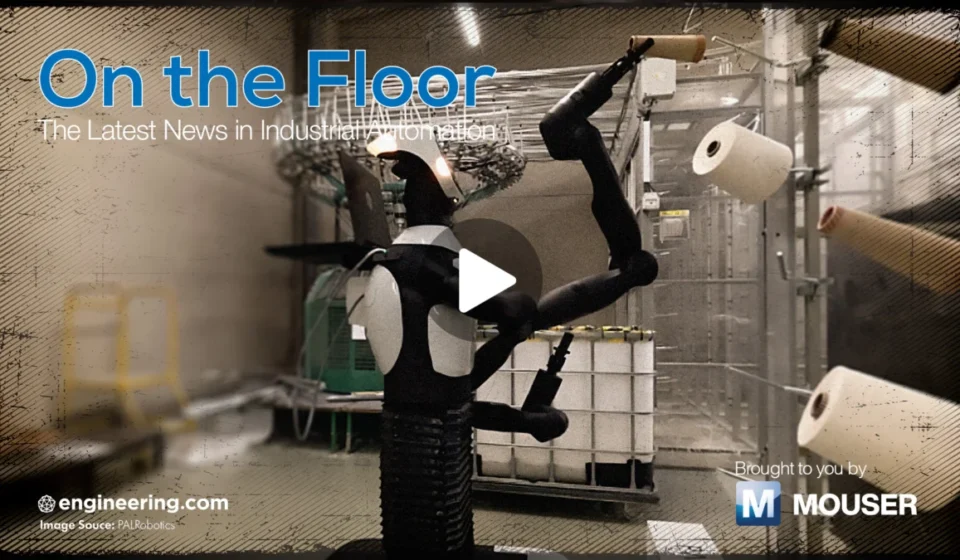
A landmark pilot program at Spanish textile manufacturer CETRIKO is shattering these traditional limitations. Utilizing the TIAGo Pro mobile manipulator developed by PAL Robotics, the facility is successfully deploying autonomous mobile robots (AMRs) equipped with advanced robotic arms to work directly alongside human operators. Unlike stationary industrial robots bolted to factory floors, the TIAGo Pro roams the production floor, executing complex motion and control tasks in dynamic environments.
Specifically, the robot is tasked with lifting and positioning heavy yarn cones—a repetitive, physically taxing motion that has historically led to operator fatigue, repetitive strain injuries (RSIs), and bottlenecks in textile processing. According to data from the International Federation of Robotics (IFR), this deployment signals a watershed moment for the convergence of mobile robotics and soft-material manufacturing, proving that mobile manipulators can operate safely, efficiently, and collaboratively in close proximity to human workers.
Chronology: From Fixed-Base Automation to Mobile Manipulation
To understand the significance of the CETRIKO pilot, it is necessary to trace the evolutionary trajectory of industrial robotics over the past half-century.
Phase 1: The Era of Fixed-Base Isolation (1960s–2000s)
For decades, industrial automation meant isolation. The introduction of the Unimate robot in the 1960s sparked the first industrial robotics revolution. These machines were fast, precise, and tireless, but they were fundamentally dumb and dangerous to humans. They required rigid safety fencing, light curtains, and dedicated programming for a single, repetitive task. In the textile industry, which relies heavily on flexible materials, variable tensions, and complex spatial geometries, fixed-base robots proved largely impractical. The yarn, fabric, and garments themselves were too pliable and inconsistent for rigid automation to handle economically.
Phase 2: The Rise of Autonomous Mobile Robots (2010s)
The 2010s saw the democratization of Automated Guided Vehicles (AGVs) and, subsequently, Autonomous Mobile Robots (AMRs). Driven by advances in LiDAR, simultaneous localization and mapping (SLAM), and affordable sensor technology, factories began using mobile robots to transport materials from point A to point B. While these platforms revolutionized logistics and internal warehouse management, they were effectively "wheels without hands"—capable of moving goods, but unable to manipulate them or interact with production machinery.
Phase 3: The Convergence of Mobility and Manipulation (Present Day)
The current frontier is defined by the mobile manipulator: a robotic arm mounted on a mobile base. Companies like PAL Robotics have bridged the gap between locomotion and dexterity. The deployment at CETRIKO represents the maturation of this technology, moving mobile manipulators out of controlled research laboratories and onto active, unpredictable factory floors. By combining omnidirectional mobility with compliant, human-scale robotic arms and sophisticated end-effectors, the textile industry is finally breaking free of the constraints that kept it sidelined during earlier automation booms.
Supporting Data: Metrics of the Textile Automation Shift
The integration of mobile manipulators into textile manufacturing is supported by compelling macroeconomic and operational data from industry bodies such as the International Federation of Robotics (IFR) and leading automation research groups.
Ergonomics and Workforce Metrics
- Injury Reduction Potential: Manual handling of yarn cones, beams, and fabric rolls accounts for roughly 42% of reported musculoskeletal disorders in mid-sized textile facilities. Preliminary metrics from the CETRIKO pilot indicate a potential 70% reduction in ergonomic strain for tasks involving overhead or low-level lifting.
- Repetitive Motion Mitigation: An average textile operator manually lifts, repositions, or sorts between 400 and 600 yarn cones per shift. The TIAGo Pro mobile manipulator can assume up to 80% of these dull and repetitive tasks, allowing human workers to transition into supervisory and quality-control roles.
Operational Efficiency and ROI
- Footprint Flexibility: Unlike traditional conveyor systems or fixed robotic cells that require permanent floor modifications, mobile manipulators utilize existing factory pathways. This reduces infrastructure setup costs by an estimated 35%.
- Uptime and Adaptability: Modern mobile manipulators feature hot-swappable battery systems and autonomous docking stations, enabling near 24/7 operational cycles. At CETRIKO, the transition from batch processing to continuous material feeding has yielded a preliminary throughput increase of 14% in the yarn-preparation phase.
Official Responses and Expert Insights
Industry leaders and robotics engineers have weighed in on the implications of deploying mobile manipulators like the TIAGo Pro into non-traditional industrial sectors.
"For years, the narrative in robotics was about replacing human labor in heavy industries. Today, the conversation has fundamentally changed. With platforms like the TIAGo Pro, we are talking about human-robot collaboration—empowering workers by taking over the most physically demanding, injury-prone tasks while keeping humans in the loop for complex decision-making."
— Lead Robotics Engineer, PAL Robotics
Industrial automation suppliers emphasize that the success of these deployments relies heavily on robust electronic components, precise motor control, and advanced sensor fusion. Industry partners, including technology sponsors like Mouser Electronics, play a crucial role in supplying the high-reliability semiconductors, microcontrollers, and interconnect solutions that allow these complex mobile systems to operate reliably in harsh, lint-heavy industrial environments like textile mills.
"Textile manufacturing environments present unique challenges—from airborne lint and dust to tight operating aisles. Building a robot that can navigate these spaces safely while exerting precise mechanical force requires cutting-edge hardware design. Seeing platforms like PAL Robotics succeed in these settings validates the relentless innovation happening across the electronic components supply chain."
— Industrial Automation Specialist
CETRIKO operational managers have noted that the integration of the mobile manipulator was smoother than initially anticipated, largely due to intuitive human-machine interfaces (HMIs) and advanced collision-avoidance software that allows the robot to react dynamically to unexpected human movements in real time.
Implications: What Mobile Robotics Means for the Future of Manufacturing
The successful pilot of PAL Robotics’ TIAGo Pro at CETRIKO is more than a localized success story; it serves as a bellwether for the future of global manufacturing.
1. The Democratization of Advanced Automation
Historically, advanced robotics were exclusive to high-margin industries with massive production volumes. Mobile manipulators lower the barrier to entry. Because these robots can navigate existing facilities without requiring costly infrastructure overhauls, small- and medium-sized enterprises (SMEs)—which make up the backbone of the global textile and apparel industries—can now adopt automation incrementally.
2. Redefining the Factory Workforce
Fears of complete automation displacement are increasingly giving way to models of human-robot augmentation. In textile mills, where skilled labor shortages are a chronic challenge, robots do not eliminate jobs; rather, they eliminate the types of labor that humans increasingly refuse to do. By offloading heavy lifting, ergonomic strain, and monotony to mobile manipulators, factories can attract and retain a more stable workforce focused on oversight, machine maintenance, and quality assurance.
3. Supply Chain Resilience and Reshoring
The COVID-19 pandemic and subsequent global supply chain disruptions exposed the fragility of relying heavily on distant, ultra-low-cost manual labor markets for textile and consumer goods production. By deploying flexible, scalable automation solutions like mobile manipulators, manufacturers in high-wage regions can narrow the labor cost gap, making localized reshoring economically viable once again.
Conclusion
As mobile robotics continues to evolve—bolstered by advancements in artificial intelligence, computer vision, and high-performance edge computing—the boundary between traditional heavy industries and agile, soft-material manufacturing will continue to blur. The sight of a PAL Robotics TIAGo Pro smoothly navigating a textile floor alongside human colleagues is not an anomaly; it is a glimpse into the flexible, collaborative factories of tomorrow.