




Elevating Compact SLS: Sinterit and DyeMansion Forge Strategic Alliance to Redefine Industrial Finishing

In a landmark development for the additive manufacturing (AM) sector, Polish selective laser sintering (SLS) pioneer Sinterit has entered into a strategic partnership with global polymer post-processing leader DyeMansion. This collaboration marks a significant shift in how compact industrial SLS users approach the production lifecycle, bridging the long-standing gap between entry-level SLS accessibility and high-end, production-grade surface finishing.
By integrating DyeMansion’s advanced vapor smoothing and coloring technologies directly into the Sinterit sales ecosystem, the companies are enabling smaller manufacturing outfits to achieve the aesthetic and functional quality typically reserved for massive, multi-million-dollar industrial factories.
The Core Partnership: An Integrated Workflow
At its heart, the partnership is designed to streamline the "Print-to-Product" workflow. Previously, users of compact SLS machines—such as Sinterit’s own Lisa X or the newly launched BIANCO2—had to navigate a fragmented market to source post-processing solutions. Often, this meant either settling for manual, labor-intensive finishing or investing in disparate, oversized industrial equipment that did not align with their scale of operation.
Under the new agreement, Sinterit will serve as a direct channel for DyeMansion’s VX1 vapor smoothing system. As businesses scale, Sinterit will also facilitate the procurement of the DM60 coloring system, allowing for a modular growth path. This "one-stop-shop" approach eliminates the friction of managing multiple vendors, allowing engineering teams to focus on design and production rather than logistics.
Chronology of Innovation: From Prototyping to Industrialization
2014–2024: The Rise of Compact SLS
Since its inception in 2014, Sinterit has dedicated itself to democratizing SLS technology. By focusing on compact, benchtop-friendly systems, the company successfully brought professional-grade powder bed fusion to over 80 countries. During this decade, the primary hurdle for Sinterit users was the surface quality of "as-printed" parts, which often exhibited the characteristic porosity and matte finish of sintered nylon.
2025: The Birth of the VX1
The shift toward professional finishing began in earnest at Formnext 2025, where DyeMansion introduced the VX1. Recognizing that the market was saturated with high-capacity industrial machines but lacked solutions for mid-tier manufacturers, DyeMansion pivoted to create a compact, efficient vapor smoothing unit. The system was an instant success, with over 50 units deployed within its first year, signaling a clear appetite for "industrial-grade" quality in smaller footprints.

2026: The Strategic Alignment
The partnership announced today is the culmination of these two trajectories. By combining Sinterit’s BIANCO2—a printer optimized for white and natural powders—with the color-receptive capabilities of the VX1 and DM60, the companies have created a complete ecosystem. For the first time, Sinterit users are seeing the output of a seamless, end-to-end process: white, natural parts that are smoothed to injection-molded standards and dyed in a vibrant spectrum of colors.
Technical Synergy: VaporFuse and the BIANCO2
The technical centerpiece of this partnership is DyeMansion’s proprietary VaporFuse Surfacing (VFS) technology. Unlike mechanical methods such as bead blasting, which can degrade part geometry, VFS uses a vapor process to seal the surface of the component.
The Impact on Surface Quality
- Sealing: The process closes the porous structure of SLS parts, making them watertight and airtight.
- Aesthetics: The result is a glossy, high-quality finish that mimics the look and feel of injection-molded plastics.
- Durability: Sealed parts are less prone to dirt accumulation and microbial growth, making them significantly more suitable for end-use applications in healthcare and consumer goods.
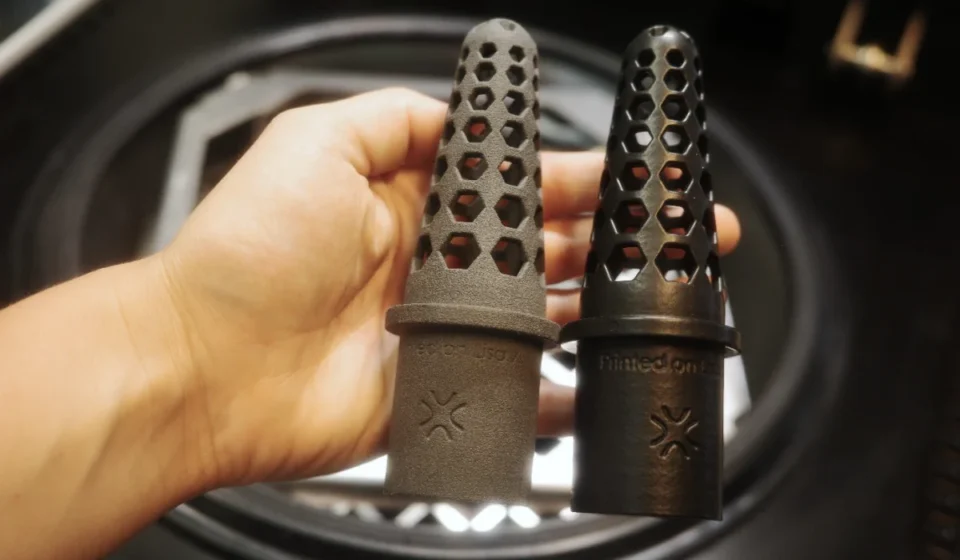
By pairing the BIANCO2—which provides the perfect "blank canvas" of white, high-purity powder—with the VX1, users can achieve color consistency that was previously impossible. During initial testing, Sinterit showcased a range of parts in yellow, orange, red, purple, blue, and green, proving that the compact SLS workflow is now capable of producing high-value, aesthetic end-use components.
Official Perspectives: Bridging the Scale Gap
The leadership at both organizations emphasizes that this partnership is about democratization.
Łukasz Adach, CFO at Sinterit, noted, “This partnership brings together Sinterit’s accessible and flexible SLS 3D printing ecosystem with DyeMansion’s leading industrial post-processing technologies. Our goal is to empower our customers to configure manufacturing setups that grow with their specific business requirements, ensuring that high-end surface finishing is no longer a luxury, but a standard feature of the Sinterit experience.”
Felix Ewald, CEO and co-founder of DyeMansion, highlighted the reach of the new alliance: “With the VX1 and our compact solutions, we are ensuring that industrial-grade surface quality is accessible to every customer, regardless of their production scale. Partnering with Sinterit gives us a strategic entry into a massive, global network of over 80 countries, effectively putting the power of our technology into the hands of thousands of engineers who were previously limited by the lack of finishing options.”

Implications for the Additive Manufacturing Landscape
A New Standard for "End-Use" Parts
For years, the industry has wrestled with the "prototype-only" stigma associated with compact 3D printers. By integrating vapor smoothing and automated coloring, Sinterit and DyeMansion are effectively pushing the boundaries of what constitutes "industrial production." When a part is sealed, smoothed, and professionally dyed, it becomes indistinguishable from mass-produced consumer goods, allowing SMEs to compete with larger manufacturing firms in terms of product finish.
Consolidation of the Workflow
The move by Sinterit follows a broader industry trend toward integrated hardware ecosystems. We saw this earlier in 2026 with the partnership between Raise3D and Additive Manufacturing Technologies (AMT), who combined the RMS220 platform with the PostPro SF2X. This confirms that the market is moving away from "siloed" equipment toward comprehensive, turn-key solutions. Customers no longer want to act as their own system integrators; they want a proven, validated, and supported manufacturing line.
Market Accessibility and Future Outlook
This partnership provides a roadmap for the next phase of 3D printing adoption. As the "Year of Institutional Filters" (as characterized by industry analysts in 2026) continues, companies that offer full-stack solutions—from raw powder to finished, colored product—are the ones likely to see sustained growth.
For Sinterit, this represents a significant expansion of their value proposition. For DyeMansion, it secures a dominant position in the compact SLS segment. For the end-user, it represents the death of the "unfinished" 3D printed look, ushering in an era where the distinction between additive and subtractive manufacturing finishes becomes increasingly blurred.
Conclusion: The Path Forward
As Sinterit and DyeMansion roll out this integrated solution to their global distributors, the industry will be watching to see how quickly adoption spreads. The technical capability is now firmly in place, and the economic barrier to entry has been lowered.
As we look toward the remainder of 2026 and into 2027, the focus will likely shift from simply "printing parts" to "scaling production." With the ability to smooth and color parts at a compact scale, companies are now equipped to handle production runs that previously would have been outsourced or abandoned. This is not just a partnership between two companies; it is a fundamental recalibration of the capabilities of the compact SLS sector, signaling that the future of additive manufacturing is, quite literally, being polished to perfection.