


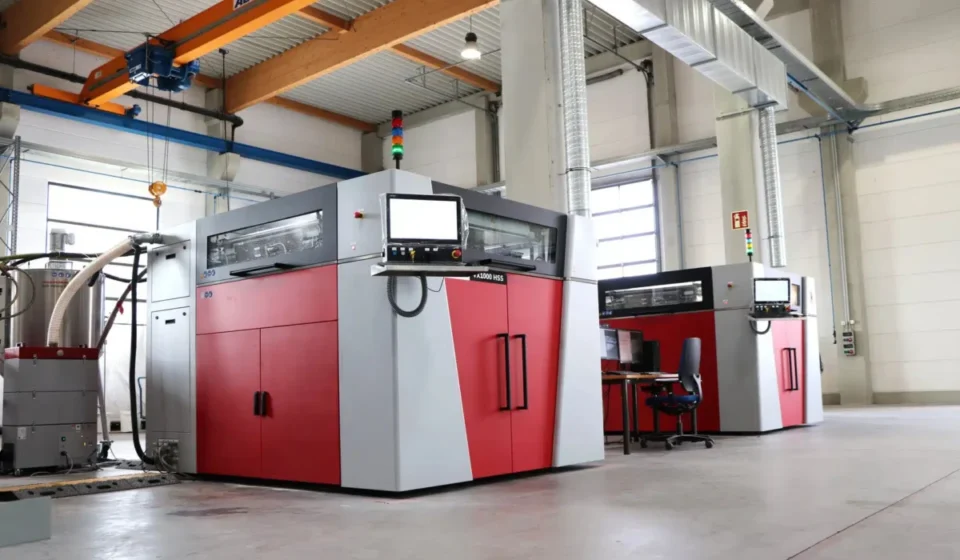
Revolutionizing Automotive R&D: Hyundai’s Strategic Integration of Large-Format High-Speed Sintering

In a significant leap for industrial additive manufacturing (AM), South Korean automotive powerhouse Hyundai has bolstered its Namyang R&D Center with the installation of two VX1000 High Speed Sintering (HSS) polymer 3D printers. Provided by German manufacturing giant ExOne Global Holdings, these systems represent a pivotal shift in how automotive engineers approach the production of large-scale, functional components. By moving away from traditional multi-part assemblies toward monolithic, single-piece printing, Hyundai is effectively redefining the speed and precision of vehicle development.
The Technological Core: High Speed Sintering (HSS)
At the heart of this installation lies the High Speed Sintering (HSS) process, a sophisticated additive manufacturing technique that balances the resolution of laser-based systems with the throughput required for industrial applications. The VX1000 utilizes an infrared-absorbing ink selectively deposited onto a bed of PA12 (polyamide) powder. A sintering emitter then traverses the bed, fusing the material layer by layer.
The sheer scale of the machine is its most disruptive feature. With a build volume of 1,000 x 550 x 190 mm, the VX1000 can produce massive, intricate components—such as full-sized vehicle door panels—in a single, uninterrupted build cycle. This capability eliminates the traditional necessity of joining smaller printed sections, a process that historically introduced cumulative tolerance errors and structural weak points.
A Chronology of Innovation at Namyang
The integration of the VX1000 printers is the latest chapter in a multi-year effort by Hyundai Motor Group to centralize and modernize its manufacturing capabilities.
- Early 2020s: Hyundai recognizes the limitations of traditional prototyping, which often suffered from long lead times associated with specialized tooling. The company begins evaluating AM as a solution for rapid design validation.
- 2025 (Mid-Year): Hyundai announces the creation of the Additive Manufacturing Solution Center at the Namyang R&D site. This facility is conceived as a comprehensive hub for both polymer and metal additive manufacturing.
- Late 2025/Early 2026: The Additive Manufacturing Solution Center becomes fully operational, consolidating vat photopolymerization and directed energy deposition (DED) capabilities.
- Current Milestone: The commissioning of the dual VX1000 HSS units marks the transition from purely experimental R&D to high-volume, large-format production-equivalent validation.
Supporting Data and Operational Efficiency
The success of large-scale polymer printing is frequently hindered by thermal instability. When printing a part as large as a door panel, even minor fluctuations in temperature can lead to warping or degradation of material properties.
ExOne’s VX1000 addresses this through advanced thermal management across the entire build envelope. The printhead, equipped with 8,000 nozzles, ensures that the sintering process remains uniform across the 1,000 mm span. Furthermore, the system is designed for a 24/7 operational environment. Routine maintenance, such as replacing sintering emitters or print modules, is streamlined to minimize downtime.
To ensure continuous production, both printers are integrated into a centralized monitoring system that provides real-time process data. This digital thread allows the Additive Manufacturing Solutions team at Namyang to track quality metrics—such as dimensional accuracy, tensile strength, and bending stiffness—against production-equivalent benchmarks. The shared powder supply and unpacking stations further optimize floor space, allowing for flexible configurations that adapt to the evolving needs of the R&D team.
The Strategic Shift: From Prototyping to Production Validation
The primary bottleneck in automotive R&D is the "tooling gap." When a new design is finalized, waiting for the manufacturing of steel or aluminum molds can take weeks or even months. This delay often causes a ripple effect, stalling downstream validation and testing.
By utilizing the VX1000, Hyundai’s Additive Manufacturing Solutions team has compressed these design cycles from weeks to days. Because the printers produce functional, end-use quality parts, the team can move straight into vehicle integration and road testing without needing to wait for traditional tooling. This agility is particularly crucial for the "pre-production" phase, where design adjustments are frequent and the cost of waiting for new tooling is prohibitive.

Official Responses and Industry Leadership
"Hyundai is using High Speed Sintering exactly as we designed it, for full-scale functional parts," noted Eric Bader, CEO of ExOne Global Holdings. "Keeping large polymer parts accurate and repeatable, print after print, is one of the hardest challenges in polymer 3D printing. We solved it, and that turns additive manufacturing into a tool automotive teams can rely on for real development work."
This sentiment is echoed by Hyundai’s internal initiatives, which view additive manufacturing not merely as a supplement to traditional processes, but as a core pillar of their "Factory of the Future" strategy. By bringing both metal DED and large-scale polymer HSS under one roof, Hyundai is setting a new standard for how OEMs (Original Equipment Manufacturers) should structure their R&D pipelines.
Implications for the Global Automotive Sector
The move by Hyundai highlights a growing divide in the automotive industry regarding the maturity of additive manufacturing.
For comparison, consider the approach taken by Jaguar Land Rover (JLR) at their Gaydon facility. While JLR boasts an impressive fleet of 20 industrial printers across six distinct technologies, their primary application remains functional prototyping for test vehicles. Industry data suggests that a vast majority of their AM output is focused on parts that support the development cycle rather than replacing production-equivalent components.
Hyundai’s installation is a departure from this "prototyping-only" mindset. By focusing on large-format, single-piece production, they are addressing the structural and dimensional challenges that have previously kept AM on the fringes of automotive assembly. This capability allows for:
- Mass Customization: Printing unique components for limited-run vehicles without the expense of bespoke tooling.
- Lightweighting: Printing complex geometries that are impossible to cast or mold, reducing vehicle weight and increasing range for electric vehicle (EV) platforms.
- Supply Chain Resilience: Reducing dependence on external toolmakers and long-distance logistics for urgent component needs.
The Future of Additive Manufacturing at Namyang
As Hyundai continues to scale its AM capabilities, the Namyang R&D Center is expected to become the blueprint for other global automotive manufacturers. The integration of 3D printing into the assembly line workflow—moving from test parts to actual, production-ready components—is the "holy grail" of the industry.
The 2026 Additive Manufacturing Applications (AMA) series will further explore these trends, with industry experts gathering to discuss the qualification of printed parts and the integration of AM into the broader supply chain. For companies like Hyundai, the message is clear: the future of vehicle manufacturing is not just about moving faster, but about removing the physical barriers that have defined the industry for over a century.
By treating additive manufacturing as a high-precision, industrial-scale production tool, Hyundai is not just printing parts—it is printing a new competitive advantage. As the line between prototype and production continues to blur, the Namyang R&D Center stands at the vanguard, demonstrating that when it comes to the future of mobility, the most effective tool is the one that builds the entire component in a single, seamless, and high-precision run.