

Monro Inc. to Pay $174K Settlement Following OSHA Investigation into Workplace Safety Lapses

Executive Summary: A Significant Regulatory Correction
In a move that underscores the federal government’s commitment to workplace safety standards in the automotive service industry, national service provider Monro Inc. has agreed to a $174,000 settlement. This financial penalty follows a rigorous investigation by the U.S. Department of Labor’s Occupational Safety and Health Administration (OSHA), which uncovered a series of hazardous conditions at the company’s facility in Norwich.
The settlement brings to a close a contentious period of litigation during which the New York-based automotive giant initially contested the citations. Beyond the monetary penalty, the agreement signals a pivot in corporate governance: Monro has committed to implementing an anonymous, company-wide safety hotline, a measure designed to empower employees across its 1,100 locations to report hazards without fear of reprisal.

The Chronology of Compliance and Contention
The Initial Inspection
The investigation began as a routine regulatory sweep that quickly revealed systemic issues at the Norwich site. OSHA inspectors found a facility failing to meet basic industrial safety standards. The agency’s report detailed a litany of risks that spanned from slip-and-fall hazards to life-threatening mechanical failures.
Citation and Contestation
Upon the issuance of the citations, Monro Inc. opted to challenge the findings through the Occupational Safety and Health Review Commission—an independent federal agency established to adjudicate disputes between OSHA and employers. For months, the company maintained that the findings were either mitigated or did not warrant the severity of the proposed penalties.

The Settlement Agreement
Ultimately, recognizing the weight of the evidence and the potential for reputational and financial damage, Monro opted to settle. The agreement requires the company to pay the $174,000 penalty in full and, more importantly, to rectify all physical hazards identified during the inspection. This settlement is not merely a payment; it represents an enforceable commitment to overhaul safety protocols at the Norwich site and establish a new culture of safety oversight throughout the national organization.
Supporting Data: Unpacking the Safety Hazards
The hazards identified by OSHA inspectors were not isolated incidents but rather a pattern of negligence that created a perilous work environment. The primary risks identified during the site visit include:

Environmental Hazards
- Slip and Fall Risks: Inspectors discovered significant accumulations of spilled engine oil and transmission fluid on the floors of the storage areas. These fluids pose a constant risk of injury to employees moving heavy automotive parts.
- Debris Management: Exterior areas surrounding the facility were found to be cluttered with commercial trash and stacks of tires, creating tripping hazards and impeding emergency egress routes.
- Fire Safety Failures: Oily rags, which are highly combustible, were left in open piles rather than being stored in approved, covered metal containers, significantly increasing the risk of spontaneous combustion and workplace fires.
Electrical and Equipment Hazards
- Infrastructure Decay: The facility suffered from damaged electrical conduits, exposing workers to potential electrical shocks and fire risks.
- Eyewash Station Deficiencies: In areas designated for battery maintenance—where workers are frequently exposed to corrosive battery acids—OSHA found a lack of necessary emergency eyewash equipment. This failure violates core safety regulations intended to mitigate permanent eye damage in the event of a chemical splash.
The "Crushing" Hazard: A Repeat Offense
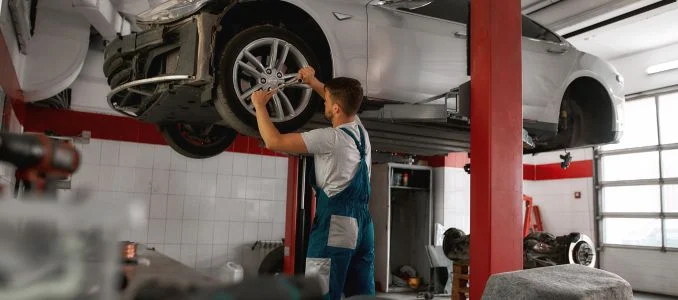
Perhaps the most alarming discovery was the repeat violation concerning a four-post rotary lift. Investigators found that the safety latch—a critical component designed to prevent the lift from collapsing—was broken. In a shocking display of makeshift repair, the company had reportedly used a pair of vice grips to hold the lift in place. This makeshift solution created an immediate "crushing hazard," placing any technician working under or around the lift at risk of severe injury or death.
Official Responses and Corporate Accountability
The Role of OSHA
The Occupational Safety and Health Administration’s role is to ensure that employers provide a workplace free from recognized hazards. By pursuing this case, OSHA has signaled that the automotive service sector—a segment often characterized by high-pressure, fast-paced work—is not exempt from stringent safety requirements.

"The safety of workers must be the paramount concern for any employer, especially in environments where heavy machinery and hazardous chemicals are involved," stated a representative of the Department of Labor. The agency emphasized that the "repeat" nature of the lift violation was a significant factor in the severity of the fine.
Monro Inc.’s Stance
While the company initially fought the findings, their recent decision to settle indicates a shift in strategy. By agreeing to the settlement, Monro has effectively acknowledged that the conditions at the Norwich facility were untenable. The establishment of the anonymous hotline is the cornerstone of their remedial action. By providing a direct line to corporate safety personnel, Monro is attempting to decentralize safety oversight, allowing the company to identify and mitigate risks in real-time at any of its 1,100 locations, rather than waiting for an OSHA inspector to discover them.

Broader Implications for the Automotive Service Industry
A New Standard for Safety Reporting
The requirement to create an anonymous reporting system sets a precedent for other national service providers. In the automotive industry, where workers are often incentivized by quotas and labor hours, safety can sometimes be pushed to the background. By formalizing a reporting channel, Monro is creating a "whistleblower-lite" environment that prioritizes life over output.
The Cost of Non-Compliance
The $174,000 fine, while substantial, is only a fraction of the cost associated with workplace accidents. The industry is currently facing a labor shortage, and companies that fail to provide a safe work environment risk not only federal fines but also high employee turnover, increased insurance premiums, and the potential for devastating lawsuits.

Lessons for Facility Managers
This case serves as a cautionary tale for facility managers across the country. The "quick fix"—such as using vice grips to repair a lift—is never an acceptable substitute for professional maintenance. Regulatory bodies are increasingly focusing on the "culture of safety" within organizations. When an inspector finds a pattern of neglect (such as the combination of fluid spills, lack of fire safety, and equipment failure), it demonstrates a systemic issue rather than a localized one.
Conclusion: Moving Toward a Safer Future
The resolution of the Monro Inc. case is a victory for the workers at the Norwich facility and a stark reminder to the automotive industry at large. As the company begins the process of implementing its new reporting hotline and rectifying its physical infrastructure, the industry will be watching.
The transition from a culture of "getting the job done at any cost" to one of "getting the job done safely" is the challenge facing modern automotive service providers. For Monro, the $174,000 settlement is an investment in that transition. The true measure of their success, however, will not be the payment of the fine, but the long-term effectiveness of their new safety-first initiatives.
As the automotive sector continues to evolve with more complex electrical systems and heavier, more sophisticated vehicles, the demands on safety infrastructure will only increase. Employers who ignore these requirements do so at their own peril, both in terms of federal regulatory scrutiny and the welfare of their most valuable asset: their employees.