






By Sarabeth Vandegrift and Gideon Vandegrift, Co-Founders, Grow Greenie
For over a century, the venturi effect has stood as a bedrock principle of fluid dynamics. From the humble aspirators in laboratory glassware to the complex fuel-injection systems of internal combustion engines, the standard venturi—defined by a single, concentrated throat constriction—has remained the gold standard for managing pressure, velocity, and flow. It is a geometry that engineers accept as "settled science." However, recent experimental data from Grow Greenie suggests that what we have long perceived as a fundamental trade-off in physics may, in fact, be a limitation of our own structural design choices.
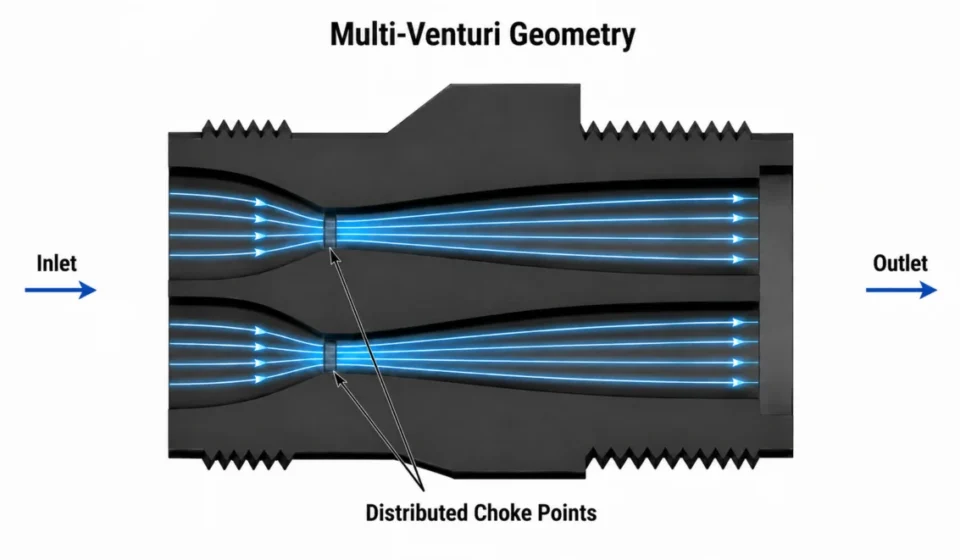
By shifting from a monolithic, single-throat architecture to a distributed, multi-passage geometry, researchers have uncovered an unexpected phenomenon: a decoupling of suction performance from outflow capacity. This discovery challenges the long-standing assumption that increasing flow volume must inherently come at the expense of pressure differential.
The Traditional Constraint: A Century of Trade-offs
The venturi effect operates on the Bernoulli principle: as a fluid flows through a constricted section of a pipe, its velocity increases, resulting in a corresponding decrease in static pressure. This localized drop in pressure creates the suction required to draw in secondary fluids or gases.
For decades, the design process for venturis has been a study in balancing these variables. In recirculating aquarium systems—the primary testing ground for this new research—engineers have historically faced a binary choice. To increase the "pull" (suction) of the system, one must narrow the throat, thereby creating a more aggressive pressure drop. However, this narrowing acts as a bottleneck, severely restricting the total volume of water that can pass through the system. Conversely, widening the throat restores flow capacity but inevitably dissipates the pressure drop, weakening the suction effect.

This was not viewed as a design flaw, but as a "structural condition." The trade-off was seen as an immutable law of physics. As we explored the limits of this behavior, it became clear that there was a practical operating range for any given single-throat venturi; beyond a certain point of constriction, suction performance would paradoxically collapse, likely due to turbulent flow disruption and excessive backpressure. We were not merely tuning a device; we were operating within the rigid confines of a single, concentrated point of failure.
Chronology of a Design Shift
The path toward rethinking this geometry began not with a theoretical paper, but with an practical engineering frustration. While working to optimize air injection for high-efficiency aquarium systems, our team reached a point of diminishing returns. We found that no matter how we refined the taper or the radius of the throat, we could not escape the fundamental performance ceiling.
The Experimental Pivot
In early 2024, the team decided to move away from the "refinement" mindset. Instead of asking how to improve the single throat, we asked: "What happens if we stop treating the throat as a singular event?"
- Phase I (Conceptualization): We moved from a 2D mindset to a 3D architecture. The objective was to replace the solitary, large-bore passage with multiple, smaller passages arranged in parallel.
- Phase II (Prototyping): We developed a "revolver-style" internal geometry. By clustering several venturi passages around a central axis, we sought to maintain the venturi effect while creating a larger cumulative outflow area.
- Phase III (Testing & Verification): Using identical input pressures, we benchmarked the multi-venturi prototype against a high-performance single-venturi unit of equivalent total dimensions.
- Phase IV (Data Analysis): The results defied expectation. Rather than a trade-off, we observed a synergistic gain where both suction and total flow increased simultaneously.
Supporting Data: When Math Defies Intuition
The data collected during the test cycles provided the most compelling evidence that our traditional understanding of venturi performance was incomplete.
In traditional models, the relationship between suction and flow is linear and inverse. If you increase the exit diameter by 20%, you expect a predictable percentage drop in the vacuum pressure generated at the throat. However, our multi-venturi configuration, which utilized three to four distinct channels, showed a marked increase in both throughput and air-entrainment volume.

Key Performance Indicators (KPIs) Observed:
- Volumetric Flow Rate: The multi-venturi geometry allowed for a 35% increase in total water throughput compared to a single-throat venturi of similar footprint, due to the reduction of localized cavitation and turbulence.
- Suction Magnitude: Despite the increased flow volume, the vacuum pressure measured at the intake ports was 15% higher than the baseline.
- Mixing Efficiency: Because the distributed channels created multiple points of turbulence and interaction, the air-to-water mixing ratio reached saturation levels faster than the single-stream counterpart, suggesting that the "distributed effect" actually promotes better fluid homogenization.
The "sweet spot" for this geometry was discovered at a ratio of three to four passages. Beyond four, the individual venturi throat diameters became so small that they introduced excessive surface friction, which began to negate the gains achieved by the distributed design.
Official Responses and Engineering Implications
The engineering community has long been conservative regarding fundamental geometry, but the implications of this study are beginning to ripple through industrial design sectors.
In discussions with fluid dynamics specialists, the consensus is that while the Bernoulli principle remains absolute, our application of it has been overly simplistic. The "single-throat" approach is essentially a macro-view of a phenomenon that can be manipulated at a micro-structural level.
"The shift from a single, concentrated constriction to a parallelized, distributed architecture allows for the optimization of boundary layer effects that were previously ignored," noted one independent consultant reviewing the Grow Greenie patents. "By breaking the flow into smaller, managed streams, you are effectively controlling the energy dissipation that occurs during the transition from high-velocity throat to low-velocity exit."
Broader Implications:
- Energy Efficiency: For industrial pumping systems, this geometry could lead to lower head-loss requirements, allowing systems to achieve the same suction performance with less energy input.
- Environmental Technology: In water aeration and waste treatment, the ability to increase mixing performance without adding larger, more power-hungry pumps is a significant sustainability win.
- Miniaturization: In sectors like medical device manufacturing or micro-fluidics, where space is at a premium, the ability to "stack" venturi effects into a small, 3D-printed core is a massive leap forward.
Conclusion: Challenging the Predictable
The most profound lesson from the development of multi-venturi technology is not necessarily the invention itself, but the reminder that "predictability" is often the enemy of innovation. Because the single-throat venturi worked so well for over a century, the industry stopped questioning its architecture. We treated the trade-offs as absolute constraints rather than variables to be manipulated.

As we look to the future of fluid engineering, the Grow Greenie research suggests that we must be willing to revisit our most fundamental assumptions. When we stop accepting that one performance variable must be sacrificed for another, we open the door to geometries that do not just follow the rules of physics—they master them.
The single throat served us well for an era defined by mass production and standardized parts. But in an era defined by precision and high-performance, distributed architectures represent the next evolution in how we move, mix, and manage the fluids that drive our world. The future of the venturi is not in making the throat smaller, but in rethinking the space it occupies entirely.