





Bridging the Gap: How Asset Tracking and Cloud-Based CMMS Transform Manufacturing Maintenance

By Reena Sommer | Published: July 28, 2026
Main Facts
For modern manufacturers, preventive maintenance often looks flawless on paper while struggling on the plant floor. While the structural elements—such as basic asset registers, digital work orders, and scheduled service intervals—frequently exist, industrial facilities continually encounter persistent operational bottlenecks. Incomplete asset service histories, delayed response times, fragmented communication channels, and a heavy reliance on siloed legacy tools consistently undermine equipment uptime.

According to data compiled by industry analysts at Deloitte, poor and reactive maintenance strategies can quietly erode an asset’s productive capacity by 5% to 20%. Furthermore, unplanned industrial downtime costs global manufacturers an estimated $50 billion annually. Addressing these deficits requires a fundamental shift in perspective: manufacturers must stop treating asset tracking as a standalone logistical utility. Instead, when tracking infrastructure is directly integrated into a cloud-based Computerized Maintenance Management System (CMMS), it evolves from a passive locating tool into an active driver of operational discipline, margin resilience, and strategic decision-making.
Chronology and Evolution of Maintenance Strategies
To understand the current state of industrial maintenance, it is helpful to examine how plant floors have attempted to transition from chaotic reaction to structured proactive strategies over the past few decades.

Phase 1: The Era of Reactive and Paper-Based Operations (Pre-2010s)
Historically, manufacturing maintenance was predominantly reactive. Equipment was run until failure occurred, leading to catastrophic production halts, rushed emergency part orders, and inflated labor costs. When preventive maintenance programs were first introduced, they relied heavily on physical paper binders, clipboards, and manual whiteboard schedulers. Asset histories were handwritten, easily misplaced, and rarely analyzed for underlying failure trends.
Phase 2: The Siloed Digital Transition (2010s–2020)
As manufacturing facilities digitized, companies began adopting disconnected software solutions. Inventory management tools lived on one system, asset tracking spreadsheets on another, and basic work order logs somewhere else. While this reduced physical paperwork, it introduced a new industrial hurdle: information fragmentation. Maintenance teams spent significant hours cross-referencing disparate platforms, leading to delayed workflows and inconsistent execution across different factory shifts.

Phase 3: The Connected Cloud and Smart Factory Ecosystem (Present Day)
Today, the industry is moving away from fragmented software toward unified, cloud-based ecosystems. The convergence of cloud computing, mobile device accessibility, Internet of Things (IoT) sensors, and modern CMMS platforms allows maintenance data to flow seamlessly in real time. Asset tracking is no longer just about locating a missing forklift or mobile pump; it is now the foundational layer that feeds context, history, and location intelligence directly into day-to-day maintenance workflows.
Supporting Data and Industry Insights
The argument for integrating asset tracking with cloud-based CMMS platforms is supported by extensive industry research and operational metrics.

- Capacity and Financial Impact: Research from Deloitte highlights that ineffective maintenance frameworks directly diminish an asset’s productive capacity by 5% to 20%. With unplanned downtime bleeding billions of dollars from the manufacturing sector annually, maintenance must be viewed as a critical core driver of plant output and financial margin, rather than a back-end utility.
- The Distinction of Preventive vs. Predictive Models: Insights from Link Labs emphasize that traditional preventive maintenance is strictly schedule-based (e.g., servicing a machine every 30 days or after 500 operating hours). While this creates baseline structure, it lacks precision. Assets may degrade prematurely between service windows or undergo unnecessary servicing while still operating efficiently. Asset tracking bridges this gap by providing granular equipment usage histories, location intelligence, and operational context that pave the way for condition-based and predictive models.
- Workflow Agility: According to data from FTMaintenance, cloud-based CMMS environments yield distinct operational advantages, including anywhere-anytime mobile access, accelerated decision-making, API-based interoperability, and real-time equipment monitoring.
Official Perspectives and Expert Analysis
Industry leaders and subject matter experts widely agree that the traditional separation between asset tracking and work execution must end.
Maintenance management authorities note that the value of an asset tracking system does not lie merely in confirming where a machine is located, but in understanding how it has performed over its lifecycle. When an asset’s physical location and movement history are tied directly to its electronic service logs, maintenance planners gain unprecedented clarity.

Furthermore, technology analysts point out that human factors often dictate the success or failure of a maintenance program. Technicians who are forced to walk back and forth to fixed office terminals to check equipment histories or look up manuals experience friction that delays task execution. Experts argue that bringing mobile capabilities directly to the technician’s tablet or smartphone—synced continuously via a cloud CMMS—removes these administrative bottlenecks.
Collaboration is another pillar emphasized by maintenance professionals. In inefficient environments, communication between operators, schedulers, and technicians happens through ad-hoc emails, verbal handoffs, or missed notes. Centralized cloud platforms embed communication tools—such as push notifications, automated SMS alerts, and shared digital work logs—directly into the workflow, replacing individual guesswork with systematic coordination.

Operational Implications for Modern Manufacturers
Transitioning to an integrated asset-tracking and cloud-CMMS framework has profound implications for small, mid-sized, and enterprise-level manufacturing plants alike.
1. Optimization of Maintenance Timing
By merging real-time asset visibility with robust historical data, plants can refine their maintenance schedules. Instead of adhering blindly to rigid calendar intervals, maintenance teams can monitor actual asset utilization patterns, environmental stressors, and wear indicators, moving steadily toward a smarter, hybrid maintenance model.

2. Elimination of Hidden Search and Travel Times
Time lost before a wrench ever touches a machine represents a massive, often invisible drain on labor efficiency. When technicians spend minutes—or hours—searching sprawling facilities for mobile assets, specialized tools, or unmapped carts, productivity plummets. Real-time location visibility transforms asset tracking into an active workflow enhancer, ensuring that work starts promptly and is completed efficiently.
3. Eradication of Incomplete Asset Histories
Incomplete documentation hides chronic machine underperformance. When every repair, inspection, and parts replacement is automatically logged against a specific asset ID within a cloud database, organizations cultivate institutional knowledge. Repeat failures can be identified, root causes addressed, and asset lifecycles significantly extended.
4. Actionable Downtime Reporting for Leadership
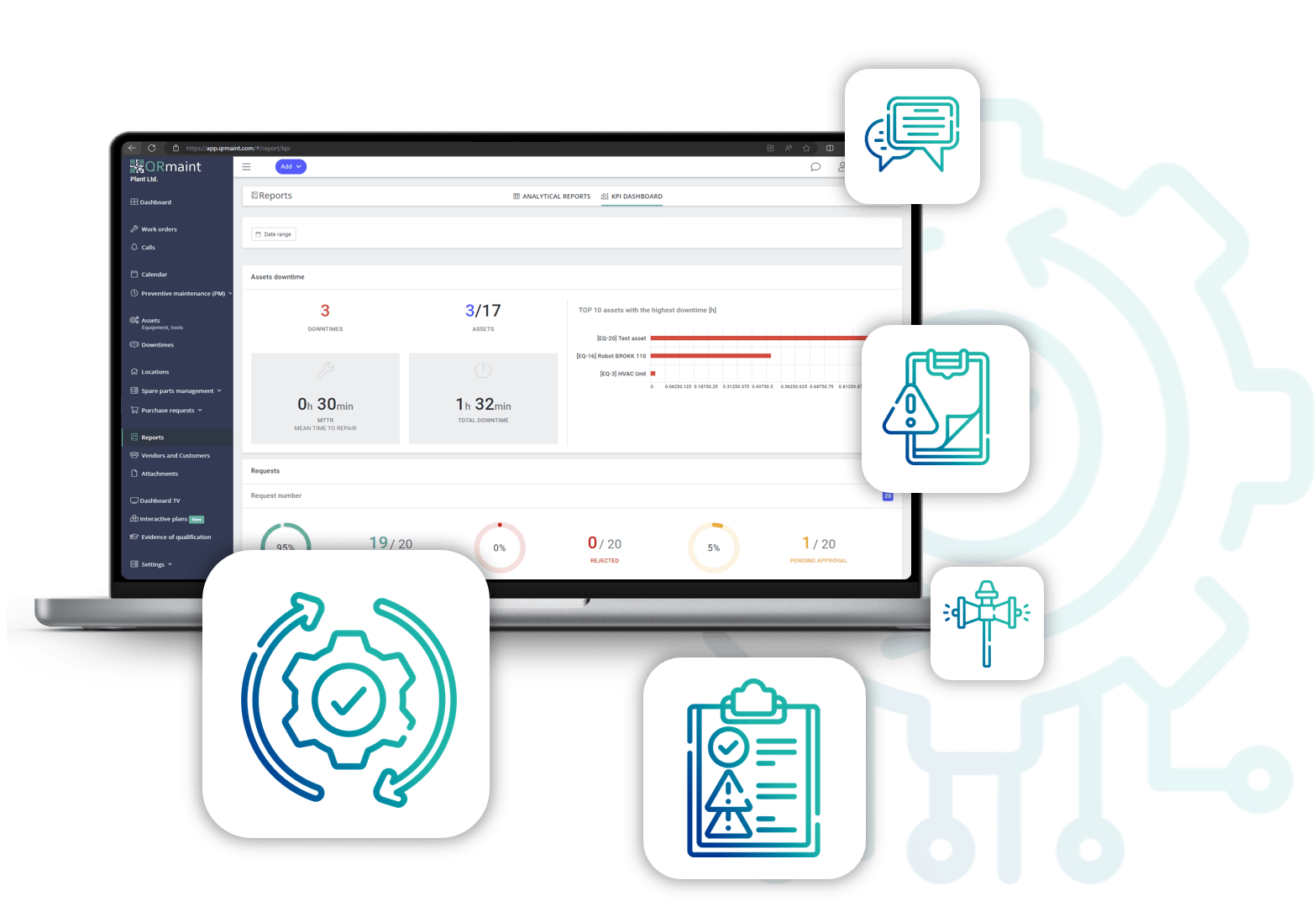
Data collection without strategic analysis yields little value. Platforms referenced by industry experts like Accruent stress that real-time equipment downtime reporting is essential for identifying failure root causes. When asset tracking data, CMMS work orders, and downtime logs converge, leadership teams can make informed decisions regarding capital expenditure, repair-versus-replace thresholds, and technician allocation.
Conclusion
Asset tracking is a powerful capability, but on its own, it remains an incomplete operational fix. Manufacturers seeking genuine resilience, higher output, and minimized downtime must look beyond basic visibility.

By integrating asset tracking into a comprehensive, cloud-based CMMS, industrial facilities can dissolve the boundaries between scheduling, field execution, and data analysis. This unified approach empowers maintenance teams to act faster, collaborate seamlessly, document consistently, and make proactive decisions before minor wear turns into costly, unexpected downtime. For growing manufacturers, this integration represents the ultimate operational lever: turning asset visibility into total operational control.