


Precision in Every Drop: Sun Hydraulics Redefines Flow Measurement with the QMEH Cartridge Valve

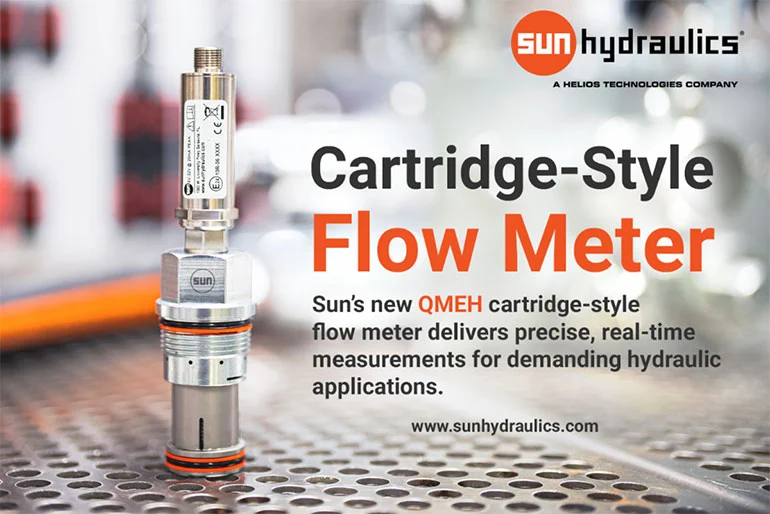
In the highly demanding world of fluid power, precision is not merely an aspiration; it is a fundamental requirement for system safety, efficiency, and longevity. Sun Hydraulics, a globally recognized leader in high-performance screw-in hydraulic cartridge valves and manifolds, has officially launched its groundbreaking QMEH cartridge-style flow meter. Designed to bridge the gap between expensive, high-end laboratory equipment and the robust, real-world requirements of mobile and industrial hydraulics, the QMEH represents a significant leap forward in sensor integration.
By combining state-of-the-art proprietary position sensing with a compact, cartridge-based architecture, Sun Hydraulics is positioning the QMEH to become a cornerstone component in the next generation of electro-hydraulic systems.
The Core Innovation: Engineering Precision at the Source
At its heart, the QMEH is a piston-style flow meter engineered for high-pressure environments. Unlike traditional flow meters that often require extensive plumbing or bulky external housings, the QMEH is designed to fit directly into Sun’s T-16A cavity. This allows engineers to integrate flow measurement directly into a manifold block, significantly reducing the external footprint and potential leak points in a system.
The Power of Proprietary Sensing
The standout feature of the QMEH is its custom-built, state-of-the-art position sensor. Driven by a need to avoid the performance limitations of off-the-shelf components, Sun’s electronic engineering team developed a proprietary design that utilizes a coiled flexible printed circuit board (PCB). This innovative approach allows for a highly compact sensor footprint while maintaining extreme accuracy.
The sensor technology is protected by patent and is built to withstand the "electrically noisy" environments typical of modern mobile equipment—such as excavators, telehandlers, and aerospace ground support systems. With E-mark EMC certification, the QMEH ensures that it neither interferes with nor is compromised by the electromagnetic fields generated by other vehicle systems.
A Chronology of Development: From Concept to Market
The journey of the QMEH from an internal engineering project to a market-ready product highlights Sun Hydraulics’ commitment to methodical, customer-driven development.
The Prototype Phase
Several years ago, the initial concept for a compact, integrated flow sensor was born out of persistent market feedback. Engineers recognized that many manufacturers were operating "blind" because existing flow meters were too expensive or too cumbersome to integrate into tight machine spaces. While initial prototypes were developed and distributed to select partners, the product was not fully commercialized at that time.
The Shift to Internal Innovation
Rather than relying on third-party sensors, which often lacked the specific ruggedization required for high-pressure hydraulic cycles, Sun’s internal teams pivoted to develop a proprietary, modular position sensor platform. This decision allowed the company to control every aspect of the sensor’s calibration, ensuring that the final output signal is both linear and factory-calibrated.
Soft Launch and Market Debut
The QMEH was soft-launched to the public at the CONEXPO/CON-AGG trade show in Las Vegas in March. The event served as a critical testing ground, allowing the company to demonstrate the device’s capabilities to industry professionals in the construction and heavy machinery sectors. Following the positive reception at CONEXPO, the formal launch took place in late May, signaling the device’s full integration into Sun’s Motion Control Technology portfolio.
Technical Specifications and Performance Metrics
The QMEH is engineered to provide more than just basic flow detection; it offers actionable data for sophisticated control loops.
- Operating Pressure: Supports up to 5,000 psi (350 bar) across all ports, ensuring reliability under extreme hydraulic loads.
- Calibration: The onboard electronics facilitate multi-point factory calibration, resulting in a consistent, linear output signal that simplifies integration into machine controllers.
- Sensitivity: The piston-style design excels at low-flow conditions. Unlike other sensors that might struggle to distinguish between "no flow" and "minimal leakage," the QMEH provides a clear, closed-position indication, making it ideal for detecting internal bypass or incipient component failure.
- Integration: Designed for the T-16A cavity, the unit is easily retrofitted or incorporated into new manifold designs.
Economic and Practical Implications
As noted by Cory Fisher, Director of Strategic Sales at Sun, the market has long been stifled by the high cost of precision flow measurement. By pricing the QMEH at $525, Sun is democratizing access to high-fidelity data. This price point changes the calculus for machine designers, allowing them to include flow monitoring in systems where it was previously deemed too expensive.

Official Perspectives: Bridging the Gap in System Diagnostics
In an exclusive discussion during the launch, Cory Fisher emphasized that the QMEH is designed for versatility. "This is a flow meter that can be used in any type of application: system flow, individual function, diagnostics/troubleshooting, or even closed-loop control when paired with an XMD," Fisher stated.
Addressing the Need for Diagnostic Insight
One of the most critical applications for the QMEH is in preventive maintenance. By installing the device on a case drain, operators can monitor for subtle increases in flow, which are often the first sign of internal wear or impending pump failure. In the past, such diagnostics might have required specialized equipment; now, the machine can report its own degradation in real-time.
The Move Toward Closed-Loop Control
Fisher highlighted that the sensor’s ability to convert electrical signals into precise, proportional flow rates makes it an ideal candidate for closed-loop control. When paired with Sun’s XMD driver, the QMEH enables a system to self-adjust, maintaining target flow rates regardless of changes in temperature, load, or fluid viscosity. This level of autonomy is becoming increasingly necessary as the industry moves toward electrified hydraulic systems, where efficiency and energy management are paramount.
Implications for the Fluid Power Industry
The release of the QMEH is indicative of a broader trend within the hydraulics sector: the transition from "dumb" mechanical systems to "smart," sensor-integrated platforms.
The Rise of Electrified Hydraulics
As heavy equipment manufacturers move toward electrification, the demand for precision control increases. Electrified actuators require reliable feedback to maintain performance parity with traditional diesel-hydraulic counterparts. The QMEH’s ability to function accurately in noisy electrical environments makes it a vital tool for engineers tasked with balancing the efficiency of electric motors with the power density of hydraulic systems.
Standardization and Modular Design
By utilizing a modular sensor platform, Sun Hydraulics is signaling its intention to standardize its electronic components across its entire catalog. If the position sensor technology behind the QMEH proves successful in the field, it is highly likely that we will see similar sensing capabilities integrated into other Sun products, such as pressure relief valves or directional control valves. This would create a unified ecosystem of "smart" hydraulic components that communicate seamlessly with a centralized machine controller.
Regulatory and Safety Compliance
The inclusion of CE certification and E-mark EMC compliance ensures that the QMEH is not just a high-performance tool, but a globally compliant one. For manufacturers shipping equipment to European markets, these certifications reduce the burden of testing and documentation, allowing for faster time-to-market.
Conclusion: A New Standard for Flow Monitoring
Sun Hydraulics’ QMEH cartridge-style flow meter is a testament to the power of integrating electronics directly into the hydraulic circuit. By overcoming the barriers of cost, footprint, and environmental interference, Sun has provided the industry with a tool that addresses both the diagnostic needs of today and the control requirements of tomorrow.
Whether it is being used to prevent the catastrophic failure of a case drain, optimize the precision of an excavator’s boom movement, or provide the data necessary for advanced closed-loop control, the QMEH offers a level of insight that was previously unattainable at this price point. As the industry continues to push toward higher levels of automation and energy efficiency, components like the QMEH will undoubtedly play a pivotal role in shaping the future of fluid power.
For those in the aerospace, construction, and industrial automation sectors, the message is clear: the era of blind hydraulic operation is ending. Precision, reliability, and cost-effective data are now available in a package as simple as a cartridge valve.