



The Quantum Leap in Microscopy: How Austria’s Researchers Are Rewriting the Rules of Imaging

For decades, the electron microscope has served as the ultimate window into the sub-atomic world. By utilizing beams of electrons—which possess much shorter wavelengths than visible light—scientists have been able to resolve the architecture of viruses, the lattice of semiconductors, and the intricate machinery of individual proteins. Yet, despite these triumphs, the technology has long been constrained by a fundamental dilemma: the "dose problem." To achieve high-resolution imagery, one must bombard a sample with a vast number of electrons. For biological materials, which are often delicate, this bombardment is essentially destructive.
Now, a pioneering collaboration of researchers from TU Wien, the University of Vienna, JKU Linz, and the University of Innsbruck is poised to solve this impasse. By integrating the mechanics of electron microscopy with the logic of quantum computing, they are creating a new breed of microscope—one that doesn’t just count electrons, but extracts the rich, often-ignored quantum information hidden within them.
The Limits of Classical Vision
To understand the magnitude of this innovation, one must first understand the limitations of the modern electron microscope. In a conventional system, the process is binary: an electron is fired at a specimen, it interacts with the sample, and its arrival is recorded. The resulting image is essentially a statistical map of these arrivals.
"Today, we can image tiny details on the atomic scale," explains Philipp Haslinger from the Institute of Atomic and Subatomic Physics at TU Wien. "However, this requires a large number of electrons. And not every sample can be exposed to so many electrons without being damaged. This is often a problem, particularly when imaging biological samples such as individual proteins."
In essence, current microscopes are "information inefficient." They discard the delicate quantum states of the electrons that have successfully interacted with a sample, viewing them merely as data points for intensity. The research team argues that if we could preserve and process these quantum states, we could derive the same high-resolution data from a fraction of the electron dose.
A Chronology of the Quantum Integration Project
The journey toward this breakthrough began with a fundamental theoretical question: Can the untapped quantum information carried by an electron be "harvested" during the imaging process?
- The Theoretical Foundation (2022-2023): Researchers at TU Wien and JKU Linz began drafting the mathematical framework for linking electron beams to trapped-ion quantum systems. The core challenge was designing a mechanism where an electron could deposit its quantum state into a stable, long-lived quantum memory without disrupting the imaging process.
- Collaborative Synthesis (2023): The project solidified under the umbrella of the quantA Cluster of Excellence. This consortium brought together experts in quantum information, high-energy physics, and advanced microscopy.
- Algorithmic Development: Johannes Kofler’s team at JKU Linz developed the sophisticated algorithms required to "read" the entangled states of the ions, effectively turning what was once random noise into a structured, coherent signal.
- The Construction Phase (2024-Present): Currently, the team is at the University Service Center for Transmission Electron Microscopy (USTEM) at TU Wien, integrating an ion-based quantum computer—developed by Philipp Schindler’s team at the University of Innsbruck—directly into the infrastructure of a transmission electron microscope.
The Mechanism: Entanglement as a Bridge
The genius of the proposed system lies in "quantum entanglement." In the classical world, information is localized. In the quantum world, particles can become inextricably linked, sharing a state regardless of distance.
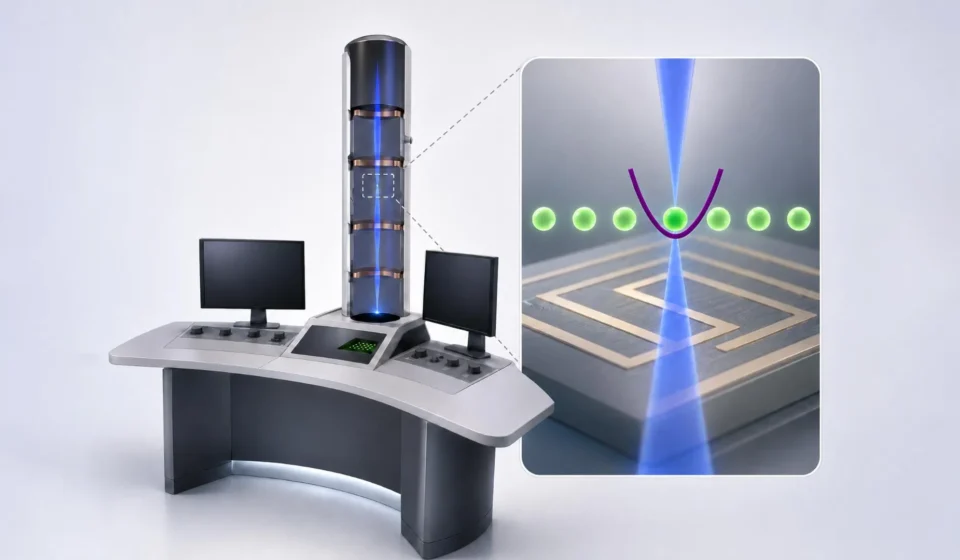
The team’s approach is to place ions, held in a trap along the path of the electron beam, to act as a bridge. As an electron passes through the microscope and interacts with the sample, it becomes entangled with the ion in the quantum computer.
"Our idea is to combine the electrons with a quantum computer. We let them interact with ions that are held in place along the path of the electron beam," explains Elias Pescoller, the project’s lead author and a doctoral student at the Institute for Theoretical Physics at TU Wien. "The electron and the ion then share a joint quantum state."
This process is not a one-off event. By performing sequential quantum operations, the system can "stack" the information from multiple electrons. Instead of each electron acting as an independent, isolated packet of information, they function as a collective, with the quantum computer acting as a repository that aggregates the data.
Dennis Rätzel, also of the Institute of Atomic and Subatomic Physics, elaborates: "If we perform very specific quantum-computing operations each time, we can optimally combine the information from several electrons so that we obtain a signal of maximum strength even though we use only a relatively small number of electrons."
Turning Noise into Data
One of the most profound implications of this technology is the ability to distinguish signal from background noise. In conventional microscopy, weak signals from delicate samples are often lost in the statistical noise inherent in electron counting.
"What would previously have been indistinguishable from random noise can thus become a clear signal," says Iva Březinová of the Institute for Theoretical Physics at TU Wien. "Quantum physics allows us to overcome the statistical limits that constrain conventional electron microscopes."
By utilizing the quantum computer as a processor, the researchers aren’t just increasing the sensitivity of the detector; they are effectively "cleaning" the signal through quantum logic. This means that features of a protein or a delicate synthetic material that were previously blurred or invisible can now be resolved with high fidelity.
Official Perspectives: A Synergy of Disciplines
The project’s success is largely attributed to the interdisciplinary nature of the quantA Cluster of Excellence. By pulling together experts from multiple Austrian universities, the consortium has created a bridge between two fields that rarely overlap.
"It is really exciting that, within the quantA Cluster of Excellence, we can combine the expertise in quantum information, quantum computing and electron microscopy available at the different universities in Austria," says Thomas Juffmann of the University of Vienna. "This allows us to launch a unique project."
The project has received significant backing from the Austrian Science Fund (FWF) and the Gordon and Betty Moore Foundation, reflecting the global scientific community’s interest in the potential of "quantum-enhanced" imaging.
The Broader Implications for Science
If the experimental phase at USTEM confirms the mathematical models, the implications for science will be transformative:
- Biological Imaging: The ability to image fragile biological molecules in their near-native states—without the "radiation burn" caused by high-dose electron beams—could lead to breakthroughs in structural biology and drug discovery.
- Materials Science: For nanotechnology, the ability to image atomic defects without causing secondary damage to the crystal structure could lead to more durable materials and more efficient semiconductors.
- Fundamental Physics: The integration of quantum computers into imaging systems provides a new laboratory for testing the laws of quantum mechanics on a macroscopic scale, bridging the gap between theoretical quantum information and physical imaging.
As the team prepares to switch on the integrated system, the scientific world is watching closely. The project represents a fundamental shift in how we perceive the act of "looking." We are moving from a passive era of observation, where we simply record the traces of particles, to an active era of quantum engagement, where we interrogate particles to reveal the hidden truths of the nanoworld.
The marriage of the electron microscope and the quantum computer may be the most significant development in imaging since the invention of the electron microscope itself. It promises to reveal not just what is there, but to do so with a precision and a gentleness that were previously deemed impossible by the laws of classical statistics. In the quest to understand the building blocks of life and matter, we are finally learning how to ask the right questions—at the quantum level.