



Bridging the Gap: How Artificial Intelligence is Moving from the Sandbox to the Packaging Plant Floor

By Rachael Pasini
Editor-in-Chief, Design World
Main Facts
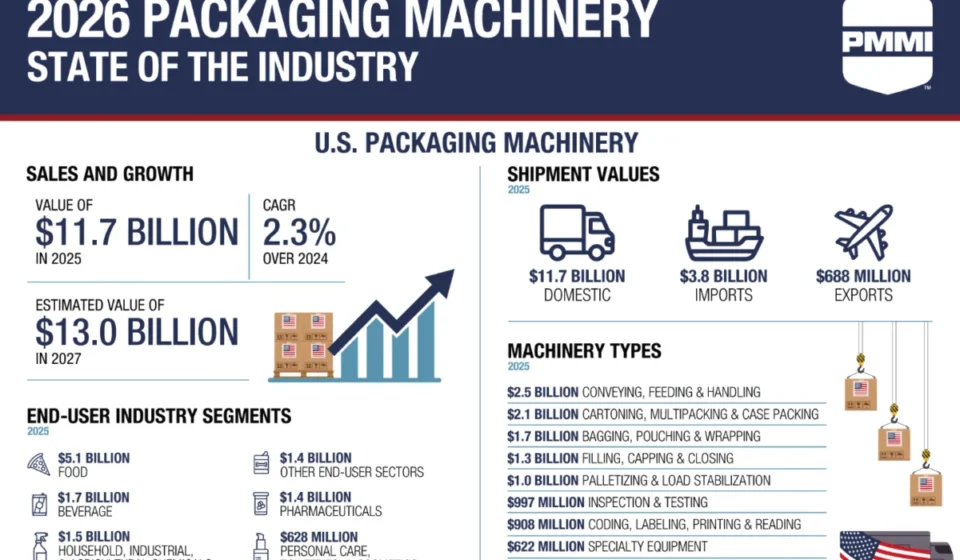
Artificial intelligence (AI) is no longer confined to theoretical whitepapers, proof-of-concept sandboxes, or isolated corporate pilot projects within the packaging sector. According to two landmark reports released by PMMI (The Association for Packaging and Processing Technologies)—specifically the 2026 Building an AI Advantage in Packaging Equipment report and the 2026 Packaging State of the Industry Report—Original Equipment Manufacturers (OEMs) and Consumer Packaged Goods (CPG) companies are actively transitioning AI systems directly onto active plant floors.
This rapid operational shift is underpinned by four primary catalysts identified by industry analysts:
- Cost and Accessibility: AI tools have become markedly more affordable and architecturally accessible, allowing manufacturing facilities of all sizes to integrate them into legacy systems.
- Heightened Awareness: Industry stakeholders have pushed past the initial exploratory phases, moving concrete applications into full-scale production cycles.
- Evolving Confidence: Plant managers and frontline operators exhibit growing trust in AI-driven outputs and automated decision-making.
- Frontline Adoption: Floor operators increasingly recognize the tangible, daily benefits of these systems in reducing physical fatigue and minimizing errors.
Presently, the industry’s most widespread AI deployments center around five distinct pillars: knowledge transfer, machine vision, predictive maintenance, regulatory compliance, and data transparency. While current implementations primarily focus on localized optimization—such as detecting bottle defects or predicting motor failures—industry experts forecast a radical paradigm shift. Within the next five years, AI is expected to graduate into coordinated, plant-wide ecosystems capable of autonomously balancing production throughput, product quality, cost efficiency, and energy consumption across entire manufacturing lines.
Despite this momentum, significant friction remains. Deployment challenges such as data hallucinations, cybersecurity vulnerabilities, legacy infrastructure constraints, unclear return on investment (ROI), and organizational resistance continue to temper the speed of total automation. To counter these hurdles, PMMI’s strategic blueprint outlines a strict five-step execution framework: defining the exact business challenge, engaging domain experts, auditing system readiness, managing internal change, and fostering cross-departmental collaboration.
Chronology: The Evolution of AI in Packaging
To understand how rapidly artificial intelligence has taken root in industrial packaging, it is necessary to examine the timeline of its adoption over recent years:
- 2024 (The Exploratory Phase): PMMI publishes its foundational baseline study on AI in packaging equipment. At this stage, the technology is largely experimental. CPGs and OEMs treat AI as a futuristic luxury, with most initiatives restricted to localized R&D laboratories or tentative, single-machine pilot programs. Data infrastructure is siloed, and frontline resistance is high due to fears of job displacement and operational complexity.
- 2025 (The Prototyping & Validation Phase): As machine learning models become leaner and open-source industrial frameworks mature, software costs decline. Early adopters begin translating proof-of-concepts into structured plant trials. Machine vision systems evolve from simple rule-based optical sensors to deep-learning-driven defect detectors capable of handling erratic packaging geometries. Concurrently, predictive maintenance algorithms begin proving their worth by averting catastrophic unplanned downtime.
- Early 2026 (The Mainstream Inflection Point): PMMI updates its comprehensive research, releasing the 2026 Building an AI Advantage in Packaging Equipment report. The narrative shifts definitively from "if" to "how." Driven by pressing labor shortages and tightening environmental regulations, AI transitions rapidly onto the plant floor. Smaller firms begin leveraging Software-as-a-Service (SaaS) operational models to bypass internal resource constraints, while OEMs start embedding native AI capabilities directly into standard machine architectures.
- October 2026 (The Showcase at Pack Expo International): The industry gathers in Chicago for Pack Expo International 2026. Rather than conceptual mock-ups, the show floor features fully operational, AI-enabled packaging lines, intelligent robotics, and predictive plant optimization suites. The event cements AI as a foundational pillar of modern manufacturing competitiveness, bridging the gap between legacy machinery and Industry 4.0 automation.
Supporting Data and Market Dynamics
The integration of artificial intelligence into packaging machinery does not occur in a vacuum. It is heavily accelerated by converging macroeconomic pressures, labor market realities, and structural shifts identified across PMMI’s 2026 research portfolio.

The Macroeconomic Drivers
Packaging machinery markets across North America are increasingly defined by three overarching pressures: workforce constraints, strict sustainability regulations, and volatile input costs.
As veteran engineering and operations staff reach retirement age, packaging plants face a massive "brain drain." Crucial institutional knowledge—such as knowing the precise quirks of a legacy form-fill-seal machine or troubleshooting a recurring thermal sealing error—threatens to walk out the door. AI applications are stepping in to capture, digitize, and operationalize this tribal knowledge. Natural language processing tools and generative diagnostic assistants allow remaining staff to query historical maintenance logs, access automated troubleshooting protocols, and generate technical specifications derived from past project parameters.
+-----------------------------------------------------------------+
|              Core Drivers of Packaging AI Adoption              |
+--------------------------+--------------------------------------+
| Workforce Constraints    | Capturing retiring institutional     |
|                          | knowledge & real-time troubleshooting|
+--------------------------+--------------------------------------+
| Sustainability Mandates  | Optimizing material usage, reducing  |
|                          | waste, and tracking energy metrics   |
+--------------------------+--------------------------------------+
| Rising Input Costs       | Maximizing throughput and minimizing |
|                          | unplanned downtime via predictive AI |
+--------------------------+--------------------------------------+
Addressing Execution Hurdles
Despite the clear incentives, PMMI’s research highlights persistent anxieties among manufacturing leadership. The primary concerns cited by CPGs and OEMs include:
- Data Hallucinations and Accountability: When an AI model generates an incorrect operational parameter or misinterprets a regulatory compliance metric, determining ultimate legal and operational accountability remains a grey area.
- Cybersecurity Vulnerabilities: Opening legacy machinery to connected, data-sharing AI architectures dramatically expands the digital attack surface of a manufacturing facility.
- Legacy Data Infrastructure: Many plants still operate on disparate, decades-old control architectures that struggle to feed clean, real-time data streams into modern machine learning algorithms.
- Latency and ROI: Real-time packaging applications require instantaneous response times (low latency). Delays can cause massive material jams at high speeds, making clear calculation of upfront ROI difficult for budget-conscious executives.
To navigate these risks, smaller and mid-sized packaging firms are increasingly turning to Software-as-a-Service (SaaS) delivery models. By outsourcing the underlying AI infrastructure and maintenance to specialized vendors, these firms effectively shift technical risk and cybersecurity burdens off their internal IT teams and onto the technology providers.
Official Responses and Strategic Frameworks
Industry associations and technical experts emphasize that successful AI adoption requires a structured, methodical approach rather than a haphazard software rollout. PMMI has formally outlined a five-step strategic path designed to guide packaging professionals from initial ideation to fully realized plant-floor integration:
- Identify the Business Challenge: Avoid implementing AI simply for the sake of technological novelty. Pinpoint a specific operational bottleneck—such as excessive changeover times, recurring material waste, or unpredicted mechanical failures—where data-driven automation can provide measurable relief.
- Consult Experts: Leverage the insights of OEMs, system integrators, and software vendors who understand both the theoretical capabilities of AI and the physical constraints of industrial packaging machinery.
- Assess System Readiness: Audit current data infrastructure, sensor arrays, and legacy hardware. Ensure that the facility can capture, clean, and transmit the requisite data streams safely and reliably before deploying advanced algorithms.
- Manage Organizational Change: Cultivate internal buy-in by actively involving frontline workers in the deployment process. Address job-security worries transparently by positioning AI as a capability-extending tool rather than a replacement for human expertise.
- Build Cross-Functional Collaboration: Break down traditional corporate silos. Successful AI integration requires continuous dialogue between IT departments, plant floor engineers, maintenance crews, and executive leadership.
Expert Outlook on Plant-Wide Integration
Reflecting on the trajectory of these technologies, industry observers note that the role of AI is fundamentally complementary. Rather than stripping human operators of their agency, modern machine learning tools act as force multipliers. They shoulder the cognitive load of data analysis, equipment tuning, and compliance reporting, freeing skilled technicians to focus on higher-level process optimization and strategic innovation.
One prominent automation expert predicts that within the next five years, the industry will cross a major operational threshold:

"We are currently in an era of localized optimization—using AI to fix a specific vision inspection flaw or predict a single motor failure. Within five years, that isolation will vanish. We will see coordinated, plant-wide autonomous ecosystems where machine learning models dynamically balance throughput, product quality, material costs, and energy consumption across the entire multi-machine production line in real time."
Implications for the Future of Packaging
The rapid evolution of artificial intelligence within packaging machinery carries profound implications for the global manufacturing supply chain. As these technologies mature, several long-term transformations are coming into focus:
- Redefining Equipment Selection: When CPG companies evaluate new packaging lines, AI capability and data-readiness are rapidly becoming decisive purchasing criteria. OEMs that fail to embed native machine learning, predictive maintenance telemetry, and seamless integration interfaces risk losing market share to forward-thinking competitors.
- Empowering the Stretched Workforce: Rather than catalyzing widespread mass layoffs, AI is proving to be a vital salve for manufacturing labor deficits. By automating tedious diagnostic routines and capturing the wisdom of retiring veterans, intelligent systems enable a smaller, less specialized workforce to manage increasingly complex packaging lines safely and efficiently.
- Unlocking True Sustainability: Packaging sustainability extends beyond recyclable materials; it includes eliminating operational waste. AI models excel at optimizing material cuts, minimizing thermal sealing energy, and preventing spoiled production batches before they occur. Consequently, AI integration directly supports corporate environmental, social, and governance (ESG) targets.
What to Expect at Pack Expo International 2026
For professionals eager to witness these theoretical frameworks translated into cold, hard steel and silicon, Pack Expo International 2026, taking place in Chicago this October, will serve as the ultimate proving ground. The exhibition floor will feature live demonstrations of AI-enabled packaging equipment, advanced robotics, adaptive machine vision, and predictive maintenance dashboards operating at industrial scale.
As the packaging industry steps boldly past the pilot phase and onto the bustling plant floor, the message from associations like PMMI is clear: embracing AI is no longer an optional differentiator for elite enterprises—it is the foundational prerequisite for modern industrial survival.
Be sure to follow Design World for ongoing, live coverage from the show floor at Pack Expo International 2026, and stop by to say hello to our editorial team.