
Robotics Investment Surge: A $4.9 Billion August Defines a New Era of Automation

In a staggering demonstration of investor confidence and rapid technological maturation, the global robotics sector closed August 2026 with a massive $4.87 billion in disclosed capital. According to comprehensive data tracked by The Robot Report, this figure represents the culmination of 162 distinct financial transactions, signaling a robust appetite for automation, artificial intelligence, and physical robotics across global markets.
While the $4.87 billion figure is significant, analysts suggest it acts merely as a floor for the actual capital infusion, as many private equity deals and venture debt arrangements remain undisclosed. This surge underscores a fundamental shift in the global economy: the transition from experimental robotics to large-scale industrial, commercial, and consumer deployment.
The Geography of Innovation: A Tale of Two Superpowers
The geographic distribution of capital in August 2026 revealed a striking concentration of wealth and development in East Asia and North America. China solidified its position as the world’s leading hub for robotics manufacturing and innovation, accounting for approximately $2.44 billion—roughly 50% of the month’s total disclosed funding.
The United States followed, securing $1.27 billion in capital. This bipolar investment environment suggests that while the U.S. continues to lead in software-driven AI and specialized robotics, China is aggressively scaling the hardware-heavy side of the industry, particularly in the humanoid and industrial sectors.
Chronology: The Month of Mega-Deals
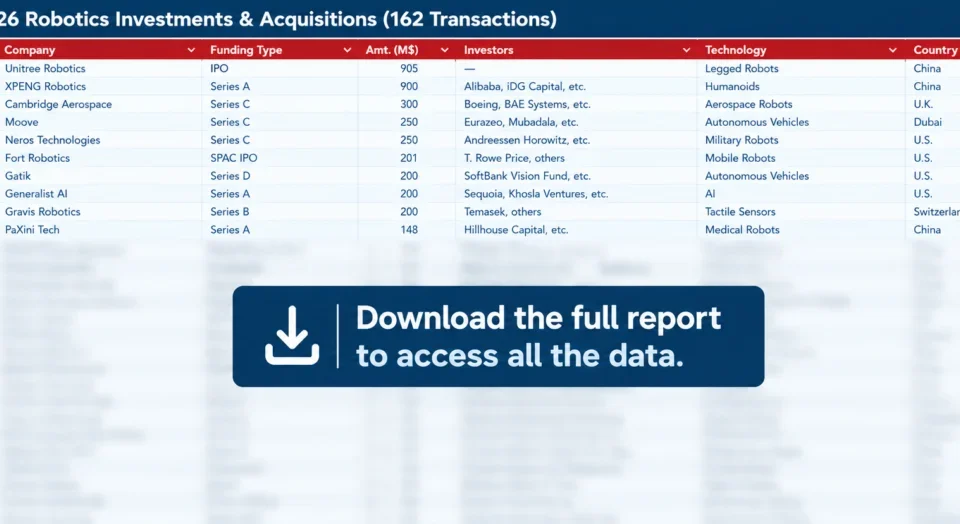
August 2026 was defined by a series of high-stakes financial maneuvers that set the tone for the remainder of the year. The concentration of capital was immense; the five largest transactions alone contributed over $3.3 billion to the monthly total.
The Rise of Humanoids
The month’s most notable trend was the continued investor obsession with humanoids. Companies in this space secured $943.8 million, accounting for nearly 20% of the month’s total funding. This trend is not merely speculative; it represents the long-term industry bet that general-purpose robots will eventually bridge the labor gap in manufacturing, logistics, and domestic services.
Key Transactions
- Unitree Robotics: The month was anchored by a landmark $905 million Initial Public Offering (IPO). As a leader in legged locomotion and AI-driven robotics, Unitree’s successful public offering marks a maturation point for the industry, moving companies from venture-backed startups to publicly traded titans.
- XPENG Robotics: Following closely behind, XPENG secured $900 million in a massive Series A round. This capital infusion for a singular company highlights the intense competition to develop humanoids that are not just prototypes, but are ready for mass-market production and integration into the automotive assembly ecosystem.
Together, these two transactions alone funneled $1.8 billion into the Chinese robotics sector, proving that institutional investors are willing to place "mega-bets" on companies capable of executing large-scale production.
Supporting Data: Dissecting the 162 Transactions
To understand the health of the robotics ecosystem, one must look beyond the headline-grabbing mega-deals. The 162 transactions tracked in August provide a granular view of an industry undergoing a structural evolution.
- Diversification of Assets: While humanoids grabbed the spotlight, investments continued to flow into established sectors such as Autonomous Mobile Robots (AMRs), collaborative robots (cobots), and specialized agricultural automation.
- The Venture Capital Climate: The high volume of transactions—162 in a single month—indicates that while mega-rounds dominate the total dollar amount, there is a healthy "mid-market" of seed and series-stage companies. This diversity is essential for the long-term resilience of the robotics sector, ensuring a pipeline of innovation that supports the industry’s future.
- The "Dark" Capital Factor: Industry insiders estimate that for every dollar disclosed, there is likely another 30 to 40 cents in private, undisclosed funding. If this holds true, the true economic impact of August 2026 likely eclipsed $6 billion.
Official Responses and Industry Perspectives
Market analysts and venture capitalists are viewing the August data as a clear indicator of a "second wave" of automation.
"We are moving past the era of the ‘gimmick robot,’" said one senior analyst at a prominent venture firm. "The capital being deployed now is aimed at tangible ROI—labor substitution, safety improvements, and supply chain resiliency. The IPOs and massive Series A rounds we saw in August are the result of years of R&D finally meeting a market that is ready to adopt at scale."
However, not all feedback is uniformly optimistic. Critics have pointed to the high valuation of humanoid companies, warning that the "hype cycle" might be outstripping the actual deployment capabilities of these machines. Despite these concerns, the sheer volume of capital indicates that the "smart money" is betting heavily on the eventual success of the humanoid form factor.
Implications: The Road Ahead for Global Robotics
The events of August 2026 hold significant implications for the global labor market, manufacturing infrastructure, and geopolitical competition.
1. The Labor Transformation
The massive influx of capital into robotics is effectively a massive bet against the long-term scarcity of human labor. As birth rates decline and the global workforce ages, companies like Unitree and XPENG are positioning themselves to provide the "workforce" of the 2030s. This transition will require significant policy shifts regarding workforce retraining and the legal status of AI-driven workers.
2. Supply Chain Sovereignty
The fact that China and the U.S. dominated the investment landscape is no coincidence. Robotics is increasingly viewed as a pillar of national security. Control over the "robotic stack"—from sensors and actuators to AI brains—is becoming as critical as control over energy or semiconductor supply chains. Nations that fail to secure investment in these sectors risk becoming dependent on the robotics output of their rivals.
3. The Shift to Public Markets
The Unitree IPO is a bellwether for the industry. Expect to see more robotics companies move from the private venture market to public exchanges. This shift will demand higher standards of transparency and performance. As these companies become public entities, their ability to hit production targets will be scrutinized by shareholders, potentially cooling the speculative environment but ultimately leading to a more disciplined and professionalized industry.
4. Integration of Artificial Intelligence
While the funding reports focus on "robotics," the real driver is the convergence with Generative AI. The ability for robots to "reason" through unstructured tasks—a capability that has advanced significantly over the past 18 months—is what has unlocked this recent wave of capital. Investors are no longer funding hardware; they are funding "Embodied Intelligence."
Conclusion: A New Baseline
August 2026 will likely be remembered as a turning point in the timeline of industrial automation. With $4.87 billion in disclosed capital, the robotics sector has graduated from a niche interest for tech enthusiasts to a cornerstone of the global industrial economy.
As the industry moves into the final quarter of the year, the focus will shift from fundraising to execution. The companies that successfully convert these billions of dollars into reliable, profitable, and autonomous systems will define the technological landscape for the next decade. For those watching the sector, the data from August confirms a singular truth: the robot revolution is no longer coming—it is here, and it is being built with unprecedented scale and urgency.
For those seeking deeper analysis, including full breakdowns by technology sector, geographical region, and investment stage, the complete August 2026 Robotics Investments Report provides a comprehensive dataset of all 162 recorded transactions. Access to this intelligence remains a vital resource for stakeholders looking to navigate the rapidly shifting landscape of modern automation.