





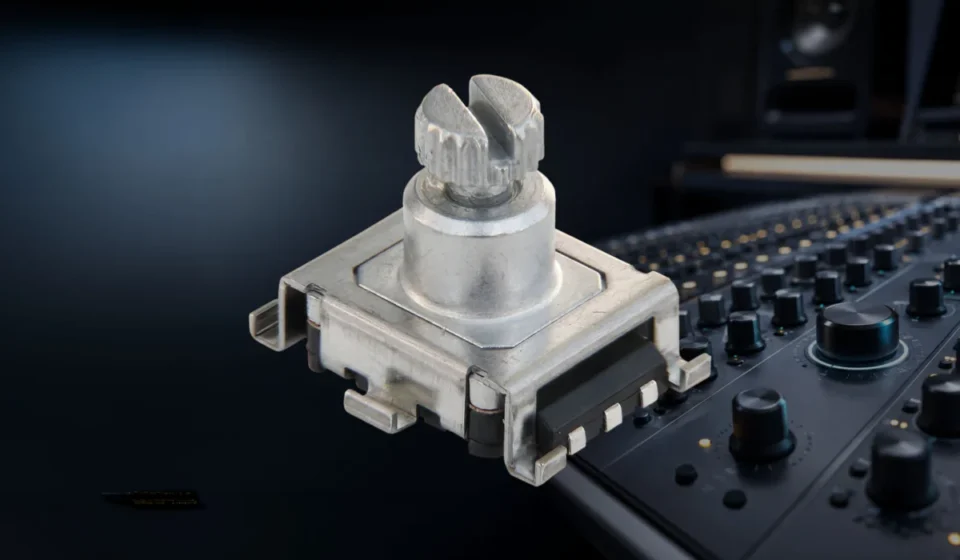
Bourns Expands PEC11S Series: High-Performance 12 mm Incremental Encoders Introduce New Shaft and Switch Options for Compact Interfaces

By Design & Engineering News Desk
Expanded coverage based on recent industry announcements regarding Bourns, Inc.’s component architecture updates.
Introduction: The Evolution of Compact Control Interfaces
As electronic devices across all sectors—from consumer gadgets to heavy industrial machinery—continue to shrink in physical footprint while growing exponentially in functional complexity, design engineers face mounting pressure. Fitting comprehensive control mechanisms into tight spaces without sacrificing user experience, durability, or reliability is a perpetual engineering tightrope walk.
Addressing this critical market demand, Bourns, Inc., a globally recognized leader in electronic component design and manufacturing, has announced a significant expansion of its popular Bourns® PEC11S series 12 mm surface-mount incremental encoders. The latest iteration of the PEC11S series introduces heavily requested customization options, including new shaft lengths and integrated Single-Pole, Single-Throw (SPST) momentary switch functionalities.
Engineered explicitly for space-constrained control interfaces, these mechanical enhancements aim to simplify front-panel layouts, minimize the need for costly and time-consuming redesign cycles, and consolidate dual-input functions—rotary navigation and push-to-select—into a single, robust component. This comprehensive overview examines the technical specifications, chronological development, performance data, industry implications, and official responses surrounding the rollout of the updated PEC11S encoder series.
Main Facts: Core Specifications of the Expanded PEC11S Series
The Bourns® PEC11S series has long been a staple for engineers requiring reliable rotational input in compact form factors. The newly expanded lineup preserves the core electrical and mechanical DNA of its predecessors while introducing vital physical configurations.
Key Technical Parameters
- Component Type: Contacting incremental encoder with optional integrated SPST momentary push-switch.
- Footprint / Size: 12 mm surface-mount device (SMD), optimized for high-density printed circuit board (PCB) layouts.
- Output Signal: 2-bit quadrature output, facilitating accurate direction and speed sensing.
- Operating Speed: Up to 60 revolutions per minute (rpm), accommodating rapid user input.
- Electrical Resistance: 3 kΩ maximum closed-circuit resistance, ensuring stable signal transmission.
- Operating Temperature Range: -40 °C to +70 °C, making it suitable for rigorous indoor and outdoor environments.
- Durability / Lifespan Ratings:
- Minimum 15,000 rotational cycles.
- Minimum 20,000 switch cycles.
- Mechanical Customizations: Newly added variable shaft lengths and flexible SPST push-button configurations designed to match diverse industrial aesthetic and ergonomic requirements.
By merging precision rotational feedback with an integrated tactile switch, the PEC11S series eliminates the historical requirement of allocating separate board real estate for navigation knobs and push-buttons.
Chronology: The Pathway to the PEC11S Expansion
The development and subsequent market rollout of the expanded PEC11S series did not happen in a vacuum; it represents a calculated response to evolving trends in Human-Machine Interface (HMI) design over the past several years.
Phase 1: The Rise of Surface-Mount Incremental Encoders
Historically, rotary encoders relied heavily on through-hole mounting techniques, which consumed valuable space on both sides of a PCB and complicated automated surface-mount assembly (SMT) lines. As consumer electronics, test and measurement equipment, and audio-visual gear shifted entirely toward SMT manufacturing, Bourns introduced the original PEC11S 12 mm platform to bridge the gap between durable electromechanical feedback and modern pick-and-place manufacturing workflows.
Phase 2: Identifying Engineering Bottlenecks (2023–2025)
Through continuous feedback loops with global OEM clients, Bourns’ engineering and product management teams identified recurring design bottlenecks. While the original PEC11S footprint was widely praised, design engineers frequently requested greater mechanical flexibility. Specifically, custom front-panel designs often demanded non-standard shaft lengths to accommodate varying bezel depths, cabinet thicknesses, and custom knob styles. Furthermore, integrating a reliable tactile switch alongside the rotary mechanism often required pairing separate components, increasing bill-of-materials (BOM) costs and assembly complexity.
Phase 3: Prototyping and Thermal/Mechanical Validation (Early 2026)
Bourns initiated an internal R&D push to overhaul the mechanical extension options of the PEC11S architecture. Prototypes underwent rigorous mechanical endurance testing to ensure that extending the shaft lengths would not compromise rotational stability, side-load resistance, or sealing integrity. Simultaneously, the internal momentary switch mechanism was refined to guarantee crisp tactile feedback while maintaining the strict -40 °C to +70 °C operational threshold.

Phase 4: Official Market Launch and Global Distribution (September 2026)
Bourns formally announced the expanded PEC11S series, releasing comprehensive technical documentation, 3D CAD models, and application notes to the engineering community. Global electronic component distributors immediately integrated the expanded part numbers into their catalogs, making samples and production volumes accessible to designers worldwide.
Supporting Data: Performance Metrics and Operational Limits
To truly appreciate the value proposition of the expanded PEC11S 12 mm encoders, a deeper dive into their underlying mechanical and electrical performance data is necessary. In electromechanical components, durability is often the primary metric of success. Bourns has balanced a compact physical profile with impressive longevity metrics.
Table 1: Summary of PEC11S Electrical and Mechanical Characteristics
| Parameter | Specification |
|---|---|
| Package Size | 12 mm square profile (Surface Mount) |
| Output Type | 2-bit Quadrature (Channel A and B) |
| Max Operating Speed | 60 RPM |
| Closed-Circuit Resistance | ≤ 3 kΩ |
| Insulation Resistance | 100 MΩ min. @ 250 VDC |
| Dielectric Strength | 50 VAC minimum for 1 minute |
| Rotational Life | 15,000 cycles minimum |
| Switch Life | 20,000 cycles minimum |
| Operating Temperature | -40 °C to +70 °C |
| Storage Temperature | -40 °C to +70 °C |
Analyzing the Quadrature Output and Switch Integration
The 2-bit quadrature output generated by the PEC11S provides a phase difference between two square waves (Channel A and Channel B). This phase shift allows microcontrollers and dedicated encoder decoder ICs to instantaneously determine not only how far the shaft has been rotated, but also in which direction (clockwise or counter-clockwise). This makes the encoder ideal for menu navigation, volume control, parameter scaling, and digital tuning.
Adding the SPST momentary switch means that pressing downward on the encoder shaft closes an independent electrical circuit. In user interface design, this "click-to-select" functionality is indispensable. By combining both inputs into a single coaxial assembly, designers preserve vertical and horizontal PCB space, reducing the overall footprint of the control cluster.
Furthermore, the specified operating temperature range of -40 °C to +70 °C ensures that the encoder can perform reliably in unheated industrial warehouses, outdoor communication hubs, automotive cabins, and commercial kitchen appliances without grease hardening or material warping.
Official Responses and Industry Insights
Industry analysts and engineering leaders have responded positively to the availability of the expanded PEC11S options, noting that component-level flexibility is more critical now than ever before.
Engineering Perspectives on Panel Layout Simplification
In technical briefings released alongside the product announcement, Bourns engineering representatives emphasized that the primary motivation behind the expansion was reducing design friction.
"Modern electronic systems demand dense packaging without sacrificing the tactile quality that end-users expect," noted product development leads at Bourns. "By expanding our shaft options and standardizing robust SPST switch integrations within the proven PEC11S footprint, we are empowering engineers to bring sophisticated, multi-functional control interfaces to market faster and with fewer custom tooling expenses."
Market Analyst Commentary
Independent sensors and automation analysts have pointed out that while software-driven touchscreens have dominated user interface design over the past decade, physical rotary controls are making a significant resurgence. Users across industrial, automotive, and high-end audio sectors increasingly prefer tactile knobs and buttons for operations requiring blind or precise adjustments, where looking away from a primary task to touch a flat screen is impractical or unsafe.
The Bourns PEC11S series sits directly at the intersection of this trend, providing a cost-effective, electromechanical bridge between traditional tactile feedback and modern digital micro-controller architectures.

Implications: Sector-Specific Applications and Engineering Impact
The introduction of these expanded shaft and switch options within the 12 mm PEC11S framework carries profound implications across multiple vertical markets. Below, we examine how different industries stand to benefit from these advancements.
1. Industrial Automation and Process Control
In industrial settings, control panels must withstand vibration, dust, and continuous human interaction. The robust construction of the PEC11S, paired with its wide thermal operating range, makes it an ideal candidate for programmable logic controller (PLC) front panels, variable frequency drive (VFD) programmers, and test instrumentation.
- The Engineering Benefit: The expanded shaft lengths allow engineers to mount the encoder deeper behind thick aluminum or Lexan bezels while still allowing standard, ergonomic knobs to be attached securely on the exterior. The integrated switch reduces the total number of panel cutouts required, improving enclosure sealing integrity against dust and moisture.
2. Consumer Electronics and Smart Home Appliances
From high-end audio mixing boards and digital synthesizers to smart home climate control hubs and kitchen appliances, consumers expect responsive, high-quality tactile feedback. A wobbly or poorly mounted knob can instantly degrade the perceived quality of an entire product.
- The Engineering Benefit: The surface-mount design of the PEC11S streamlines automated assembly lines, lowering manufacturing labor costs. The crisp 15,000-cycle rotational and 20,000-cycle switch ratings guarantee a long operational lifespan that easily outlasts typical consumer warranty periods.
3. Communications and Networking Equipment
Routers, switches, base stations, and field-programmable test gear often require local configuration interfaces for technicians working in cramped server racks or outdoor cell-site cabinets.
- The Engineering Benefit: Space is at an absolute premium on front-panel maintenance boards. By combining rotary menu navigation and push-to-confirm functions into a single 12 mm square component, hardware designers can fit more diagnostic and control features onto compact rack-mount modules.
4. Minimizing Redesign Work and Supply Chain Stability
For project managers and hardware designers, choosing an established component family like the Bourns PEC11S series mitigates supply chain risk. Rather than sourcing entirely custom electromechanical encoders—which often carry high minimum order quantities (MOQs) and lengthy lead times—engineers can leverage standard catalog parts that now offer the exact mechanical dimensions required for their specific enclosure geometry. This dramatically cuts down prototyping iterations and accelerates time-to-market.
Conclusion: Setting a New Standard for Compact Encoders
The expansion of the Bourns® PEC11S series 12 mm surface-mount incremental encoders underscores Bourns, Inc.’s ongoing commitment to solving real-world hardware design challenges. By thoughtfully pairing high-density surface-mount packaging with flexible shaft configurations and reliable SPST momentary switch options, Bourns has eliminated a persistent headache for interface designers.
Offering robust electrical performance—such as 2-bit quadrature output, a 3 kΩ maximum closed-circuit resistance, and operation up to 60 rpm—alongside certified durability ratings, the updated PEC11S series stands ready to support the next generation of industrial, consumer, and communication control interfaces. As engineers continue to pack more intelligence into smaller devices, versatile, high-reliability components like the expanded PEC11S will remain indispensable building blocks of modern electronic design.
For more information on the Bourns® PEC11S series, including detailed datasheets, 3D CAD files, and distributor availability, visit the official Bourns, Inc. website or consult the authorized product documentation.