

Fitting for the Future: How Industrial Workwear is Evolving to Welcome More Women into Manufacturing

BIRMINGHAM, Mich. — For decades, the image of the American manufacturing floor has been defined by the heavy hum of machinery, the spark of welding torches, and rows of workers clad in uniform gear. While the automation and technology powering these plants have undergone radical transformations, one fundamental element of the factory floor has remained stubbornly outdated: the clothing.
For the women who make up nearly 29% of the U.S. manufacturing workforce, getting dressed for a shift has historically meant squeezing into garments engineered for the male anatomy—shrunk-down versions of men’s shirts and trousers that bunch, sag, restrict movement, and create unnecessary safety hazards.
However, as manufacturers grapple with severe labor shortages and an urgent need to diversify their talent pools, industry leaders are realizing that attracting women to production careers requires more than progressive recruiting campaigns or inclusive corporate slogans. It requires a hard look at the everyday infrastructure of the job, right down to the apparel.
Main Facts: The Industrial Workwear Gap
The challenge facing the manufacturing sector is multifaceted, combining demographic shifts, psychological barriers, and basic ergonomic design flaws.
According to data from the U.S. Bureau of Labor Statistics, women currently account for approximately 28.6% of total manufacturing employment. Despite this substantial presence, the commercial industrial workwear market has historically overlooked their specific physiological needs. Traditionally, "women’s workwear" has meant adapting existing men’s designs by simply sizing them down or narrowing the cuts—a "shrink it and pink it" approach that fails to account for differences in waist-to-hip ratios, torso lengths, and range of motion.
A recent manufacturing workforce study underscored the breadth of the recruitment challenge. Only 23% of surveyed women reported that they intentionally chose a manufacturing career, compared to 35% of men. When asked about barriers to entering the industry, female respondents pointed to gender stereotypes, systemic biases, work-life balance concerns, a general lack of awareness regarding manufacturing pathways, and workplace culture.
Beneath these well-documented hurdles lies a less-discussed physical environment barrier: poorly fitting personal protective equipment (PPE) and workwear. When clothing fails to fit properly, it ceases to be a mere comfort issue and becomes a safety hazard. Excessively long sleeves can get caught in machinery; loose pant legs can cause tripping; and poorly contoured waistbands can cause chafing, lower back discomfort, and restricted mobility during repetitive lifting, bending, and reaching tasks.
Chronology: The Slow Shift Toward Inclusive Design
The realization that workwear design is an equity issue has been a long time coming, evolving alongside broader social movements within the industrial sector.
- Mid-to-Late 20th Century: As women entered the industrial workforce en masse during periods of national crisis—most notably "Rosie the Riveter" during World War II—they wore whatever surplus or modified garments were available. In the decades that followed, as manufacturing became heavily male-dominated again, the standardization of men’s workwear became the default global baseline for industrial apparel.
- The 2010s: As diversity, equity, and inclusion (DEI) initiatives gained traction across corporate America, human resources and operations leaders began examining workplace culture. However, physical accommodations—such as properly fitting PPE, restrooms, and uniforms—often lagged behind policy changes. Female industrial workers frequently took to social media and industry forums to voice frustration over dangerous, ill-fitting gear.
- The Early 2020s: Facing an unprecedented labor shortage dubbed the "Silver Tsunami" (as older generations of male workers retire), manufacturing executives began aggressively targeting female demographics to fill the talent gap. Industry organizations started conducting comprehensive workforce studies, identifying that modern women entering the field expected a modern, accommodating environment.
- Present Day: Major industrial suppliers and textile service providers have begun introducing lines built from the ground up specifically for women. Companies like UniFirst are spearheading this shift, pivoting away from the historical practice of adapted men’s wear to engineer collections rooted entirely in female biomechanics.
Supporting Data: Understanding the Modern Manufacturing Workforce
To contextualize the workwear revolution, industry analysts point to a confluence of labor statistics, recruitment trends, and behavioral studies.
+-------------------------------------------------------------------+
|               WOMEN IN U.S. MANUFACTURING STATISTICS              |
+-------------------------------------------------------------------+
|  Metric                                             | Percentage  |
+-----------------------------------------------------+-------------+
|  Total U.S. manufacturing workforce (female)        |    28.6%    |
|  Women who intentionally chose manufacturing careers|    23.0%    |
|  Men who intentionally chose manufacturing careers  |    35.0%    |
+-------------------------------------------------------------------+
The data reveals a distinct "discovery gap" in manufacturing. Because fewer women stumble into or intentionally pursue industrial careers early in life, employers must work twice as hard to remove friction points once a candidate shows interest.
When a prospective female worker tours a facility and sees a uniform policy that forces her to wear boxy, oversized, or uncomfortable garments, it sends a powerful, albeit often subconscious, signal about who the workplace was built for. Conversely, providing tailored, functional gear communicates that the employer values safety, comfort, and inclusivity at every level of the organization.

Official Responses: Industry Leaders Speak Out
The introduction of dedicated women’s workwear lines marks a critical turning point for uniform suppliers who recognize that their business models must adapt to a changing workforce.
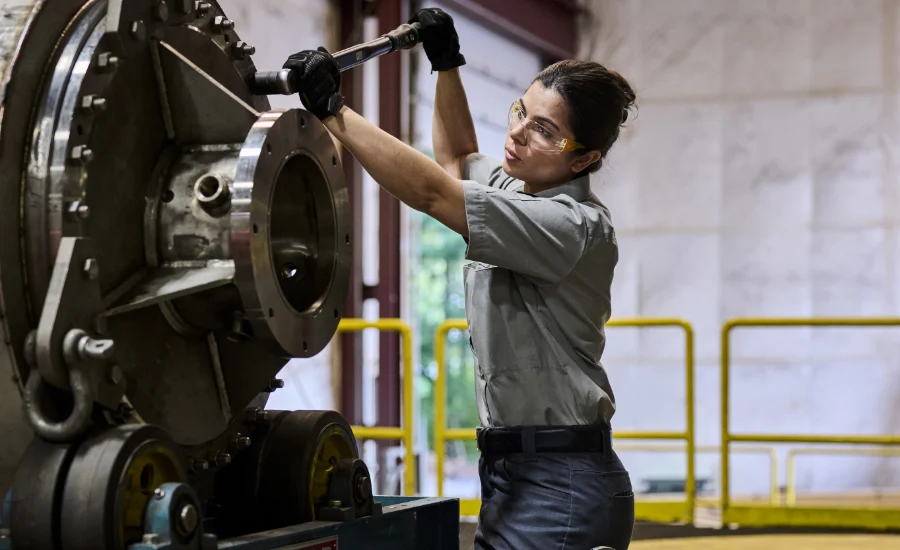
UniFirst is among the latest major suppliers to tackle this mismatch head-on. The company recently rolled out a comprehensive workwear collection that includes shirts and pants engineered specifically around women’s physical fit and dynamic movement. Unlike historical iterations that altered men’s patterns, UniFirst’s garments were developed from scratch. The line features functional elements tailored to the female form, including waist shaping, contoured mid-rise waistbands, adjusted hem lengths, lay-flat pockets, and streamlined cargo storage.
Leigh-Anne Zavalick, product manager at UniFirst, emphasized the long-overdue nature of these design choices.
"Women have long been an essential part of the workforce, but traditional workwear hasn’t always been designed with their specific needs in mind," Zavalick stated.
This philosophy extends into the company’s broader "Always U" collection, which incorporates specialized ergonomics intended to accommodate the rigorous physical movements common in manufacturing, assembly, and warehousing. The features are specifically calibrated to grant greater mobility as workers bend, reach, twist, and walk across concrete floors throughout an entire shift.
Experts in recruitment and talent acquisition echo the sentiment that environmental details heavily influence hiring and retention success. Dawn Fichter, owner of consulting firm Tools 4 Hiring, recently shared insights with ASSEMBLY regarding the realities of bringing new talent onto the production floor.
According to Fichter, women considering manufacturing careers are heavily influenced by visual and cultural cues—specifically, whether they see other women thriving in production roles and whether the employer presents an ecosystem in which they can genuinely envision a long-term career. When physical elements like uniforms signal exclusion or discomfort, it creates an invisible barrier to retention.
Implications: Beyond the Factory Floor
The movement toward gender-inclusive workwear is more than a fashion update; it is a strategic business imperative for an industry desperate for skilled labor.
As manufacturers fiercely compete for talent in a tight labor market, adapting the workplace to suit a diverse production workforce extends far beyond updating hiring practices or hosting diversity workshops. It encompasses the structural realities of daily employment:
- Flexible and equitable work schedules that support work-life integration.
- An inclusive shop-floor culture that stamps out historical biases.
- Physical accommodations, ranging from properly sized safety harnesses and PPE to ergonomically sound, tailored work uniforms.
By eliminating micro-frustrations like ill-fitting garments, industrial organizations remove physical distractions that can lead to fatigue, injury, and job dissatisfaction. When a worker is comfortable, safe, and respected by the tools and clothing provided to them, productivity naturally rises, and turnover rates fall.
Ultimately, the evolution of industrial workwear serves as a metaphor for the broader transformation sweeping the manufacturing sector. To build the factory of the future, companies must modernize not only their assembly lines and digital software, but also the fundamental ways they equip, clothe, and welcome the people who keep the engines running.