By Ahmed Rezika, SimpleWays OU Published: August 5, 2026
Main Facts: The Industrial Evolution of Humanoid Robotics
When a new piece of heavy machinery arrives at an industrial facility, seasoned maintenance engineers rarely stop at reading the manufacturer’s brochure. Driven by an innate instinct, they want to look inside. They want to trace signals, inspect internal components, and mentally simulate failure modes long before the first preventative maintenance schedule is even drafted.
Now, industrial facilities face a paradigm shift: what happens when the newest colleague on the plant floor is not another technician, but a humanoid robot?
While still emerging as mainstream industrial assets, today’s advanced humanoid robots are transitioning from science fiction to practical factory deployment. Beneath their sleek, anthropomorphic exterior shells lies an intricate integration of established engineering disciplines—ranging from power electronics and distributed control systems to advanced materials science and embedded software.
A meticulous exploration of a humanoid robot reveals that it is neither an oversized collaborative robot (cobot) nor a miniature production line. Instead, it is a highly integrated mechatronic platform designed to navigate environments built for humans, balancing on two feet while performing physically demanding tasks.
Chronology: The Evolution of Industrial Robotics to Embodied AI
The journey toward humanoid robots working alongside human maintenance teams has evolved over decades:
Late 1960s: The foundational theoretical framework for bipedal locomotion is established. Pioneering roboticist Miomir Vukobratović formalizes the concept of the Zero Moment Point (ZMP), creating the mathematical basis for balancing bipedal machines.
1990s–2000s: Traditional industrial automation thrives on fixed, highly specialized robotic arms bolted to rigid foundations. These machines excel at repetitive assembly-line tasks but lack the adaptability required for unstructured factory environments.
2010s: The rise of advanced sensors, lightweight carbon-fiber composites, and high-performance brushless actuators enables researchers to build agile bipedal platforms capable of dynamic balancing and stair-climbing.
Early 2020s: The integration of edge computing, whole-body dynamic control, and Model Predictive Control (MPC) allows humanoid systems to actively anticipate disturbances rather than merely reacting to them.
2026 and Beyond: Industry pioneers begin exploring humanoids not just as experimental novelties, but as maintainable assets capable of navigating complex industrial plants, performing routine inspections, and executing heavy physical labor.
Supporting Data & Technical Anatomy: Inside the Humanoid Platform
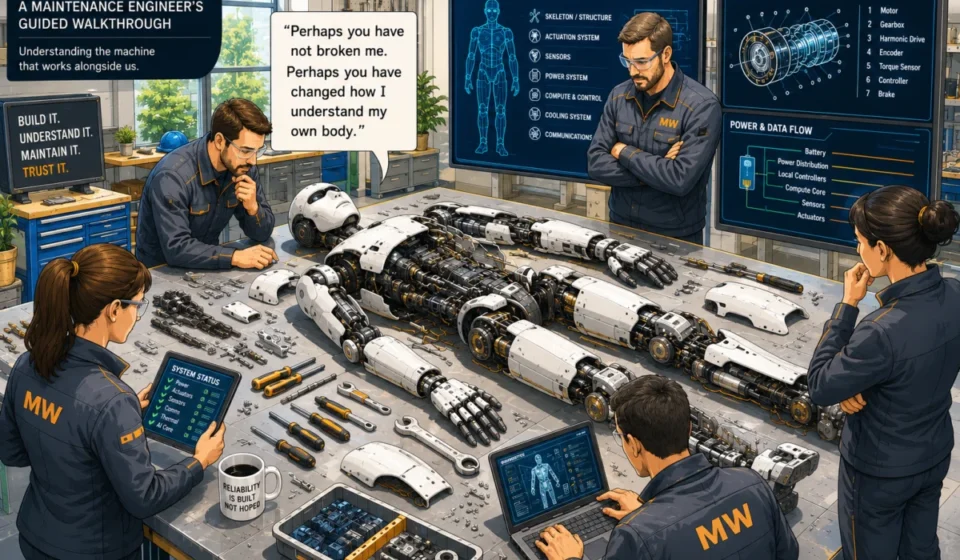
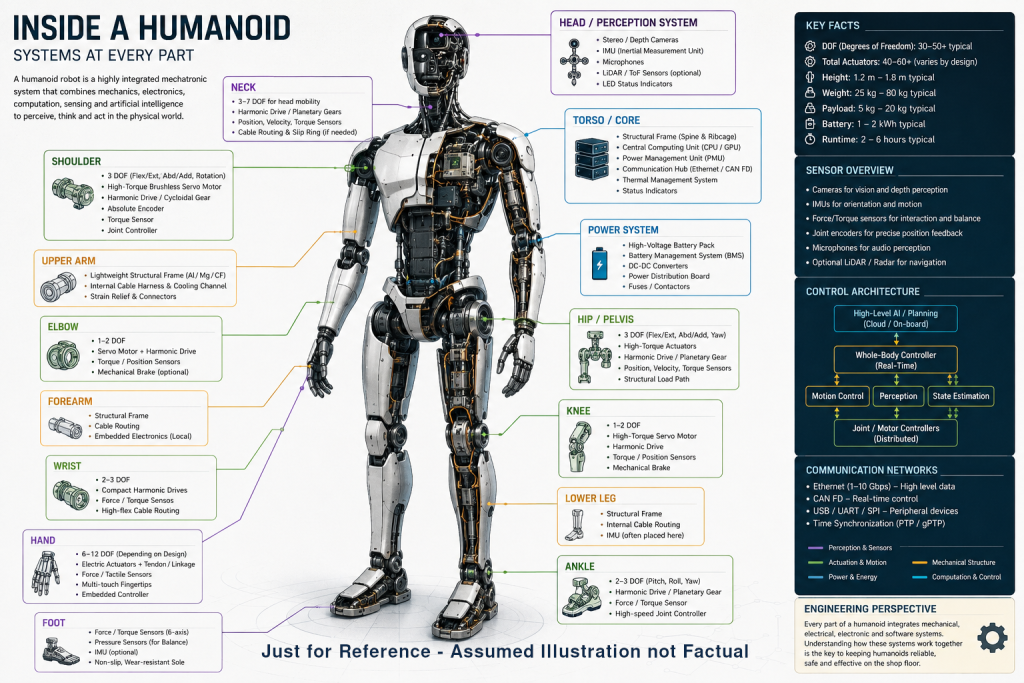
To understand how a humanoid robot operates in a demanding industrial setting, one must look past its outer shell and examine its core internal subsystems.
1. The External Body and Material Selection
The outer covers of a humanoid robot serve multiple critical functions: they protect internal wiring from dust and debris, optimize aerodynamic cooling channels, reduce operational noise, and provide safe, ergonomic surfaces for human-robot collaboration.
Materials: Manufacturers commonly fabricate these panels using engineering plastics, carbon-fiber composites, glass-fiber reinforced polymers, or lightweight aluminum assemblies.
Trade-offs: Material selection requires balancing impact resistance, structural stiffness, weight, manufacturability, field repairability, and cost—trade-offs well-known in the aerospace and automotive sectors.
2. Distributed Electronics vs. Centralized Cabinets
Unlike traditional industrial production lines that rely on large, centralized electrical cabinets, humanoid robots utilize a distributed electronic architecture.
Decentralized Control: Local motor controllers are positioned directly next to individual joints. This minimizes cable lengths, reduces electromagnetic interference (EMI), and cuts power transmission losses.
Torso Computing: Higher-level computing units and power distribution hubs reside within the torso, where they benefit from centralized cooling and straightforward maintenance access.
3. The Structural Skeleton and Dynamic Balancing
Unlike stationary industrial arms, humanoids must continuously balance while performing mechanical work. Every movement of an arm alters the robot’s center of mass, requiring the torso, hips, and legs to compensate instantaneously.
Lightweight Limbs: To minimize rotational inertia, heavy components like battery packs and main computers are concentrated in the torso. Limbs are kept as lightweight as possible using aluminum and magnesium alloys, allowing for faster acceleration and lower energy consumption.
Sensor Fusion: To maintain balance, the robot relies on a continuous stream of data from multiple sources:
Inertial Measurement Units (IMUs): Measure angular velocity and linear acceleration.
Force/Torque Sensors: Integrated into the ankles and feet to gauge floor interaction forces.
Joint Encoders: Report exact actuator positions and velocities.
LiDAR and Stereo Depth Cameras: Map terrain geometry and anticipate obstacles.
Algorithms: Using sensor fusion techniques like the Kalman Filter and optimization frameworks like Model Predictive Control (MPC), the robot estimates its state and calculates whole-body adjustments thousands of times per second.
Official Perspectives and Expert Insights
Industry veterans emphasize that maintaining a humanoid robot requires a fundamental shift in technical mindsets. Speaking on the integration of digital technologies in maintenance, Ahmed Rezika, a seasoned Projects and Maintenance Manager and founder of SimpleWays OU, notes:
"Modern humanoids rely on an internal representation of their physical structure—a kinematic and dynamic model. Every motion planner and balance controller assumes this model accurately reflects reality. A maintenance intervention that alters the physical system without updating the corresponding model creates a mismatch between the robot’s expectations and its actual capabilities."
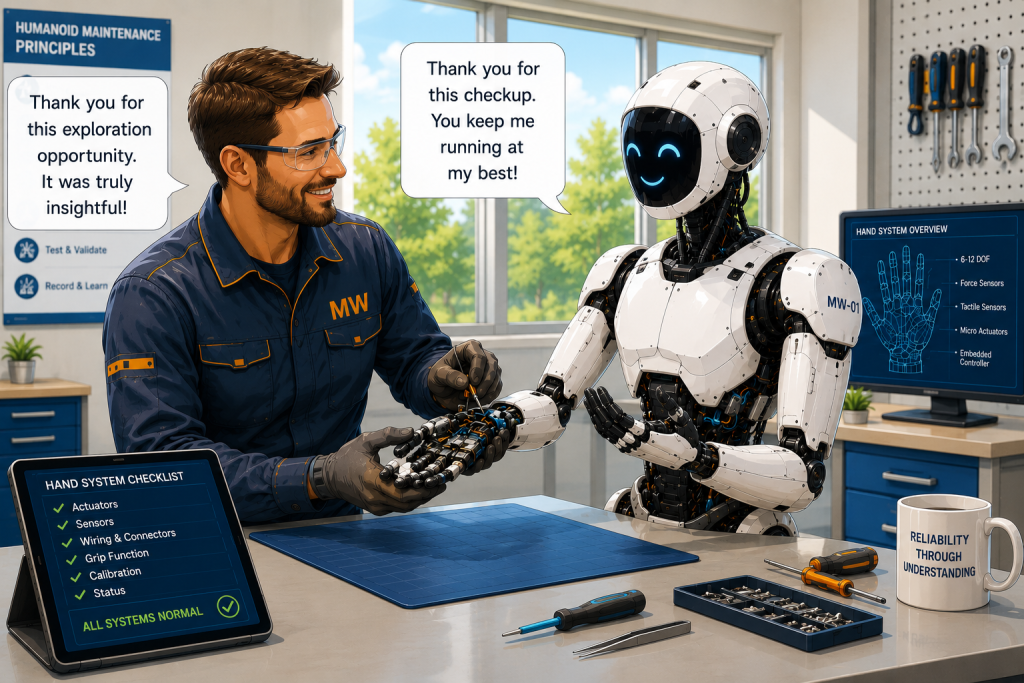
Rather than viewing mechanical repair as an isolated discipline, experts argue that humanoid maintenance mirrors aircraft flight-control maintenance. In these advanced systems, replacing a mechanical component is only half the battle; it must immediately be followed by rigorous software recalibration, sensor alignment, and multi-dimensional functional validation.
Implications for the Future of Industrial Maintenance
The advent of humanoid robots in industrial facilities carries profound implications for plant operations, workforce training, and reliability engineering:
Redefining Maintenance Disciplines: Traditional troubleshooting separates mechanical wear from electrical performance and software timing. In humanoids, these domains are deeply coupled inside compact mechatronic modules. Maintenance professionals must cross-train in embedded systems, kinematics, and software calibration.
The Danger of Micro-Modifications: In standard industrial equipment, adding a slightly heavier bracket or a minor protective guard is a trivial change. In a humanoid, adding mass to a limb alters the robot’s dynamic model, potentially degrading its balance controllers and locomotion safety.
Human-Robot Synergy: As these systems become more prevalent, maintenance teams will shift from repairing fixed production lines to managing fleets of intelligent, mobile robotic assets. Ensuring the long-term reliability of these machines will depend on maintaining both their physical hardware and the accuracy of the digital models through which they understand themselves.
Must-Know Industrial Jargon
Centre of Mass (CoM): The point at which the total mass of a system acts under gravity, critical for analyzing load distribution and stability.
Zero Moment Point (ZMP): The point on the support surface where the resultant of all inertia and gravity forces produces no tipping moment, ensuring dynamic bipedal stability.
Inertial Measurement Unit (IMU): An electronic sensor package combining accelerometers and gyroscopes to measure tilt, orientation, and dynamic motion in real time.
Force/Torque Sensors: Multi-axis load cells that measure forces and rotational moments simultaneously at joints and contact points.
Sensor Fusion: The algorithmic process of combining data from multiple sensors to produce a unified, highly reliable estimate of system state.
Whole-Body Control: A control strategy that coordinates all actuated degrees of freedom across a machine to achieve complex tasks while respecting physical constraints.
Model Predictive Control (MPC): An advanced control method using mathematical models to predict future behavior over a finite time horizon and compute optimal operational actions.
Kalman Filter: A recursive algorithm combining dynamic system models with noisy sensor measurements to calculate optimal state estimates.
References & Further Reading
Jorge Angeles, Fundamentals of Robotic Mechanical Systems, Springer International Publishing, 2014.
Matjaž Mihelj et al., Robotics, Springer International Publishing, 2019.
V. Bonnet et al., “Practical whole-body elasto-geometric calibration of a humanoid robot: Application to the TALOS robot,” Robotics and Autonomous Systems, Elsevier, 2023.