


Synchronized Quantum Rhythm: Physicists Discover Collective Behavior in Semiconductor Time Crystals

In a landmark advancement for quantum physics, researchers at TU Dortmund University have unveiled a phenomenon that challenges our fundamental understanding of matter. Building on their January 2024 breakthrough—where they demonstrated that a continuous time crystal could persist within a semiconductor for hours—Professor Alex Greilich and his team have now proven that multiple time crystals can spontaneously emerge within the same material and synchronize their electron-nuclear spin oscillations.
This study, recently published in the prestigious journal Nature Communications, marks a shift from observing individual quantum anomalies to understanding how these systems interact collectively. By orchestrating a "quantum choir" of oscillators, the Dortmund team has bridged the gap between microscopic spin dynamics and macroscopic synchronization, echoing the historic observations of 17th-century physics while pushing into the frontiers of modern information technology.
Understanding the Time Crystal: A Rhythmic Anomaly
To understand the magnitude of this discovery, one must first grasp the nature of a time crystal. Unlike conventional crystals, which are defined by a repeating arrangement of atoms in space, time crystals are defined by their behavior in the dimension of time. They are non-equilibrium systems that oscillate in a regular, rhythmic fashion without the need for an external driving force.
In a standard physical system, a perpetual motion of this kind would eventually succumb to entropy, winding down as energy dissipates. However, the systems developed at TU Dortmund bypass this limitation. Within a semiconductor composed of gallium arsenide, infused with trace amounts of indium and silicon, the researchers create a unique environment where localized electrons interact with a vast "sea" of approximately one million surrounding nuclear spins.
When cooled to extreme temperatures near -270°C—a regime where thermal fluctuations are suppressed—the system enters a quantum state where the electron and nuclear spins engage in a feedback loop. This loop maintains a stable, rhythmic oscillation, essentially defying the standard thermodynamic tendency toward stillness.
Chronology: From Stability to Synchronization
The trajectory of this research has been rapid and precise. The team’s journey began with the realization that they could stabilize these structures for unprecedented durations.
- January 2024: The team first reports the observation of a "continuous" time crystal within a gallium arsenide semiconductor. The oscillations were shown to remain stable for hours, providing a robust platform for experimental observation.
- Early 2024: Following the successful stabilization of a single crystal, Professor Greilich’s team turned their attention to the question of locality. If one crystal could exist, what would happen if multiple crystals were induced in different regions of the same semiconductor?
- Mid-2024: The researchers designed an experiment using a broad-beam laser to illuminate multiple regions of the material simultaneously.
- Late 2024 (Current Study): The publication of the findings in Nature Communications confirms that these spatially separated time crystals do not merely exist in isolation; they communicate and synchronize their oscillations, behaving as a unified system.
Supporting Data: The Mechanics of the Quantum Link
The process is initiated by a "pump laser," which aligns the electron spins. These electrons then transfer their polarization to the surrounding nuclear spins. Once a weak magnetic field is applied, the nuclear spins begin to rotate. The interaction is monitored via a second, probe laser that tracks the development of these oscillations over time.
The Problem of Microscopic Variation
At the microscopic level, no semiconductor is perfectly uniform. Local variations in the crystal lattice mean that time crystals forming in different locations naturally possess slightly different frequencies. Under normal circumstances, these oscillators would be "out of tune," drifting apart as they evolve.
The Synchronization Mechanism
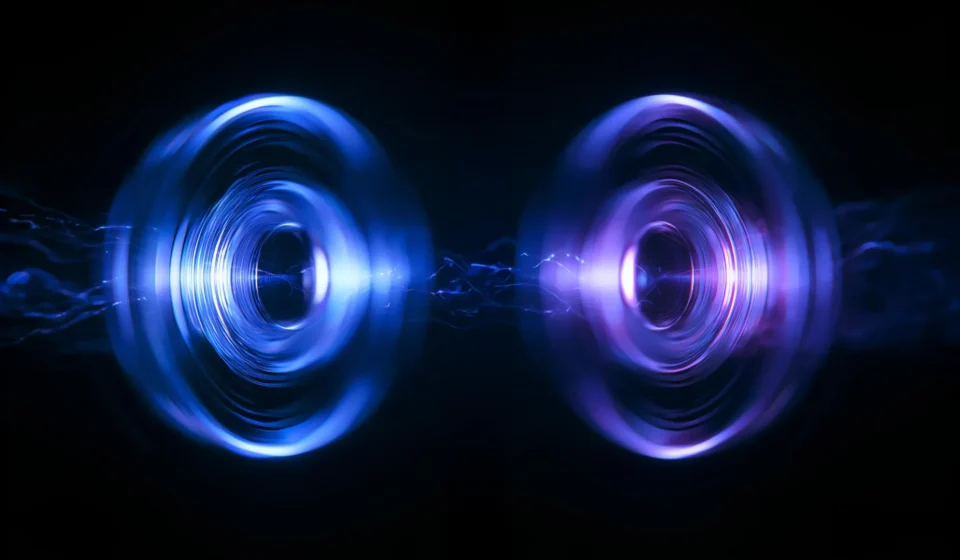
The team discovered that when a broad laser beam illuminates multiple regions at once, the "frequency mismatch" is overcome. The separate oscillations lock together, operating at a singular, unified frequency.
This behavior is remarkably reminiscent of an observation made by the Dutch scientist Christiaan Huygens in 1665. Huygens noticed that two pendulum clocks, when mounted on the same wooden beam, would eventually synchronize their swings due to the minute mechanical vibrations transmitted through the support structure. In the TU Dortmund experiment, the "support structure" is the semiconductor itself. However, instead of mechanical vibrations, the synchronization is mediated by the movement of spin-polarized electrons, which act as the medium through which the crystals "talk" to one another.
Official Responses and Scientific Context
In discussions surrounding the publication, Professor Alex Greilich noted the unexpected nature of the distances involved. "We were surprised by the scale at which this non-local coupling occurred," Greilich stated.
The data indicates that time crystals separated by up to 40 micrometers can synchronize. To put this in perspective, this distance is more than one thousand times larger than the characteristic size of a single oscillator. Beyond this 40-micrometer threshold, the coupling effect wanes, and the time crystals revert to their independent, non-synchronized states.
Peer reviewers of the Nature Communications study have highlighted the significance of this "non-local coupling." By demonstrating that spatially separated spin systems can influence one another without direct contact, the research provides a new lens through which to view quantum coherence in solid-state materials. The experiment proves that the "rhythm" of a time crystal is not merely a local property, but a collective one that can propagate through a lattice.
Implications for Future Technology
The implications of this discovery extend far beyond the walls of the physics laboratory. The ability to synchronize multiple spin oscillators is a foundational step toward the development of complex quantum networks.
Spin-Based Computing
Modern computing relies on the movement of charge (electrons). Future technologies, such as spintronics, aim to utilize the "spin" of electrons to process and store information. Because spin-based systems consume less energy and generate less heat than traditional electronic circuits, they are viewed as a potential successor to silicon-based microprocessors. The ability to lock multiple spin oscillators into a synchronized state could allow for the creation of sophisticated, high-density spin-logic gates.
Quantum Sensing and Metrology
Synchronized time crystals could serve as ultra-precise sensors. Because these systems are incredibly sensitive to their environment—including magnetic fields and thermal shifts—a network of synchronized oscillators could act as a highly sensitive detector for electromagnetic interference or other environmental anomalies, far exceeding the precision of current sensor technologies.
Quantum Communication
The non-local coupling observed by the Dortmund team suggests that information might be transmitted or processed across a material in a way that bypasses traditional wiring. While this is not "teleportation" in the science-fiction sense, it does provide a roadmap for how quantum information could be distributed across a semiconductor chip, enabling more efficient interconnects in future quantum computers.
Conclusion: A New Era for Time-Based Matter
The research conducted at TU Dortmund University transforms the time crystal from an exotic curiosity into a manageable, scalable, and functional component of solid-state physics. By proving that these rhythmic anomalies can synchronize across significant distances, Professor Greilich and his colleagues have opened a door to a new field of "temporal electronics."
As the team continues to refine their methods, the focus will likely shift toward scaling these networks. If researchers can maintain synchronization across larger areas and over longer periods, the dream of a robust, spin-based computer—one that pulses with the synchronized heartbeat of billions of quantum oscillators—may move from the realm of theoretical possibility to practical engineering.
This study confirms that time, often viewed as a background stage for physical events, can itself be structured and synchronized within the solid state, offering a glimpse into a future where matter is defined as much by its rhythm as it is by its form.