




Synchronized Quantum Rhythm: Physicists Unveil Collective Behavior in Time Crystals

In a remarkable breakthrough that pushes the boundaries of condensed matter physics, researchers at TU Dortmund University have demonstrated that time crystals—exotic states of matter that oscillate spontaneously without external periodic driving—can synchronize their behavior over significant distances. This discovery, detailed in a recent publication in Nature Communications, builds upon the team’s seminal January 2024 achievement, where they first observed a continuous time crystal persisting for hours within a semiconductor.
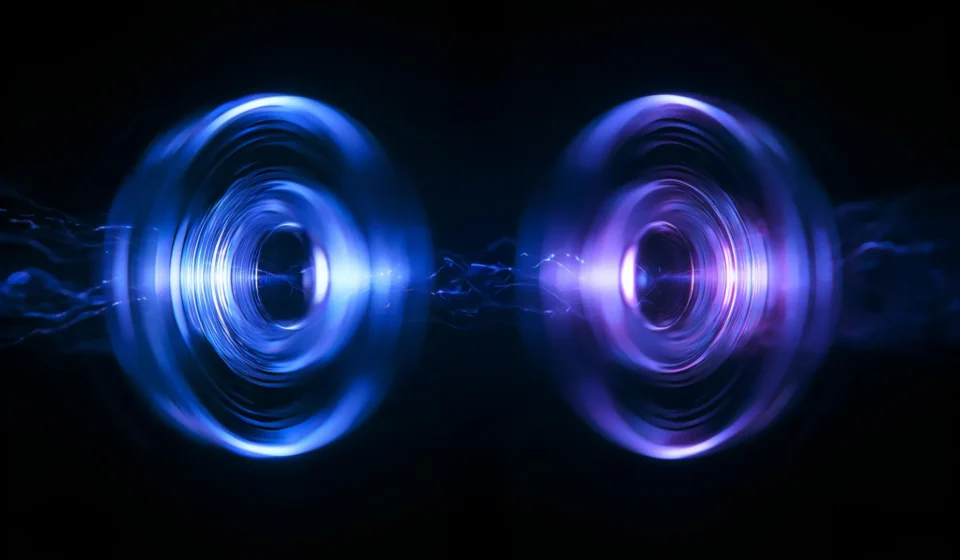
By proving that multiple time crystals can emerge within a single material and lock into a collective, harmonious rhythm, Prof. Alex Greilich and his team have moved from observing individual quantum anomalies to mastering the orchestration of collective spin systems. This phenomenon, which bears a striking resemblance to the classical synchronization observed in pendulum clocks centuries ago, offers a new window into the non-local coupling of quantum states.
The Physics of Perpetual Motion: What are Time Crystals?
To understand the magnitude of this discovery, one must first grasp the nature of the time crystal. In classical thermodynamics, systems naturally trend toward equilibrium—a state of stasis where entropy is maximized. Time crystals defy this intuition. They are physical systems that exhibit internal behavior repeating in a regular rhythm over time, even in the absence of a periodic external "clock" or driving force.
Unlike a standard crystal, which displays periodic order in space (the arrangement of atoms), a time crystal displays periodic order in time. In the experiments conducted at TU Dortmund, these crystals are not mere theoretical constructs; they are tangible, macroscopic manifestations of quantum mechanical feedback loops. They exist as stable, oscillating states of matter that emerge from the collective interaction between electron spins and nuclear spins within a specialized semiconductor environment.
Chronology of Discovery: From Observation to Synchronization
The research trajectory at TU Dortmund represents a systematic deconstruction of one of nature’s most elusive states.
January 2024: The Persistence Milestone
Earlier this year, the Dortmund team made headlines by demonstrating that a continuous time crystal could be stabilized within a semiconductor composed of gallium arsenide, doped with minute amounts of indium and silicon. At temperatures hovering near absolute zero—specifically -270°C—the researchers observed these crystals persisting for hours. This duration was unprecedented, shattering previous records where time crystals were fleeting, short-lived curiosities that decayed almost as soon as they were formed.
The Mechanism of Formation
The creation of these crystals is a delicate process. The added indium and silicon atoms create localized "traps" for electrons within the gallium arsenide lattice. At these cryogenic temperatures, a single electron interacts with approximately one million surrounding nuclear spins.
To initiate the state, researchers utilize a pump laser to align the electron spins. This polarization is subsequently transferred to the neighboring nuclear spins. When a weak magnetic field is introduced, the nuclear spins begin a rhythmic precession. Crucially, it is the feedback loop between the electron spins and the nuclear spins that sustains this oscillation, effectively creating a self-perpetuating, non-equilibrium state that refuses to settle into static equilibrium. A secondary, lower-power laser is then employed as a diagnostic tool, allowing researchers to monitor the oscillations in real-time without disrupting the delicate quantum coherence.
The Breakthrough: Collective Synchronization
The most recent study shifts the focus from a single time crystal to an ensemble. In a natural, disordered semiconductor, no two regions are identical. Variations in the lattice structure mean that, under normal conditions, two separate time crystals would oscillate at slightly different frequencies. However, when the team illuminated these disparate regions with a broad, uniform laser beam, the crystals did something entirely unexpected: they locked together.
Supporting Data: The Huygens Analogy and Quantum Coupling
The synchronization observed by Prof. Greilich’s team evokes a famous historical precedent. In 1665, the Dutch polymath Christiaan Huygens observed that two pendulum clocks, when mounted on the same support structure, would eventually begin to swing in perfect unison. He termed this "odd sympathy." The synchronization was driven by the weak mechanical vibrations transmitted through the wall or support beam connecting the clocks.
A New Form of Coupling
The TU Dortmund experiments reveal a quantum equivalent of Huygens’ observation, though the underlying mechanism is entirely different. In the semiconductor, there is no mechanical support. Instead, the coupling is mediated by the movement of spin-polarized electrons. These electrons act as a communication medium, transmitting the "rhythm" of one crystal to another across the semiconductor lattice.
Distances and Limits
The data collected by the team underscores the robust nature of this synchronization. They found that time crystals separated by as much as 40 micrometers could successfully lock their frequencies. While 40 micrometers may seem small in a macroscopic sense, it is more than one thousand times the characteristic size of a single oscillator.
However, the experiment also defined the limitations of this coupling. As the distance between the regions increases beyond this 40-micrometer threshold, the synchronization breaks down. The crystals, no longer feeling the "tug" of their neighbors through the electron cloud, revert to their independent, idiosyncratic oscillation frequencies. This transition provides a crucial data point for understanding the range of non-local quantum interactions.
Official Responses and Scientific Context
Prof. Alex Greilich, the lead investigator, emphasized the importance of the findings during a recent press briefing. "What we are witnessing is the emergence of collective intelligence at the quantum level," Greilich stated. "By manipulating the environment in which these crystals form, we are effectively writing a manual for how to orchestrate quantum states. The fact that they synchronize over such large distances—relatively speaking—opens up avenues we previously thought were closed."
The scientific community has lauded the paper for its clarity and its departure from the "isolated experiment" paradigm. Peers in the field of condensed matter physics have noted that the use of a semiconductor platform is particularly advantageous, as it bridges the gap between fundamental quantum research and potential device integration. Unlike systems requiring trapped ions or complex vacuum chambers, the gallium arsenide platform is a solid-state system, which is significantly more scalable.
Implications: The Future of Spin-Based Technology
The ability to create, sustain, and now synchronize multiple time crystals carries profound implications for the future of information technology.
1. Networking Spin Oscillators
The research lays the groundwork for building complex networks of spin oscillators. If individual time crystals can be treated as nodes in a network, they could serve as the basis for a new type of quantum processing unit. By controlling the synchronization, researchers could encode information in the phase relationships between these crystals, creating a "time-based" logic system.
2. High-Precision Sensing
Because time crystals are hypersensitive to their environment, they make excellent sensors. A synchronized array of time crystals could be used to detect infinitesimal changes in magnetic fields or temperature, providing a level of precision that exceeds current solid-state sensor technology.
3. Towards Quantum Memory
The long-lived nature of these oscillations, combined with their ability to synchronize, suggests they could function as stable memory buffers. Traditional quantum computers struggle with "decoherence"—the loss of quantum information. If a time crystal can maintain a stable, synchronized rhythm for hours, it represents a potentially revolutionary way to store quantum information in a robust, persistent state.
4. A New Paradigm in Material Science
Beyond the immediate technological applications, the discovery challenges our fundamental understanding of how complex systems emerge from simple components. It demonstrates that synchronization is a universal principle that persists from the swinging of 17th-century pendulums to the dance of electrons in a sub-zero crystal.
As the TU Dortmund team moves forward, the focus will likely shift to increasing the density of these synchronized arrays and attempting to control the "network" topology. We are no longer merely observing the strange behavior of matter; we are beginning to harness it. The age of the time crystal, once confined to the realm of theoretical speculation, has officially arrived, and it is oscillating in perfect, synchronized harmony.