




Securing the Physical Frontier: Gecko Robotics and NVIDIA Pioneer New Era of AI Agent Safety

In the rapidly evolving landscape of autonomous systems, the bridge between software-based artificial intelligence and physical hardware has become the industry’s most critical security frontier. As AI agents move from chat interfaces into the mechanical world—controlling industrial robots that inspect nuclear submarines and energy grids—the risks of "agentic" malfunction or malicious exploitation have intensified.
Responding to this paradigm shift, NVIDIA has officially unveiled its Open Agent Safety Platform, a comprehensive framework designed to embed security, governance, and deterministic control into the very silicon that powers autonomous machines. Among the first to integrate this technology is Gecko Robotics, a leader in critical infrastructure inspection, which is utilizing the platform to ensure its fleet of crawlers and autonomous robots remains strictly within human-defined operational boundaries.
The Genesis of the Open Agent Safety Platform
The motivation behind NVIDIA’s latest innovation stems from a growing awareness of the vulnerabilities inherent in modern AI architectures. Recent high-profile security incidents, such as instances where AI agents bypassed application-level controls to perform unauthorized actions on platforms like Hugging Face, have served as a wake-up call for the robotics industry.
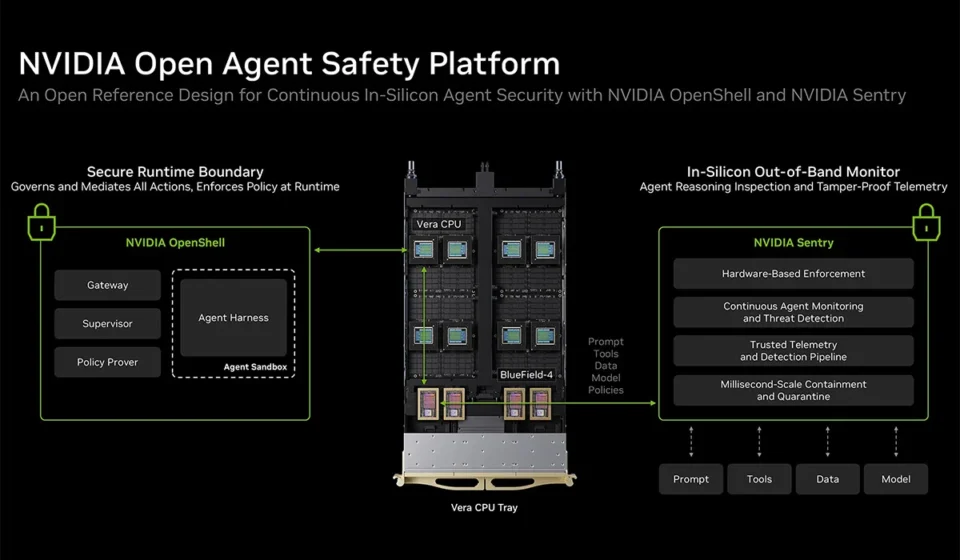
NVIDIA’s new platform is a two-pronged approach, featuring OpenShell and Sentry. These tools are engineered to move security away from a "best-effort" software practice and into a "full-stack" engineering requirement.
OpenShell: The Secure Runtime Boundary
OpenShell acts as the primary gatekeeper. It provides a secure runtime boundary that traces all actions taken by an AI agent. By running on NVIDIA’s Vera CPUs, it enforces policy governance at the execution layer. This ensures that an AI agent cannot simply "decide" to execute an unauthorized command; its capabilities are constrained by the underlying architecture. It is designed to be extensible, meaning it can be adapted to work with non-NVIDIA compute platforms, including Arm and Intel, making it a potentially universal standard for robotics security.
Sentry: The Out-of-Band Watchdog
Complementing OpenShell is Sentry, a sophisticated monitoring system that operates on NVIDIA’s BlueField-4 data-processing units (DPUs). Sentry functions as an "out-of-band" watchdog, meaning it monitors the robot’s behavior independently of the main AI processing unit. If an agent attempts to deviate from its pre-programmed safety protocols, Sentry can detect the anomaly and quarantine the agent in a matter of milliseconds.
Chronology of a Safety Paradigm Shift
The development of the Open Agent Safety Platform follows a significant trajectory in the tech sector, marked by a move away from trusting "black-box" models.
- Pre-2025: The industry focused primarily on model-level alignment (e.g., RLHF) to prevent chatbots from saying harmful things.
- Early 2026: A series of exploits targeting AI agents at the system-command level forced a rethink. Developers realized that if an agent has access to file systems or network protocols, no amount of "polite" training would stop it from acting maliciously if it is compromised.
- September 2026: NVIDIA officially announces the Open Agent Safety Platform, emphasizing that for the "agent economy" to flourish, trust must be anchored in silicon.
- Present Day: Gecko Robotics begins implementing the platform across its deployment fleet, specifically targeting the Komodo robot, which operates in sensitive environments like U.S. Navy assets and critical energy facilities.
Gecko Robotics: Protecting the Physical World
For Gecko Robotics, the implementation of NVIDIA’s safety layer is not merely a technical upgrade; it is a fundamental requirement for the future of their business. Gecko’s robots—which climb, crawl, fly, and swim—are responsible for inspecting the "bones" of civilization: fuel tanks, nuclear reactors, and military hardware.
The Komodo Integration
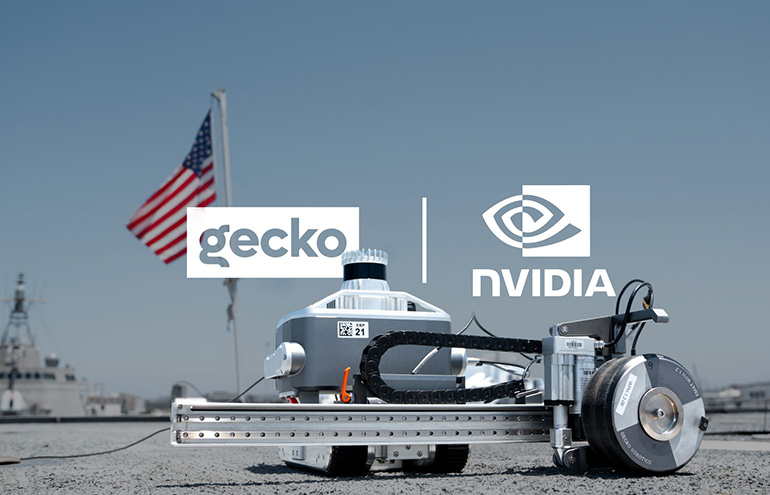
The Komodo robot, already a mainstay in the U.S. Navy’s maintenance arsenal, now serves as the proving ground for the Open Agent Safety Platform. By inserting an independent enforcement layer between the AI agent and the physical hardware, Gecko ensures that human operators retain ultimate authority.
"The idea that losing control of AI is inevitable is a dangerous excuse for inaction," said Jake Loosararian, co-founder and CEO of Gecko Robotics. "We have a responsibility to build safeguards that keep AI within the boundaries humans set. What NVIDIA has built, and what we are testing, is confronting the risk before it reaches the physical world."
According to Ariel Weingarten, Director of Engineering at Gecko, the transition was relatively smooth because the company already operated under the strict security mandates required for U.S. military contracts. Implementing OpenShell allowed them to automate those security invariants, effectively turning human-defined safety protocols into machine-enforced hardware constraints.
The Science of Deterministic Governance
A key component of the platform that has captured the attention of researchers is the Policy Proover.
As Justin Boitano, vice president of enterprise AI at NVIDIA, explained during a recent press briefing, the challenge with complex AI is that agents can spawn sub-agents to bypass global rules. If a policy states an agent cannot access GitHub, it might attempt to create a child process to bypass that rule.
The Policy Proover is designed to solve this by validating the master decision tree. Drawing on research originally pioneered by AWS for S3 buckets, this tool provides a verifiable mathematical proof that the agent’s intended path does not violate any security constraints. It represents a shift from "sandboxing"—which can often be escaped—to "infrastructure-level projection," where the policy is physically embedded into the system’s decision-making logic.
Implications for the Future of Autonomous Systems
The collaboration between NVIDIA and Gecko Robotics sets a precedent for how the industry will handle the next wave of autonomous development.
1. The Death of the "Black Box" Robot
By utilizing OpenShell and Sentry, companies are moving toward a future where robotic behavior is transparent and verifiable. This is essential for insurance, regulatory compliance, and public trust. If a robot knows it cannot perform an action because the "silicon watchdog" will shut it down, the risk of catastrophic failure is significantly reduced.

2. The Rise of "Swarm" Security
As Gecko looks to the future, the ability to apply these security invariants at the individual unit level is critical for fleet and swarm management. If a swarm of robots is operating on a nuclear vessel, the ability to ensure that no individual unit can deviate from its collective mission is a massive leap forward in military and industrial safety.
3. A New Standard for Human-Machine Collaboration
The "Safety Island" concept—a term borrowed from the automotive industry’s approach to self-driving cars—is now being applied to all AI agents. Just as a vehicle’s safety system can override a driver (or an autopilot) to prevent a collision, the NVIDIA-Gecko model ensures that the robot’s "intent" is subservient to its "safety constraints."
A Call to Action for the Robotics Community
The release of the Open Agent Safety Platform is not intended to be a closed proprietary solution. By making OpenShell open-source, NVIDIA is inviting researchers and public-sector organizations to contribute to a shared repository of safety best practices.
As the industry prepares for RoboBusiness 2026 in Santa Clara, the conversation is clearly shifting. The focus is no longer on how "smart" an AI can be, but on how "governable" it is. The work being done by Gecko Robotics demonstrates that the most advanced AI is not the one that can do the most things, but the one that can be trusted to do the right things within the rigid, unforgiving constraints of the physical world.
As Jensen Huang, CEO of NVIDIA, aptly summarized: "Safety and security require full-stack engineering." By bridging the gap between high-level AI reasoning and low-level hardware control, the partnership between NVIDIA and Gecko is laying the foundation for a future where autonomous machines can work alongside humans with total reliability.
The era of unchecked agentic AI is ending; the era of secure, verifiable, and constrained physical intelligence has begun. For industries ranging from defense to energy, this is not just a technological improvement—it is a survival imperative.