


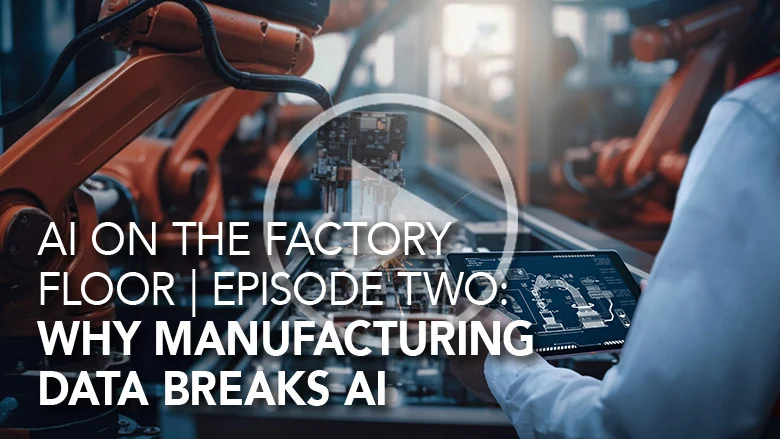
The AI Paradox: Why Manufacturing Data Remains the Final Frontier for Digital Transformation

While artificial intelligence has revolutionized the front office—optimizing sales funnels, automating financial reporting, and accelerating product design—the factory floor remains a stubborn holdout. Despite the promise of Industry 4.0, the integration of AI into manufacturing operations is proving to be a significantly more complex endeavor than in other corporate sectors.
The primary culprit is not a lack of computing power or sophisticated algorithms, but the fundamental nature of industrial data. Unlike the structured, clean datasets that power modern business intelligence, manufacturing data is often a chaotic, fragmented mosaic born from decades of disparate infrastructure.
The Structural Divide: Why Factory Data Defies Traditional AI
In the realms of finance and marketing, data is often "born digital." Customer relationship management (CRM) systems and cloud-based accounting software provide consistent, clean, and standardized inputs. By contrast, the shop floor is a historical record of technological evolution.
Jon Sobel, co-founder and CEO of Sight Machine, explains that manufacturing data is frequently a collection of legacies. "Manufacturing data is often collected over decades from equipment supplied by different vendors," Sobel notes. "You are left with inconsistent labels, disconnected systems, and very little context about what those individual data points actually represent."
For an AI model to learn, it requires "ground truth"—a consistent baseline of what constitutes normal versus anomalous behavior. In a factory where one machine’s temperature sensor uses a different naming convention or units of measurement than another’s, the AI lacks the foundational syntax required to generate reliable insights.
The Chronology of Industrial Data Silos
To understand the current impasse, one must look at the historical progression of factory floor technology.
- The Pre-Digital Era (1970s–1990s): Manufacturing relied on manual logs and analog gauges. Data was transient and rarely captured in a digital format.
- The Advent of OT Integration (1990s–2010s): Operational Technology (OT) integrators began installing programmable logic controllers (PLCs) and sensors. However, these systems were designed for localized control, not for enterprise-wide data harvesting. Each vendor operated in a vacuum, creating "islands of automation."
- The Data Lake Illusion (2010s–Present): With the rise of Big Data, many manufacturers began "dumping" sensor outputs into centralized data lakes. The assumption was that the sheer volume of data would naturally lead to insights.
"If we take a bunch of data from a bunch of sensors and dump it all in a data lake, nobody knows what it means," Sobel explains. "The labels on the data, the way data has been named on shop floors, the way it has been added year after year by different OT integrators—nobody knows what the data even is, never mind how it all fits together."
The Temporal Mismatch: The "Quality Gap"
One of the most persistent hurdles in industrial AI is the asynchronous nature of manufacturing metrics. In a perfect digital system, cause and effect are linked in real-time. On the factory floor, this is rarely the case.
Machine sensor data—vibration, thermal output, pressure—is often available in millisecond intervals. However, critical performance indicators, such as quality assurance results, destructive testing data, or end-of-line defect reports, may not be available for hours, days, or even weeks.
"You actually want to be able to understand, ‘Am I making good stuff or bad stuff?’" says Sobel. "But you don’t get your quality data until maybe an hour, or a day, or a week later. Integrating all of that across time is an extremely challenging problem."
This temporal lag creates a "blind spot" for AI models. If a machine produces a defect at 10:00 AM, but the defect is only detected by an inspector at 4:00 PM, the AI needs to be capable of "back-tracking" through vast amounts of sensor data to find the specific pattern that preceded the failure. Without sophisticated time-series alignment, the AI is effectively looking at a puzzle where the pieces were manufactured in different centuries.
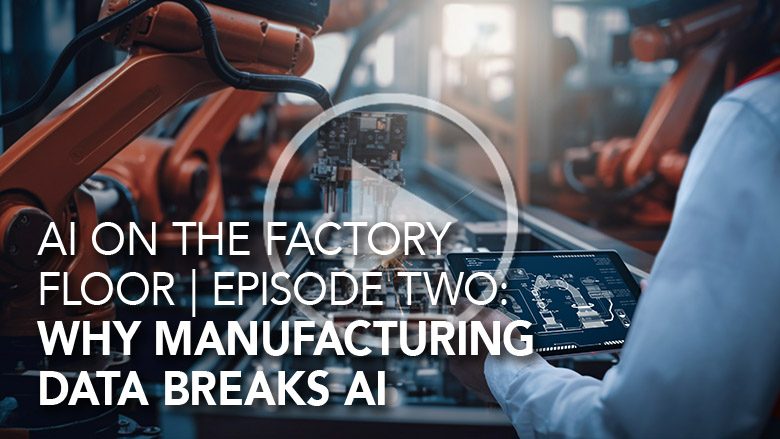
The Strategy for Success: Mapping and Contextualization
Before manufacturers can hope to achieve the "lights-out" factory of the future, they must undergo a phase of digital housekeeping. Sobel emphasizes that AI is not a magic wand that can fix broken data infrastructure; rather, it is a tool that requires a stable foundation.
Manufacturers must adopt a three-step approach:
- Normalization: Converting disparate sensor outputs into a unified data language.
- Mapping: Creating a digital twin or a semantic model that explains the relationship between the machine’s state and the final product’s quality.
- Contextualization: Adding the "why" to the "what." This involves tagging raw data with human-readable context, such as shift changes, raw material batch numbers, and environmental conditions.
Once these challenges are addressed, the AI can pivot from a passive observer to an active, diagnostic partner. It can identify hidden correlations—such as a specific, subtle vibration frequency occurring only when a certain raw material supplier is used—that would be invisible to even the most experienced floor manager.
Implications for the Future of Manufacturing
The transition to AI-enabled manufacturing is not merely a technical upgrade; it is a fundamental shift in the role of the human expert.
"We think of data and AI as being another next-generation tool in the hands of experts that lets you see deeper and farther than you could with your own senses," Sobel argues.
The implication is that the factory of the future will not be "AI-run," but "AI-augmented." The human expert remains the pilot, but the AI provides the radar, the navigation, and the warning systems that allow for precision at a scale previously unimaginable.
Bridging the Knowledge Gap
For the modern manufacturer, the path forward involves acknowledging that the barrier to AI adoption is organizational rather than technological. Companies that prioritize data hygiene and semantic modeling today will be the ones that dominate the competitive landscape of tomorrow.
As the industry continues to grapple with these challenges, tools are emerging to assist in this transition. Platforms like Ask ASM are beginning to help assembly professionals navigate these complex topics, providing quick access to the institutional knowledge required to bridge the gap between legacy manufacturing and the AI-driven future.
Conclusion: A New Era of Visibility
The difficulty of applying AI to manufacturing is the price of admission for the next industrial revolution. The factories that successfully reconcile their disparate, time-lagged, and historically inconsistent data will gain a level of visibility that their predecessors could never have achieved.
The goal is no longer just to collect data, but to create a coherent narrative from it. By treating manufacturing data as an asset that requires curation and context, companies can finally unlock the hidden relationships that lead to higher quality, reduced downtime, and a more resilient supply chain.
The digital transformation of the factory floor is underway, but it is a journey that requires patience, discipline, and a deep respect for the complex, often messy, reality of industrial production. As Sobel suggests, the AI is ready—the question is whether the data is ready to meet it.