

The Brampton Crossroads: Stellantis, Industrial Anxiety, and the Shadow of an Emerging U.S.-Canada Trade War

By Global Automotive Intelligence Desk
Published in partnership with industrial policy and labor market trackers
Main Facts
The potential sale of Stellantis’s storied Brampton Assembly plant in Ontario, Canada, to a low-volume defense vehicle manufacturer has ignited a firestorm across Canadian labor unions, federal and provincial governments, and the broader North American automotive sector.
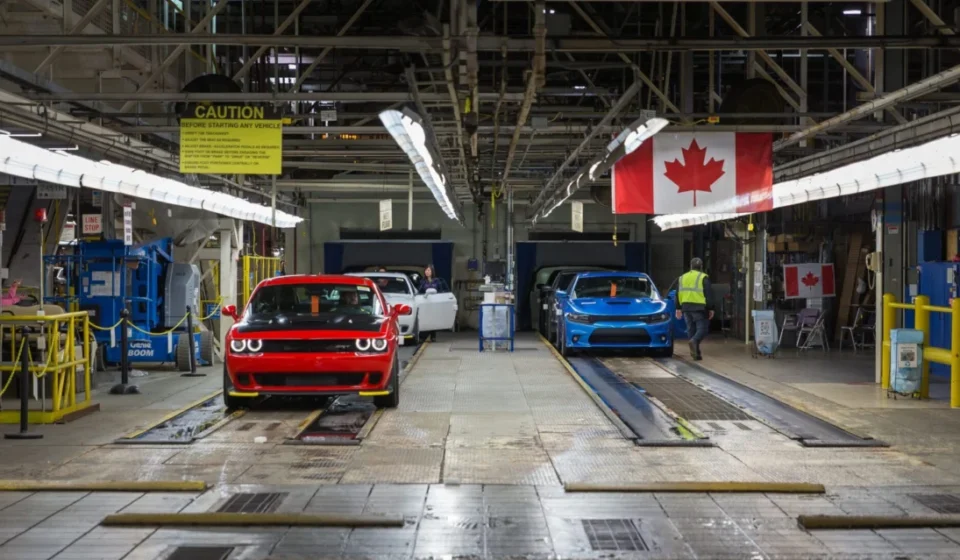
Once a crown jewel of Canadian automotive manufacturing, the sprawling facility has stood completely idle since late 2023, when production of the final-generation rear-wheel-drive sedans—including the Chrysler 300, Dodge Charger, and Dodge Challenger—officially ceased. The closure left approximately 2,200 direct hourly and salaried workers displaced. While these employees have been partially cushioned by a negotiated supplemental unemployment benefit package paying roughly 70% of their historical wages, the temporary financial relief is rapidly expiring, and the psychological toll on a community built around generations of auto manufacturing is palpable.
The core controversy centers on the identity of the prospective buyer. Rather than a transition to another major high-volume electric vehicle (EV) or internal combustion engine (ICE) platform that could absorb the plant’s vast production capacity and workforce, rumors and preliminary reports point toward a specialized, low-volume defense contractor. Industry experts note that pivoting a massive, highly automated 3-million-square-foot facility designed for mass passenger vehicle assembly into a low-volume military hardware workshop represents a severe industrial downgrade. It signals not only a retreat from Canada’s aggressive green automotive transition strategy, but also a capitulation to broader cross-border trade friction.
Behind this corporate maneuvering lies an increasingly hostile economic environment. The fate of Brampton Assembly is increasingly viewed by economists and policy analysts as the first major casualty of a simmering, unspoken trade war between the United States and Canada. Escalating protectionist rhetoric, divergent subsidy frameworks, strict domestic sourcing requirements under the United States-Mexico-Canada Agreement (USMCA), and the looming specter of targeted tariffs have fundamentally altered how multinational automakers allocate capital across North America. For Stellantis, the math of maintaining excess, idle capacity north of the border in an era of geopolitical uncertainty no longer pencils out—leaving Canadian workers and policymakers scrambling to salvage what remains of an era defined by cross-border manufacturing integration.
Chronology of Decline: From AMC Origins to Industrial Limbo
To understand the gravity of the potential sale of Brampton Assembly, one must trace its nearly four-decade history as a barometer of the North American automotive landscape.
- 1986: The plant officially opens under the ownership of the American Motors Corporation (AMC), representing a massive technological and capital investment designed to modernize Canadian vehicle production and introduce advanced assembly methodologies.
- 1987: In a landmark acquisition, Chrysler Corporation buys AMC, taking control of the Brampton facility. Under Chrysler, the plant begins a long trajectory of producing high-volume, rear-wheel-drive passenger cars that would come to define American muscle and executive cruiser segments.
- 1990s–2000s: Brampton becomes synonymous with platform flexibility and high-volume output. It undergoes multi-million-dollar retooling phases to launch legendary vehicles built on the Chrysler LX platform, generating billions in regional economic activity and supporting a dense ecosystem of tier-1 and tier-2 automotive suppliers throughout Ontario.
- 2020–2022: As the global automotive industry aggressively pivots toward electrification, Stellantis outlines its "Dare Forward 2030" strategy. Promises are made regarding the future retooling of Canadian facilities, including Brampton, to support multi-energy assembly lines capable of building next-generation architectures. Workers hold onto cautious optimism as production numbers for the aging Chrysler 300 and Dodge LX twins wind down.
- Late 2023: Production lines grind to a definitive halt. Stellantis officially idles the Brampton plant to begin a promised retooling process for the STLA Large platform. The 2,200-strong workforce is laid off, entering a compensation scheme paying roughly 70% of their baseline wages while the company reviews its operational footprints.
- 2024: Hopes for a swift EV-focused retooling begin to fade amid shifting consumer demand, macroeconomic headwinds, and tightening margins. Rumors surface that Stellantis is exploring alternative strategic options for the massive real estate and machinery footprint, culminating in discussions with low-volume defense vehicle manufacturers.
- Present: The prospective sale leaks to industry publications, sparking immediate and fierce backlash from Unifor, provincial leaders, and federal officials who view the move as a betrayal of long-standing industrial partnership agreements.
Supporting Data & Operational Metrics
An analysis of Brampton Assembly’s operational metrics highlights why a conversion to defense manufacturing is viewed by industrial economists as a devastating step backward for the region.
+-----------------------------------+--------------------------------------------+
| Metric Category                   | Historical & Current Data Points           |
+-----------------------------------+--------------------------------------------+
| Facility Size                     | ~3 million square feet                     |
| Peak Employment (Direct)          | 2,200 - 4,500 workers (depending on shift) |
| Current Operational Status        | Completely Idle (Since Q4 2023)            |
| Current Worker Compensation       | ~70% of historical wages (via SUB fund)    |
| Historical Core Products          | Chrysler 300, Dodge Charger, Challenger    |
| Original Retooling Promise        | STLA Large EV/Multi-Energy Platform        |
| Prospective Buyer Profile         | Low-volume defense vehicle manufacturer    |
| Regional Supply Chain Impact      | Over 100 tier-1 and tier-2 suppliers       |
+-----------------------------------+--------------------------------------------+
The Economic Ripple Effect
Automotive manufacturing is uniquely multiplier-heavy. According to economic impact studies conducted by provincial automotive associations, every single direct job at an assembly plant like Brampton supports between five and seven indirect jobs within the broader economy. These include positions in parts manufacturing, logistics, tooling, raw material processing, software development, and local service sectors ranging from food catering to commercial real estate.
The idling of 2,200 workers at Brampton immediately threatens over 10,000 indirect jobs across Ontario. Should the facility be sold to a defense contractor—an industry characterized by low-unit production runs, highly specialized boutique engineering, and minimal reliance on mass consumer supply chains—the vast ecosystem of local automotive parts suppliers built up over decades faces catastrophic contraction. Companies that invested heavily in retooling their own machinery to supply lightweight materials, specialized electronics, and interior components for the next-gen Stellantis platforms will find themselves with no domestic customer base.
Official Responses and Stakeholder Positions
The prospect of the Brampton plant falling out of the automotive mainstream has triggered a unified, defensive outcry from labor organizations and government offices alike.
Unifor and Organized Labor
Unifor, the union representing the affected hourly workers at Brampton, has adopted an uncompromising stance against the rumored sale. National President Lana Payne and local union leaders have repeatedly emphasized that Stellantis received substantial public subsidies conditioned on maintaining a robust manufacturing footprint in Canada.
"Our members gave decades of their lives building the profits that Stellantis now enjoys," a senior Unifor representative noted. "To pivot away from mass automotive manufacturing toward a low-volume niche defense operation is a direct violation of the social contract between major automakers and Canadian workers. We expect corporate accountability, and we expect investments in the green vehicle transition to be honored."
Unifor has threatened to mobilize industrial action and political pressure campaigns if Stellantis attempts to divest the plant without securing a high-employment, high-volume automotive future for the workforce.
Federal and Provincial Government Reaction
Elected officials in Ottawa and Queen’s Park find themselves under intense pressure to justify the public tax dollars previously funneled into corporate green subsidies. Both the federal government and the Ontario provincial government have poured billions into attracting EV battery plants (such as the NextStar Energy facility in Windsor) and securing assembly footprints to future-proof the Canadian economy.
Behind closed doors, trade ministers and economic development officials are reportedly pressing Stellantis executives for clarity. Publicly, government statements stress that any transaction involving critical industrial infrastructure must align with national security and economic resilience goals. Lawmakers are increasingly sensitive to the political optics of allowing a premier automotive asset to slip away during a period of intense industrial competition with the United States.
Stellantis Corporate Perspective
Stellantis, facing a rapidly shifting global automotive market characterized by slowing near-term EV adoption curves, high interest rates, and fierce pricing pressures from Chinese competitors, has defended its right to optimize its global manufacturing footprint. Corporate leadership argues that excess capacity must be managed ruthlessly to protect overall enterprise profitability.
While executives have not formally confirmed the details of the defense vehicle sale, company spokespersons maintain that Stellantis remains committed to the Canadian market overall—pointing to its ongoing multi-billion-dollar investments in EV battery manufacturing elsewhere in the country as proof of its long-term partnership with Canada. However, these reassurances do little to comfort the displaced workers and stranded suppliers tied specifically to the Brampton soil.
Broader Implications: The U.S.-Canada Trade War Context
The crisis at Brampton Assembly cannot be evaluated in a vacuum. It serves as the canary in the coal mine for a deepening, structural trade conflict between the United States and Canada over the future of the North American industrial base.
The Return of Economic Nationalism
For decades, the auto industries of the U.S. and Canada operated under a deeply integrated, borderless paradigm facilitated first by the Auto Pact of 1965 and later by NAFTA and the USMCA. Vehicles crossed the border multiple times during the manufacturing process, with parts and sub-assemblies treated as a single continental inventory.
However, recent legislative shifts in Washington—most notably the implementation of the Inflation Reduction Act (IRA) with its stringent domestic content and North American assembly mandates—have quietly incentivized automakers to onshore capital investments exclusively within the United States. Subsidies heavily favor plants built on U.S. soil, creating a powerful centrifugal force pulling automotive investment away from Canadian provinces.
Canadian policymakers have responded by matching subsidies dollar-for-dollar to keep factories anchored in Ontario. Yet, this has created a precarious subsidy arms race. When market realities force automakers to scale back aggressive electrification timelines, plants located on the Canadian periphery—such as Brampton—are disproportionately vulnerable to being downsized, mothballed, or repurposed for non-automotive applications.
Strategic Divergence: Auto vs. Defense
The irony of a major automotive assembly plant being converted to manufacture defense vehicles highlights a profound strategic divergence. While Canada and the U.S. are tightly allied militarily through NATO and NORAD, their industrial policies are actively diverging.
On one hand, the U.S. defense industrial base is actively seeking expanded manufacturing capacity to replenish stockpiles and meet rising geopolitical tensions globally. On the other hand, Canada’s industrial strategy has heavily prioritized the green energy transition, zero-emission vehicle (ZEV) mandates, and climate change mitigation.
If Brampton Assembly becomes a defense manufacturing hub, it represents a symbolic and practical defeat for Canada’s green industrial policy. It proves that market forces and cross-border trade friction can easily override well-intentioned government subsidies, transforming advanced civilian manufacturing infrastructure into military supply depots under pressure from macroeconomic realities.
Looking Ahead
As negotiations between Stellantis, prospective buyers, labor unions, and government regulators continue behind closed doors, the stakes could not be higher. For the 2,200 laid-off workers in Brampton, the outcome will determine whether they have a future in modern manufacturing or face painful career transitions. For Canada, the plant’s fate will serve as a definitive test of whether its national industrial strategy can withstand the gravitational pull of American protectionism and corporate restructuring in an era of global trade uncertainty.