



Bridging the Gap: How Granular Elastomers Are Redefining 3D Printing Durability

For decades, the field of materials science has been haunted by a persistent trade-off: in the world of elastomers—rubbery, flexible materials—you could have high fracture toughness, or you could have high fatigue resistance, but rarely both. Materials engineered to withstand catastrophic tearing often fail under the repetitive, low-level stress of daily use, while those designed to survive millions of cycles often snap under sudden, high-intensity loads.
A breakthrough study published in Science Advances from researchers at EPFL’s Soft Materials Laboratory (SMaL) may have finally resolved this mechanical paradox. By utilizing a unique architecture known as "double network granular elastomers" (DNGEs), the team has developed a 3D-printable material that balances these two critical properties, opening the door for a new generation of resilient soft robotics, durable wearables, and long-lasting biomedical devices.
The Mechanical Dilemma: Why Toughness and Fatigue Conflict
To understand the magnitude of this discovery, one must first understand the "toughness-versus-fatigue" compromise. Toughness describes a material’s ability to absorb energy and deform without fracturing. Fatigue resistance, conversely, describes a material’s ability to withstand repeated loading and unloading without developing microscopic cracks that eventually lead to failure.
In traditional elastomers, increasing toughness usually involves creating a dense, cross-linked molecular network that can dissipate energy. However, these rigid structures are brittle over time; under repetitive cyclic stress, the energy dissipation mechanisms become exhausted, and covalent bonds begin to break. Once these bonds snap, the damage accumulates, leading to premature fatigue failure.
Conversely, highly flexible elastomers that excel in fatigue resistance often lack the structural integrity to resist a single, sharp tear. This conflict has long forced engineers to choose the "lesser of two evils" when designing parts for soft robots or flexible sensors—components that must, by definition, move and flex constantly without falling apart.
Chronology of the DNGE Innovation
The development of DNGEs at EPFL is the result of a multi-year effort to master the rheology of 3D-printable inks.
- 2024: The Conceptual Breakthrough: The Soft Materials Laboratory (SMaL), led by Esther Amstad, first introduced the concept of DNGEs. Initially, the goal was purely pragmatic: to create a 3D-printable "ink" that allowed for the precise tuning of mechanical behavior. The team designed a material consisting of microscopic elastomer particles suspended in a softer, secondary elastomer network.
- The Discovery Phase: As the researchers characterized the material, they noticed an anomaly. The DNGEs were not just easy to print; they exhibited mechanical properties that far exceeded the sum of their parts. The "granular" structure was doing more than just facilitating flow through a print nozzle; it was actively managing mechanical strain.
- 2025–2026: Testing and Validation: The team subjected the DNGEs to rigorous mechanical testing, comparing them against industry-standard elastomers. They discovered that the granular architecture functioned as an internal "shock absorber," allowing the material to dissipate energy repetitively without sustaining permanent damage.
- Current Status: The findings have now been formalized in Science Advances, and the SMaL team is moving toward optimizing the material for industrial use, with a specific focus on sustainability and broader accessibility for labs using commercial 3D printers.
Supporting Data: By the Numbers
The metrics reported by the EPFL team provide compelling evidence that the DNGE architecture is a superior alternative for demanding applications. In comparative testing, optimized DNGEs demonstrated:
- Fracture Toughness: The materials achieved levels up to 15 times higher than comparable conventional elastomers.
- Fatigue Resistance: The DNGEs exhibited a fatigue threshold three times higher than their counterparts.
- Strain Energy Dissipation: Because the material structure allows for the sliding and rearrangement of polymer chains rather than the snapping of covalent bonds, it can withstand significantly higher numbers of deformation cycles before the onset of crack propagation.
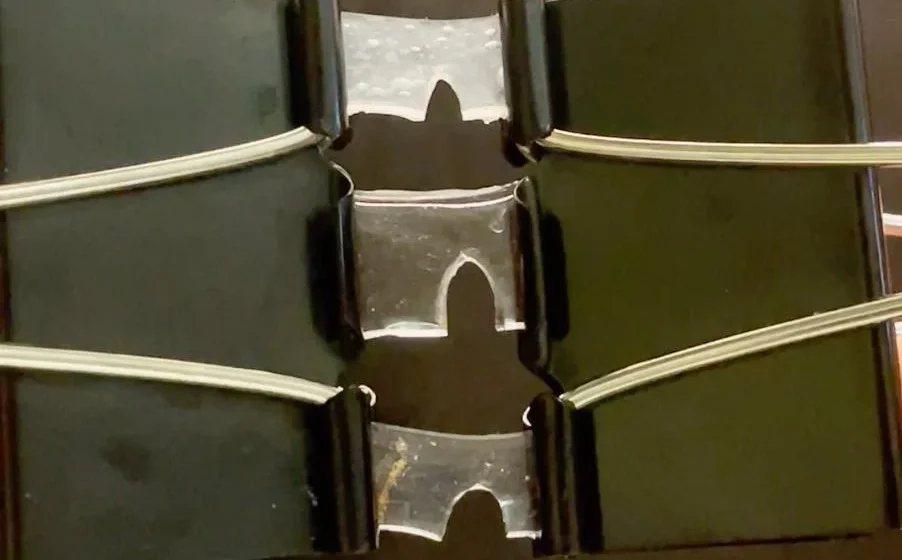
The mechanism is effectively a structural rerouting system. When a crack begins to form in a DNGE, it does not propagate in a straight line. Instead, the crack is forced to "wander" through the softer, energy-dissipating regions between the microscopic particles. This meandering path drastically slows the crack’s progress, postponing the ultimate failure of the material.
Official Responses and Researcher Insights
Esther Amstad, head of the Soft Materials Laboratory at EPFL, describes the discovery as a fortuitous shift in focus. "Originally, our focus was on improving processibility," Amstad noted. "But once we had the granular structure, we discovered that these materials are also very tough. Then, we realized that a lot of this toughness came from repetitive energy dissipation mechanisms; the material could absorb energy over and over without irreversibly breaking."

Amstad emphasizes that the "magic" of the material lies in its architecture, not its chemistry. By sharing mechanical strain between the granular particles and the surrounding soft matrix, the material effectively offloads stress from the most vulnerable points.
Addressing the future of the technology, Amstad highlighted the team’s commitment to the environment: "Our aim is to implement more sustainable materials without compromising on mechanics. By increasing the scope of materials we can use, we can not only reduce the DNGEs’ environmental footprint, but also make them even more widely accessible to any lab with a commercial 3D printer."
Implications for Soft Robotics and Beyond
The implications of this research extend far beyond the laboratory bench. Soft robotics, a field currently hampered by the rapid degradation of actuators and "muscles," stands to benefit the most. If a robot can operate for thousands of hours without the synthetic skin or internal bellows tearing, it moves from the realm of academic prototyping to real-world industrial utility.
Similarly, in the biomedical sector, the longevity of implants and flexible wearable electronics is paramount. A heart-monitoring patch or a prosthetic limb interface that can withstand the rigors of constant, cyclic movement will significantly reduce the need for replacement surgeries or frequent maintenance.
The EPFL research places the university at the center of a growing global movement to industrialize soft matter. Other institutions, such as Harvard’s efforts in multimaterial MM3D printing and CU Boulder’s OpenVCAD software, are contributing to a broader ecosystem where soft robots are becoming more complex, more programmable, and—thanks to the work at EPFL—more durable.
Technical Limitations and Challenges
Despite the breakthrough, the EPFL team is candid about the current limitations of DNGEs.
- Stiffness Constraints: The primary trade-off identified is stiffness. Because the material relies on soft microparticles, it is inherently less rigid than traditional "bulk" double-network elastomers. While multi-material printing can mitigate this, it remains an open research challenge.
- The "Elastic Ceiling": The fatigue resistance is exceptional, but only up to a point. At very high strains, the covalent bonds within the stiff microparticles will eventually rupture. Once this damage occurs, it accumulates, meaning the material is not "indestructible," but rather "highly durable under moderate conditions."
- Fabrication Geometry: The curing process is limited by UV light penetration. Current samples are limited to roughly 5 millimeters in thickness to ensure an even cure. Thickening these parts would require a fundamental shift in how the second network is formed during the printing process.
Conclusion: The Future of Printed Resilience
The work authored by Eva Baur, John Kolinski, and Esther Amstad represents a significant milestone in additive manufacturing. By successfully separating the mechanical performance from the chemical limitations of traditional rubbers, the SMaL team has provided a blueprint for a new class of materials.
As the team pivots to exploring biodegradable and recycled feedstocks, the potential for DNGEs to influence sustainable manufacturing grows. We are moving toward a future where 3D-printed soft matter is not just a novelty for short-term testing, but a robust, reliable component of our technological infrastructure. Through the clever manipulation of granular architecture, EPFL has demonstrated that even in the world of soft materials, structural intelligence is the key to longevity.