

Beyond the Software Mirage: The Brutal Physical Reality of Scaling Robotaxis

The autonomous vehicle (AV) industry has spent the better part of a decade convincing the public, regulators, and investors that the hardest part of the equation was the "brain." Today, that battle is largely won. Waymo has logged over 220 million autonomous miles, demonstrating that its vehicles are significantly safer than human drivers, with a 94% reduction in serious injury crashes. With nearly half a million paid rides occurring weekly, the question has shifted from "Does this technology work?" to "How do we make it ubiquitous?"
However, as the industry eyes the transition from a handful of pilot cities to a global footprint of 15,000 municipalities, it is colliding with a stubborn, unglamorous reality: the physical infrastructure required to keep these fleets running is currently a bottleneck that threatens to derail the entire vision. While billions of dollars flow into AI training and vehicle hardware, the "pit stop"—the logistical necessity of cleaning, charging, and inspecting cars between rides—remains a systemic failure point.
The Mathematical Wall: From 14 Cities to 15,000
The disparity between current operations and the required scale is stark. Waymo, the industry gold standard, is currently operational in 14 cities. By contrast, ride-hailing giant Uber operates in over 15,000. Last quarter alone, Uber facilitated 3.9 billion trips. To put that in perspective, Uber processes Waymo’s entire weekly ride volume every 17 minutes.
To bridge this gap, the industry must solve the "Empty Mile" problem. Currently, when a robotaxi finishes a ride—perhaps containing a spilled latte or a dying battery—it often must drive up to 15 miles, empty, to a centralized depot. California Department of Motor Vehicles data provides a sobering look at this inefficiency: of the 86 million Waymo miles reported through 2025, only 54% were revenue-generating passenger miles. The rest were "deadhead" miles, serving no purpose other than returning to base for manual servicing.
This model is a vestige of the early-stage, "controlled environment" phase of autonomous development. It cannot scale. To survive in 15,000 cities, the industry requires a decentralized, automated, and standardized approach to vehicle care.
A Chronology of the Operational Bottleneck
The history of the robotaxi industry has been one of extreme vertical integration, which served a purpose in the early years but has now become a liability:
- 2015–2019 (The R&D Era): Companies like Waymo and Cruise built their own vehicles, software, and depots. Success was defined by the vehicle’s ability to navigate complex urban environments without a human driver.
- 2020–2023 (The Validation Era): Success moved to the metric of safety. With billions in funding, companies proved that autonomous systems could outperform humans. Infrastructure was an afterthought, handled by manual labor in massive, expensive warehouses.
- 2024–2026 (The Specialization Shift): The model began to fragment. Waymo began offloading manufacturing to companies like Zeekr and outsourcing depot operations to firms like Moove and Avis. The "brains" (Wayve, Nuro, Mobileye) were separated from the "chassis" (Nissan, VW, Lucid).
- 2026 and Beyond (The Infrastructure Crisis): The industry has realized that while the software is commoditizing, the operational reality of managing diverse, multi-brand fleets in thousands of distinct cities is the new "hard problem."
Supporting Data: Why the Current Model Fails
The failure to scale is not a lack of vision; it is a lack of physical resources. Three primary constraints are currently stifling the expansion of autonomous transit:
1. The Real Estate War
Industrial-zoned land is the scarcest resource in modern logistics. Robotaxi depots require specific power configurations and proximity to urban centers. However, these same parcels are being aggressively snapped up by data center developers to power the AI revolution. An AV operator entering a new market is essentially entering a bidding war against Microsoft and Amazon. They are losing.
2. The Power and Regulatory Clock
The time required to energize a facility is prohibitive. Current regulatory frameworks in states like California demand up to six months just to energize a standard site. If a new circuit is required, the timeline jumps to 1.9 years. A full substation upgrade takes 2.8 years, and building a new substation—a requirement for large-scale fleets—takes nearly 9 years. If this cycle is repeated across thousands of cities, the industry will spend the next century just waiting for the grid to catch up.
3. The "Every City is Different" Dilemma
There is no "one-size-fits-all" depot. Phoenix requires vast, heat-shielded parking; Riyadh demands advanced cooling for batteries and sensor-cleaning systems that handle relentless dust; Zurich requires fitting into medieval, narrow street grids with rigid planning committees. Bespoke infrastructure for every city is a recipe for operational bankruptcy.
Official Responses and Industry Shifts
The industry is beginning to acknowledge this shift. Leaders in the autonomous space have largely stopped claiming that software is the final hurdle. The focus has moved toward "Operational Efficiency" (OpEff).
Executives at companies like Wayve and Mobileye have emphasized that they no longer wish to manage the physical fleet, but rather provide the software stack to existing car manufacturers. This creates a multi-brand ecosystem where one city might see a fleet of Nissans, Volkswagens, and Lucids on the same road, all using different autonomous stacks.
The implication is clear: The entity that owns the infrastructure—the standardized "pit stop" that can service any vehicle from any manufacturer—will hold more power than the company that wrote the code. This is a lesson learned from the shared scooter wars of the early 2020s. In that market, the winning companies were not those with the best scooter, but those who mastered the logistics of charging, repairing, and repositioning thousands of units daily.
Implications: The Standardization Imperative
To achieve the scale of 15,000 cities, the industry must emulate the shipping container. Before the standardized shipping container was introduced in the 1950s, global trade was slow, manual, and expensive. The container didn’t make ships faster; it made every port identical. It turned the world into a standardized grid.
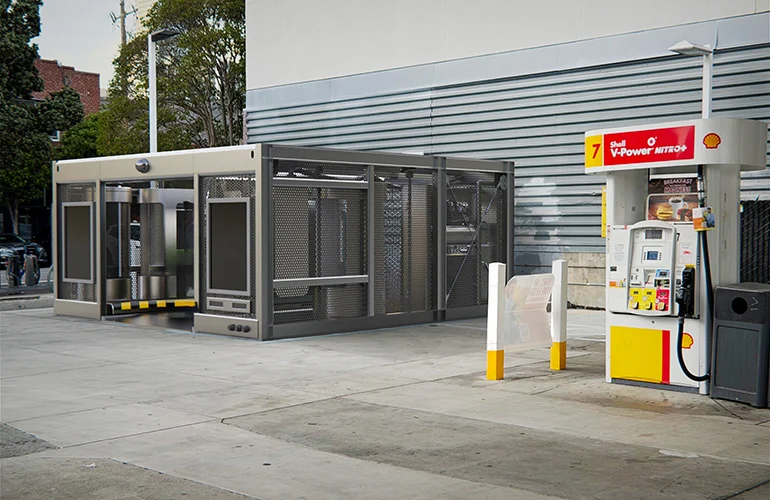
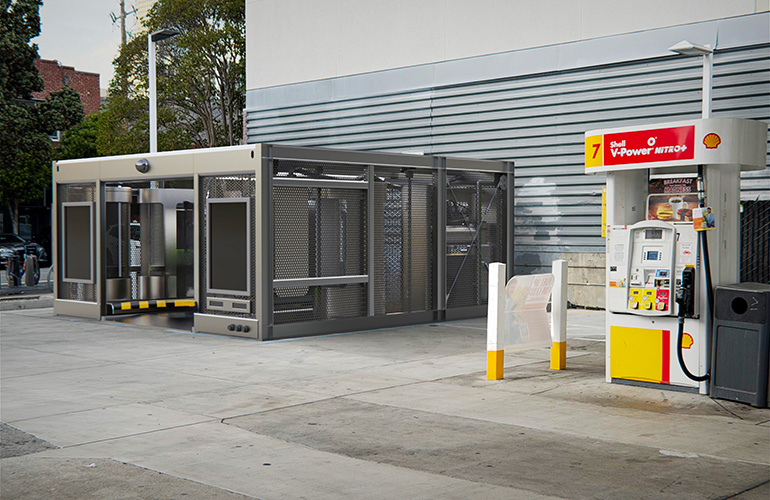
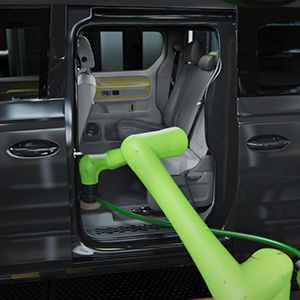
Robotaxis require a similar breakthrough: a modular, standardized "servicing container" that can be deployed in a parking bay within 24 hours. This unit would need to be:

- Manufacturer-Agnostic: Capable of servicing a Lucid, a Nissan, or a Waymo-style pod.
- Distributed: Placed throughout the city, not just at the city limits, to minimize deadhead miles.
- Automated: Performing vacuuming, charging, and sensor inspection without human intervention.
If the industry continues to rely on massive, bespoke warehouses, the cost of an autonomous ride will never drop below that of human-driven services, and the environmental cost of "deadhead" miles will trigger massive regulatory backlash.
Conclusion: The Final Piece of the Puzzle
The transition from "autonomous demo" to "autonomous utility" is fundamentally a transition from the digital to the physical. For years, the rallying cry was "Software eats the world." That is true. But as we move toward a future of ubiquitous robotaxis, we must acknowledge that software needs somewhere to park.
The cars have learned how to drive themselves. Now, the industry must learn how to care for them at scale. The "pit" is no longer just a place to fix a car; it is the central nervous system of the future city. Whoever builds that pit will hold the keys to the future of transportation. As we look toward the next twenty years of robotics, the question is no longer about the intelligence of the machine, but the intelligence of the network that supports it.