






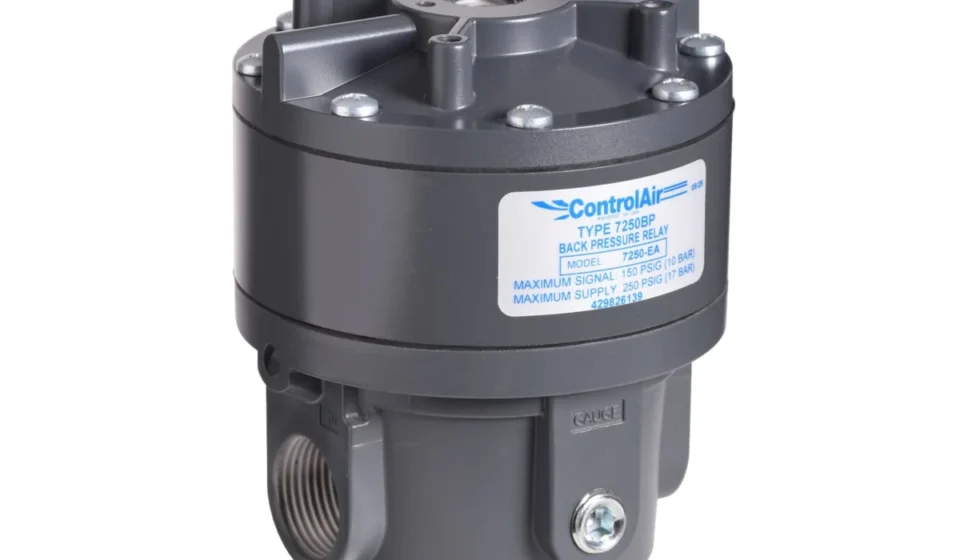
Enhancing Industrial Precision: ControlAir Unveils Type 715BP and 7250BP Back Pressure Regulators

In the demanding landscape of modern industrial pneumatic systems, the necessity for precise pressure management and equipment protection has never been more critical. Recognizing this need, ControlAir LLC, a global leader in precision air control, has officially announced the launch of its latest innovation: the Type 715BP and Type 7250BP signal-operated back pressure regulators. Designed to offer unparalleled control and flow capacity, these new units are poised to set a new benchmark for reliability in industrial automation and process control.
Main Facts: A New Standard in Pressure Regulation
The Type 715BP and Type 7250BP represent the next generation of signal-operated back pressure regulation. Operating on a 1:1 signal-to-output ratio, both models function as normally closed valves, engineered to open automatically when upstream pressure exceeds the defined control signal or setpoint. This mechanism is vital for systems where safeguarding downstream equipment from the hazards of over-pressurization is paramount.
The introduction of these regulators addresses a specific gap in the market: the need for high-performance units that can handle varying flow conditions while maintaining structural integrity. Both models boast an impressive operating capability, handling system pressures up to 250 psig and signal pressures up to 150 psig. Constructed with robust aluminum bodies, these regulators are designed to endure the rigors of heavy-duty industrial service.
Chronology: The Evolution of ControlAir’s Product Line
ControlAir’s trajectory has long been defined by its commitment to pneumatic precision. To understand the significance of the 715BP and 7250BP launch, one must look at the company’s historical focus on air preparation and regulation.
Early Foundations
Since its inception, ControlAir has prioritized the development of I/P transducers and high-precision pressure regulators. For decades, the company has served as a key supplier to industries ranging from automotive manufacturing to oil and gas.
The Shift Toward Signal-Operated Systems
In the mid-2010s, ControlAir identified a trend toward increased integration of electronic controls in pneumatic circuits. This shifted the engineering focus from purely mechanical regulation to signal-driven pneumatic systems. The development of the 715BP and 7250BP is the culmination of years of R&D aimed at perfecting the interface between electronic signal pressure—often provided by an I/P transducer—and physical pneumatic flow relief.
The Development Cycle
The design process for these regulators involved extensive stress testing to ensure stability in high-vibration environments. The Type 715BP, in particular, underwent significant iterations to perfect its "isolated control chamber," a feature designed to mitigate hunting and vibration—common issues that plague less sophisticated regulators in high-accuracy applications.

Supporting Data: Technical Specifications and Performance Metrics
The distinction between the Type 715BP and the Type 7250BP lies in their intended application environments. Understanding their technical specifications is essential for engineers tasked with system integration.
Type 715BP: Precision and Stability
The Type 715BP is engineered for applications requiring high accuracy and moderate flow capacity. Key data points include:
- Flow Capacity: Up to 90 SCFM.
- Sensitivity: Extremely high, with sensitivity as low as 1/4 inch water column.
- Maintenance Advantage: A standout feature is its design for "on-line" maintenance, allowing technicians to service internal components without disconnecting the unit from the air line, significantly reducing system downtime.
Type 7250BP: High-Capacity Relief
For heavy-duty applications where volume is the priority, the Type 7250BP offers:
- Flow Capacity: Up to 375 SCFM, making it ideal for large-scale industrial relief and emergency venting.
- Response Time: Optimized for rapid response to pressure surges, ensuring that downstream equipment is protected instantaneously during process upsets.
- Versatility: The unit is capable of venting excess pressure directly to the atmosphere or, alternatively, can be configured to trigger emergency shut-off systems.
Universal Specifications
Both models are designed for global adaptability, featuring:
- Porting: Multiple port sizes available for varied system requirements.
- Certifications: ATEX certification options, allowing for use in potentially explosive atmospheres—a critical requirement for the petrochemical and chemical processing sectors.
- Temperature Resilience: Available with extended temperature range options to ensure consistent operation in extreme climate conditions.
Official Perspectives: Engineering for the Future
While ControlAir has not released a singular press statement from their executive board, industry insiders and lead engineers at the company emphasize that these products were designed with the "IIoT-ready" factory in mind. By allowing users to adjust signal pressure remotely via transducers, these regulators bridge the gap between legacy pneumatic hardware and modern digital control architectures.
"Our goal was to create a regulator that behaves as a silent guardian," noted an internal engineering lead familiar with the product development. "In automated systems, the regulator is often the last line of defense against catastrophic failure. By improving sensitivity in the 715BP and throughput in the 7250BP, we are giving our clients the ability to operate their systems closer to their theoretical maximum efficiency without the fear of over-pressure damage."
Implications: Impact on Modern Industry
The introduction of the Type 715BP and 7250BP carries significant implications for several key industrial sectors.

Enhancing Industrial Automation
In automated assembly lines, precision is the difference between a high-yield process and one plagued by rejects. The 715BP’s high sensitivity allows for tighter control of pneumatic actuators, ensuring that forces remain constant even if air supply pressures fluctuate slightly.
Process Control and Safety
In the chemical and oil and gas industries, safety is the primary metric of success. The 7250BP’s ability to act as an emergency relief valve is a major asset. By integrating these regulators into safety instrumented systems (SIS), plant operators can create a secondary, purely pneumatic fail-safe that operates independently of the plant’s electrical logic, providing a vital layer of defense against power-related control failures.
Reduced Maintenance Costs
The "on-line" maintenance capability of the 715BP is a game-changer for facilities operating under a 24/7 production schedule. Traditional regulators often require the entire line to be depressurized and dismantled for seal replacements or diaphragm checks. The ControlAir approach, which allows for top-side access, minimizes the "Mean Time To Repair" (MTTR), thereby increasing the overall equipment effectiveness (OEE) of the manufacturing plant.
Environmental and Energy Considerations
Precision regulation is inherently linked to energy efficiency. By preventing the "leaking" or "hunting" associated with inferior regulators, these units minimize the waste of compressed air—a significant utility cost in many manufacturing environments. By maintaining precise setpoints, the 715BP and 7250BP ensure that compressors are not cycling unnecessarily, leading to a smaller carbon footprint and lower operational expenditures for the end user.
Conclusion: The Path Forward
ControlAir’s release of the Type 715BP and 7250BP regulators is more than just a product update; it is a strategic alignment with the needs of a modern, safety-conscious, and efficiency-driven industrial sector. By focusing on the critical pillars of sensitivity, high flow, and ease of maintenance, ControlAir has provided a versatile solution that addresses both the delicate requirements of precision flow control and the aggressive demands of industrial pressure relief.
As industries continue to trend toward higher levels of automation and stricter safety compliance, the reliance on robust, dependable hardware becomes non-negotiable. The Type 715BP and 7250BP are well-positioned to serve as the backbone of these critical systems, offering a reliable, high-performance solution that engineers can trust to keep their operations safe, efficient, and productive.
For those looking to integrate these regulators into existing or upcoming projects, detailed specifications, configuration tools, and technical support are available through the official ControlAir website. As the industrial landscape evolves, the 715BP and 7250BP serve as a testament to the fact that even in an age of digital transformation, the physical fundamentals of pneumatic regulation remain the heartbeat of the manufacturing world.