


Revolutionizing Aerospace Manufacturing: ORNL and Boeing’s Breakthrough in Multi-Material Additive Manufacturing

In a significant leap forward for industrial manufacturing, Oak Ridge National Laboratory (ORNL) and Boeing have successfully engineered a massive, two-ton steel Stamp Form Die (SFD) mold using wire-arc additive manufacturing (WAAM). This achievement, part of NASA’s Hi-Rate Composite Aircraft Manufacturing (HiCAM) project, represents a pivotal shift in how large-scale industrial tools are conceptualized, designed, and fabricated. By successfully printing a complex, multi-alloy tool with integrated thermal management, the collaboration has demonstrated that additive manufacturing (AM) is ready to graduate from prototyping to the heavy-duty production floor.
Main Facts: A Giant Leap in Metal Additive Manufacturing
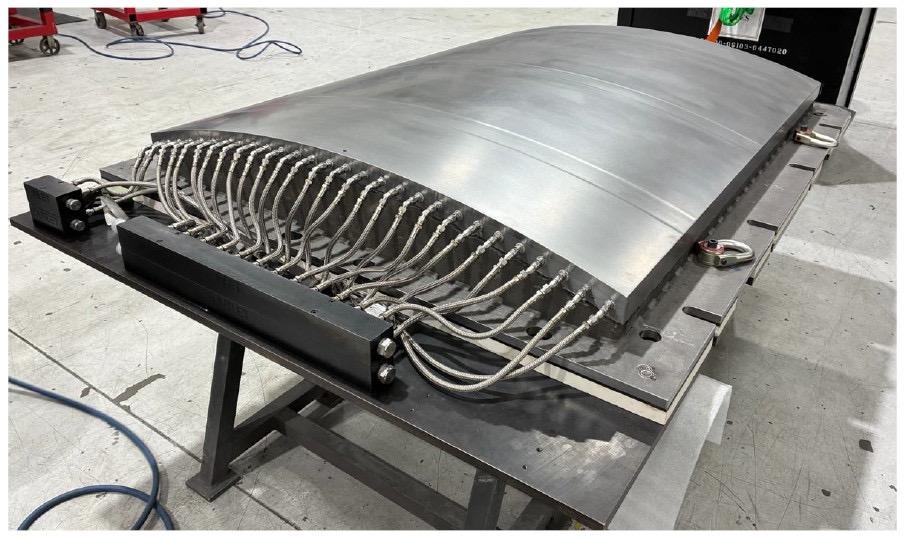
The mold stands as a testament to the capabilities of modern robotics and material science. Measuring six feet tall and four feet wide, this two-ton steel structure is not merely a proof of concept; it is a high-performance tool designed to survive the rigors of thermoplastic composite part production.
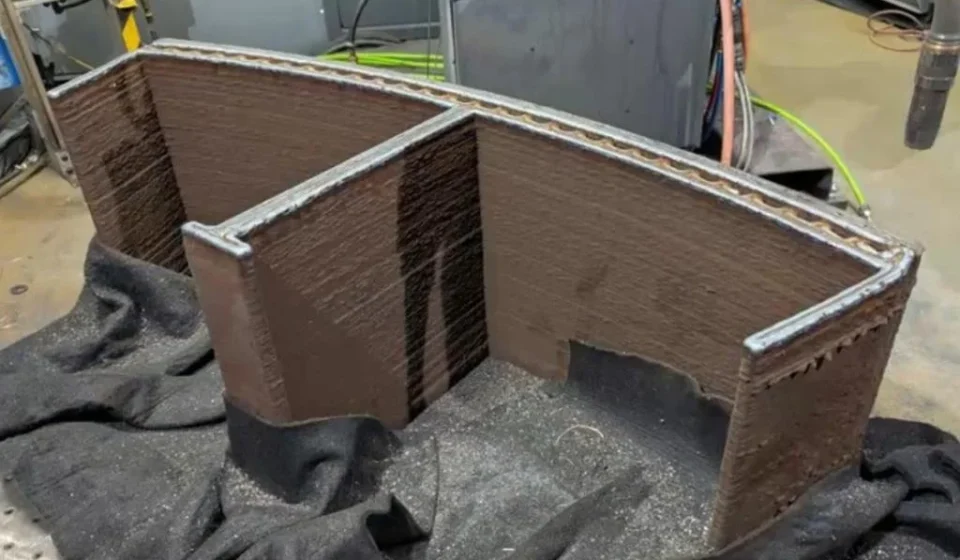
The manufacturing process, which spanned eight weeks, utilized ORNL’s proprietary Arc-1 system. Unlike standard WAAM setups that rely on a single feed, the Arc-1 system utilizes a sophisticated robotic arm and a multi-wire welding torch configuration. This allows the system to switch between or combine different metals during the printing process. For this specific mold, the team utilized a dual-alloy strategy: mild steel was used to construct the structural core, providing necessary rigidity and mass, while stainless steel was deposited on the working surface to ensure corrosion resistance, dimensional stability, and long-term durability.
Perhaps the most innovative feature of the mold is the inclusion of conformal cooling channels. In traditional manufacturing, creating channels for heating and cooling fluids requires drilling long, straight holes into a solid block of metal, which often leads to uneven temperature distribution. By printing the tool, the team was able to incorporate curved, internal channels that follow the exact geometry of the mold, allowing for significantly more efficient thermal regulation during the thermoplastic pressing process.
Chronology: From Digital Concept to Physical Reality
The development of this tool was a highly iterative process that required precise coordination between laboratory research and industrial application.
Phase 1: Simulation and Design Optimization
Before a single drop of metal was deposited, the team engaged in extensive computer-aided engineering. The primary challenge identified early on was the risk of structural warping. As metal is deposited at high temperatures, the subsequent cooling phase creates residual thermal stresses that can cause the structure to twist or deviate from its intended dimensions. To combat this, the team ran 32 distinct simulation iterations. Through this "digital twin" approach, they were able to adjust the design to compensate for anticipated distortion, effectively building the correction into the print path.
Phase 2: The Build Process
The printing phase occurred at the Department of Energy’s Manufacturing Demonstration Facility (MDF) at ORNL. To manage the inherent stresses of such a large build, the team attached temporary support ribs to the back of the mold. These ribs acted as a scaffold, maintaining the structure’s integrity as it grew layer by layer. The Arc-1 system operated continuously, managing the transition between the mild steel base and the stainless steel face, a process that requires precise control of welding parameters to ensure metallurgical compatibility between the two alloys.
Phase 3: Post-Processing and Refinement
Once the raw print was completed, the mold was transported to Baker Industries, a Lincoln Electric subsidiary in Michigan. Here, the tool underwent annealing—a heat-treatment process designed to relieve internal stresses locked in during the printing phase. Following the removal of the temporary support ribs, the mold underwent final CNC finish machining to ensure the surface met the stringent tolerances required by Boeing for aircraft component production.
Supporting Data: The Efficiency of the Multi-Material Approach
While cost and lead-time metrics remain proprietary, the technical advantages of this project are clear. The integration of multi-material deposition allows for the "fine-tuning" of mechanical performance. By separating the structural requirements (strength and stiffness) from the functional requirements (corrosion resistance and surface durability), engineers can optimize material usage, potentially reducing the consumption of expensive high-grade alloys.
The comparison with other industry efforts highlights the unique nature of the ORNL/Boeing project. For example, a recent collaboration between Italy’s Eligio Re Fraschini and Caracol utilized WAAM to produce a spar tool that achieved a 50% weight reduction compared to traditional methods. However, that tool was smaller and made from a single alloy without integrated thermal channels. Similarly, Australia’s AML3D is currently working with an aerospace partner to address the industry’s massive "tooling bottleneck"—where lead times for traditional tools can stretch up to 24 months. While these projects are vital for the advancement of WAAM, the ORNL/Boeing mold stands out as the most complex application to date, combining multi-material deposition with advanced conformal thermal control on a massive, production-grade scale.
Official Responses: Aligning for the Future of Flight
The project serves as a cornerstone for NASA’s HiCAM initiative, which aims to modernize the production of composite aircraft to meet the skyrocketing global demand for air travel.
"NASA and its industry partners are working to increase the production rate of composite aircraft to meet the growing demand for air travel and to reduce aircraft weight, which improves fuel efficiency, lowering costs for aircraft operators," stated Richard Young, NASA HiCAM project manager. "Doing so is essential to maintaining U.S. competitive advantage in the commercial aircraft industry."
For the engineers at ORNL, the project was a critical "test case" for the scalability of the technology. "Boeing wanted to explore the possibility of using WAAM," noted William Carter, ORNL robotics engineer at the MDF. "They worked with us to evaluate the issues in making the mold."
Andrzej Nycz, a senior robotics engineer at ORNL, underscored the significance of the material science involved, noting that "multi-material WAAM allows for the realization of completely new designs, combining fine-tuned mechanical performance with time and cost savings."
Implications: The Industrialization of Additive Manufacturing
The success of the Stamp Form Die mold project has profound implications for the future of American manufacturing. By demonstrating that large, complex, and thermally efficient tools can be printed, ORNL and Boeing have effectively opened the door for similar innovations in other high-stakes sectors, including the automotive and energy industries.
1. Disrupting the Tooling Bottleneck
The aerospace industry has long been hampered by the time and cost required to produce massive, high-tolerance molds. By shifting from subtractive manufacturing (machining/casting) to additive, companies can potentially cut lead times from months to weeks. This agility is crucial for rapid prototyping and the ability to adapt to changing aircraft design requirements without waiting for long supply chain cycles.
2. Design Freedom and Performance
The ability to print conformal cooling channels is a game-changer. Standard, straight-drilled channels often leave "hot spots" or "cold spots" in a mold, leading to inconsistent parts and longer cycle times. Conformal channels allow for uniform heating and cooling, which improves the quality of thermoplastic composite parts, reduces scrap rates, and increases the throughput of the manufacturing process.
3. Strengthening the Supply Chain
The project was not a solo endeavor; it involved a network of small and large US businesses, facilitated by a Cooperative Research and Development Agreement (CRADA). This ecosystem approach demonstrates how national labs can bridge the gap between basic research and commercial application, helping to revitalize the US manufacturing sector by integrating new technologies into established industrial workflows.
As the industry moves toward 2026 and beyond, the success of this mold serves as a beacon for what is possible when government research institutions and private industry leaders align their resources. While the transition from traditional forging and machining to large-scale metal AM is still in its infancy, the Boeing/ORNL mold provides a tangible, two-ton piece of evidence that the future of aerospace manufacturing will be defined by the precision of the robotic arm and the versatility of the additive print.