




Tripo AI Secures $447M: A Watershed Moment for Generative 3D Foundation Models

In a move that underscores the explosive growth of the generative AI sector, Tripo AI—a pioneering force in 3D foundation models and world models—has successfully closed a monumental funding round. The company announced it has secured approximately 3 billion yuan, equivalent to roughly $447 million, across its Series B and Series B+ financing stages. Led by MPCi, the capital infusion arrives as the industry grapples with the transition from simple 2D image generation to the complex, high-fidelity world of 3D asset creation.
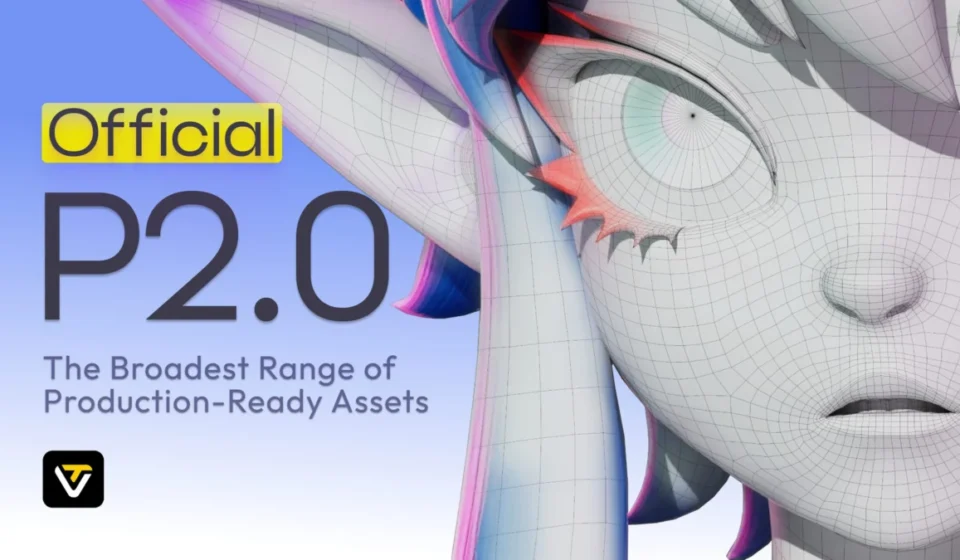
Concurrent with this significant financial milestone, Tripo AI has unveiled the preview of its latest flagship model, Tripo P2.0. This release is being hailed by industry analysts as a critical advancement, as it marks the first time a 3D-native foundation model has supported quad-based topology—a technical requirement that has long served as a bottleneck for professional-grade game design and animation pipelines.
A Diverse Financial Coalition
The sheer scale of this investment round reflects the high-stakes nature of the current AI race. The funding was not provided by a single source, but rather by a broad, diverse coalition of strategic industry giants and institutional financial backers.
Strategic investors—many of whom are likely to integrate Tripo’s technology into their own production pipelines—include Perfect World, BlueFocus, SPC, Yanqu Games, ThunderSoft, and 37 Interactive Entertainment. These entities represent the vanguard of the interactive entertainment and gaming sectors, where the ability to rapidly generate 3D props and characters is a transformative business advantage.
On the financial side, the round was supported by a roster of heavyweights, including CDH Venture, Growth Capital, CICC, CMC Capital Partners, Hongtai Aplus, 3H Health, Zhongping Capital, and GreatOrigin Asia. Furthermore, the company saw a robust vote of confidence from its existing cap table, with investors such as Fortune Capital, Primavera Capital, 4399 Network, Muhua Tech Ventures, Vitalbridge Capital, INCE Capital, and T-Capital increasing their commitments.
According to company statements, the capital will be strategically allocated to three primary pillars: the advancement of 3D-native foundation models and proprietary data infrastructure, the massive expansion of computing capacity required for the next generation of AI training and inference, and the aggressive acceleration of product development and commercialization.

Tripo P2.0: Solving the Topology Problem
The core of the excitement surrounding the Tripo P2.0 announcement lies in its technical architecture. In the world of 3D modeling, "topology"—the way a mesh is constructed—is everything. Most current generative AI models produce triangle-based meshes, which are often "dirty" and difficult for artists to manipulate. They require tedious "retopology" work before they can be rigged or animated.
Tripo P2.0 changes this by introducing native support for quad topology. By building assets out of four-sided polygons rather than three-sided ones, Tripo P2.0 generates models that are inherently cleaner, more efficient, and immediately ready for professional animation workflows.
Key Technical Upgrades in P2.0:
- Expanded Mesh Budgets: While the predecessor, P1.0, was limited to 20,000 triangle faces, P2.0 pushes the boundaries significantly. It supports up to 50,000 faces for triangle meshes and introduces a dedicated quad topology mode supporting up to 25,000 faces. This increase allows for significantly higher detail in hard-surface mechanical assemblies and complex character meshes.
- Multi-View Reconstruction: The model utilizes a sophisticated input pipeline, accepting up to four reference images (front, left, right, and back). This multi-view approach drastically improves the accuracy of the "hidden" sides of an object, solving the common issue of hallucinated or distorted rear geometry often found in single-image generative models.
- Rapid Generation: Despite the increase in complexity, Tripo has optimized its inference engine to produce assets in approximately 10 to 40 seconds, depending on the requested polygon count.
Chronology of Rapid Expansion
The trajectory of Tripo AI’s growth over the past twelve months serves as a microcosm for the entire generative 3D industry.
- Early 2026: Tripo AI secured a $50 million infusion from tech giants Alibaba and Baidu Ventures. At the time, this was considered a robust investment for the sector.
- Mid-2026: The competitive landscape intensified as rivals like Meshy secured nearly $400 million in a Series B round, valuing their business at $1.5 billion. This highlighted the "arms race" mentality currently dominating the market.
- Late 2026: The industry saw significant consolidation, most notably with Alphabet’s acquisition of Common Sense Machines. This confirmed that the world’s largest tech companies view 3D generative AI as a critical component of their long-term infrastructure.
- Present Day: Tripo AI’s $447 million round places it squarely at the front of the pack, proving that for companies with the right technological edge, capital access remains highly liquid.
Implications for Game Development and Embodied AI
The implications of this technology extend far beyond static assets. The game development industry is currently facing a "content crisis"—the cost and time required to build high-fidelity 3D worlds are ballooning as player expectations rise.
By automating the creation of quad-topology meshes, Tripo P2.0 allows developers to skip the most time-consuming parts of the production pipeline. A character generated in seconds can, in theory, be brought directly into a software suite like Maya or Blender, rigged with a skeleton, and put into an animation state immediately. This "production-ready" output is the holy grail for indie studios and large-scale game houses alike.
Furthermore, as the industry pivots toward Embodied AI—the science of giving robots and AI agents a "physical" presence in the world—the need for high-quality, simulated 3D environments becomes paramount. Tripo’s focus on "world models" suggests they are looking to build not just individual items, but the underlying logic of how objects interact in 3D space, which will be essential for training autonomous agents.

The Market Context: A Shift from Niche to Essential
The transition of 3D generative AI from a niche research interest to a multi-billion dollar sector is now complete. The rapid-fire rounds of funding from companies like Tripo AI and Meshy, coupled with the strategic acquisition of smaller players like Common Sense Machines by Alphabet, signal a maturing market.
Investors are no longer looking for simple "proof of concept" demos; they are looking for scalable infrastructure. The market is increasingly dominated by a "winner-take-most" dynamic, where the models that offer the highest degree of control, the most efficient topology, and the best integration with existing industry-standard software (like Unity or Unreal Engine) will become the industry standard.
For Tripo AI, the challenge moving forward will be stability. While the P2.0 preview is a significant leap, the company has acknowledged that a full release, including further improvements to stability and user control, is still on the horizon.
Conclusion: The Path Ahead
As Tripo AI moves to scale its computing infrastructure, the broader 3D industry is watching closely. The ability to generate complex, quad-topological geometry on demand is a foundational shift in how digital content will be produced over the next decade.
With nearly $447 million in new funding and a clear technological path established by the P2.0 release, Tripo AI is no longer just a research startup—it is a critical player in the future of the digital economy. Whether in gaming, virtual reality, or the simulation environments required for robotics, the company is positioning itself to be the primary engine behind the next generation of 3D content creation.
As the competition intensifies and capital continues to pour into this vertical, the winners will be those who can successfully bridge the gap between AI-generated chaos and the precise, structured requirements of professional creative workflows. With P2.0, Tripo AI has taken a massive step toward bridging that divide.