



Beyond the Software: Why Strategic Leadership is the Missing Link in Enterprise Asset Management (EAM) Digital Transformations

By Chetan Madaan | Maintenance World
In capital-intensive industries ranging from oil and gas to heavy manufacturing and utilities, executives are constantly searching for the silver bullet to maximize efficiency. For decades, that silver bullet has been technology. Organizations pour millions of dollars into cutting-edge Enterprise Asset Management (EAM) software, computerized maintenance management systems (CMMS), and Internet of Things (IoT) sensors, anticipating immediate, game-changing operational improvements.
Yet, a staggering number of these digital transformation initiatives fall short of expectations. Software and technology alone, industry experts warn, are fundamentally incapable of delivering sustainable gains in isolation.
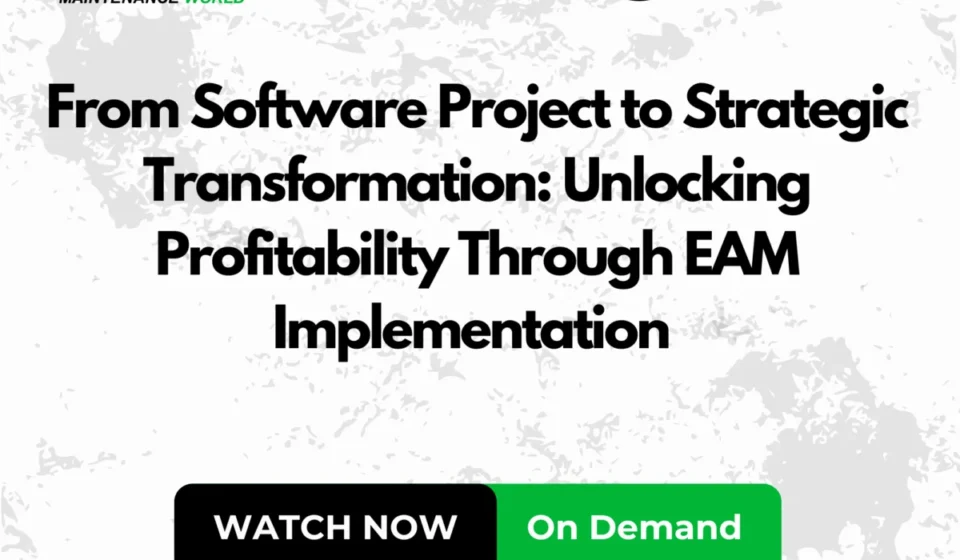
To unpack this persistent challenge, a panel of global industry veterans is set to convene for an exclusive webinar titled "Embracing Digital Transformation in Maintenance & Plant Operations." Scheduled for March 13 at 10:00 AM EST, the session aims to reframe how plant leaders, IT sponsors, and executives approach modernization. Rather than viewing technology as an end in itself, the panel will argue that true operational excellence requires a synergy of strategic leadership, optimized maintenance practices, and cultural alignment.
The Core Dilemma: Why Technology Fails Without Strategy
For many organizations, digital transformation begins with an expensive software procurement process. Companies license powerful EAM platforms, migrate legacy data, and roll out the systems across plants. Months later, leadership often confronts a disheartening reality: downtime remains high, maintenance backlogs are growing, and the software is either underutilized or actively resisted by frontline workers.
According to global experts participating in the upcoming March 13 webinar, the root cause of this failure is rarely the software itself. Instead, it stems from a fundamental misunderstanding of change management. Implementing an EAM system is not merely an IT upgrade; it is a profound operational overhaul that alters how people work, communicate, and make decisions.
When organizations treat EAM deployment as an IT project rather than a business transformation, they encounter predictable pitfalls. Without engaged leadership to champion the change, employees view new software as administrative friction rather than a tool to make their jobs easier. Consequently, data integrity plummets, workflows are bypassed, and the promised return on investment (ROI) evaporates.
Chronology of an EAM Evolution: From Reactive Maintenance to Smart Operations
To understand where modern asset management stands today, it is helpful to examine the historical evolution of maintenance strategies across capital-intensive sectors.
- The Era of Reactive Maintenance (Pre-1990s): For decades, maintenance was viewed purely as a cost center. Equipment was run to failure, and technicians operated in a strictly firefighting mode. Record-keeping was manual, paper-based, and localized.
- The Advent of Computerized Systems (1990s–2000s): The introduction of early CMMS and basic EAM platforms allowed organizations to digitize work orders, track spare parts inventory, and schedule basic preventive maintenance. However, these systems were often siloed, difficult to use, and dependent on manual data entry.
- The Digital Transformation Boom (2010s–Present): Cloud computing, advanced analytics, mobile maintenance devices, and IoT sensors transformed EAM systems into comprehensive enterprise platforms. Organizations gained the ability to monitor asset health in real time.
- The Current Bottleneck: Despite advanced technological capabilities, many companies find themselves bottlenecked not by hardware or software limitations, but by human factors—specifically, organizational culture, legacy habits, and a lack of standardized workflows.
The upcoming webinar is designed to address this modern bottleneck, providing participants with a roadmap to bridge the gap between technological potential and operational reality.
Supporting Data: The Profitability Impact of Holistic EAM
While technology alone cannot solve operational inefficiencies, integrating well-designed EAM processes with engaged leadership yields measurable, high-impact financial results.
According to preview insights from the panel, organizations that successfully pivot their implementation strategies can unlock profitability improvements of 3% to 5%. In capital-intensive industries operating on thin margins, a 3% to 5% boost in profitability represents millions of dollars in bottom-line value.
These gains are typically achieved across three primary pillars:
- Asset Performance Optimization: By shifting from reactive firefighting to strategic preventive and predictive maintenance, plants experience dramatic reductions in unplanned downtime. Equipment operates at higher OEE (Overall Equipment Effectiveness) rates, extending asset lifespans and deferring costly capital replacements.
- MRO (Maintenance, Repair, and Operations) Inventory Control: Poorly managed storerooms tie up massive amounts of working capital in obsolete or redundant spare parts, while failing to stock critical components when emergencies strike. A strategic EAM implementation rationalizes MRO inventory, reduces carrying costs, and ensures parts are available precisely when needed.
- Working Capital Reduction: Streamlining maintenance workflows and optimizing inventory directly reduces working capital tied up in the plant, freeing up cash flow for strategic business investments.
Official Perspectives: Shifting the Roadmap
The panel discussion will draw extensively on real-world experiences across diverse industrial sectors. Rather than presenting theoretical models, the speakers will confront the messy, complex realities of plant floor operations.
Executives, plant managers, and IT sponsors often speak different languages. IT professionals focus on system architecture, data security, and software deployment timelines. Plant managers care about safety, production output, and minimizing equipment downtime. Maintenance technicians care about practical usability and reliable tools.
The webinar will provide a practical framework to align these disparate stakeholders. Attendees will learn how standardized work processes—when implemented correctly—serve as the connective tissue that bridges the gap between boardroom strategy and front-line execution.
Furthermore, the discussion will highlight proven methods for driving cultural change. Best practices do not stick because they are written in a manual; they stick when leadership actively demonstrates their value, removes institutional barriers, and empowers workers to take ownership of asset reliability.
Broader Implications for Industry Leaders
As global markets face economic headwinds, supply chain volatility, and increasing pressure to operate sustainably, the margin for error in plant operations is shrinking. Organizations can no longer afford the luxury of failed software rollouts or stalled digital transformations.
The implications of the March 13 webinar extend far beyond software configuration. They touch on core questions of corporate governance, workforce engagement, and operational resilience:
- Redefining IT and Operations Partnership: Companies must move away from the traditional model where IT dictates software implementation and operations simply receives it. A collaborative, co-led approach is essential.
- Investing in People Over Software: While budgeting for software licenses is straightforward, budgeting for change management, continuous training, and cultural alignment is what ultimately determines success.
- Building Sustainable Competencies: True digital transformation is not a one-time event with a completion date. It is an ongoing journey of continuous improvement, supported by systems that adapt to evolving business needs.
Related Industry Training and Development
For professionals looking to deepen their expertise in plant maintenance, asset reliability, and condition monitoring, a range of specialized training and certification opportunities are available throughout the year:
- Electric Motor Testing Certification (PdMA Corporation): Designed to provide rigorous training for technicians and analysts, enabling them to achieve motor testing certification and evaluate motor circuit conditions. Courses are offered on multiple dates in Tampa, Florida.
- Develop and Manage Preventive Maintenance (IDCON): Scheduled for March 13–14 and November 7–8, this hybrid (online/in-person) training helps organizations establish the right preventive maintenance strategy, task frequencies, and documentation methods based on equipment criticality.
- Essential Care and Inspection Techniques (IDCON): An in-person, hands-on training course in Raleigh, NC (August 21–23) focusing on foundational equipment care, condition monitoring, and smart inspection techniques for maintenance technicians and operators.
- Introduction to MCEMAX (PdMA Corporation): Training focused on safely performing MCE® and EMAX tests to evaluate motor circuit health.
- Vibration Analysis Courses (Vibration Institute): Offering programs such as the Vibration Analysis Overview (VAO) for non-practitioners (management, sales, engineering, and purchasing) and CAT III Machinery Vibration Analysis for advanced technical evaluation and certification preparation.
Register for the Webinar
To learn more about how your organization can reposition its EAM implementation, avoid costly pitfalls, and drive a 3% to 5% improvement in profitability, secure your spot at the upcoming webinar.
- Event: [webinar] Embracing Digital Transformation in Maintenance & Plant Operations
- Date & Time: March 13 at 10:00 AM EST
- Registration: Click here to register via Zoom
Join the conversation by visiting the Maintenance World Information Exchange, or subscribe to receive weekly maintenance tips delivered directly to your inbox.