


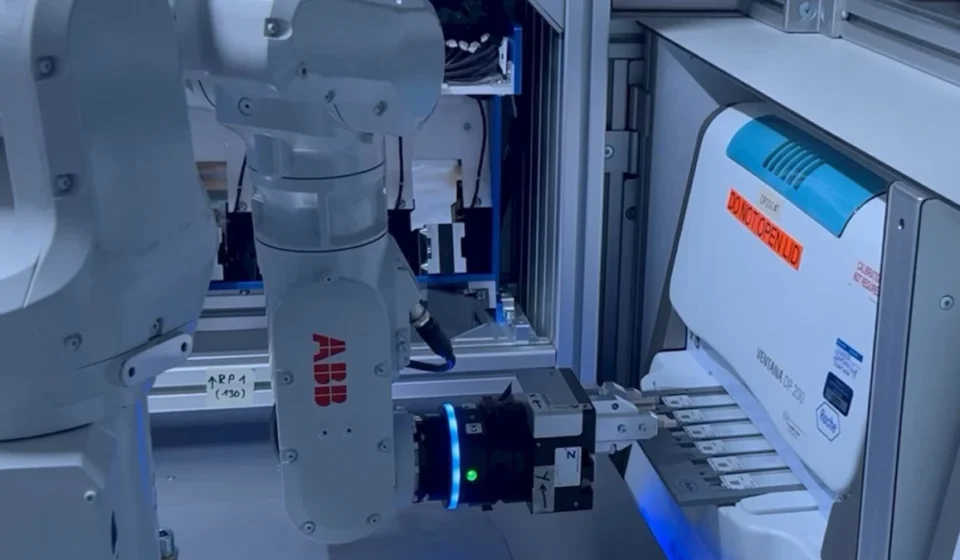
The Future of Diagnostics: ABB Robotics and Roche Forge Global Alliance to Transform Laboratory Automation

In a strategic move set to reshape the landscape of clinical diagnostics, ABB Robotics has announced a landmark global collaboration with Roche Diagnostics. This partnership aims to bridge the gap between high-tech industrial automation and the precision-driven environment of the clinical laboratory. By integrating ABB’s advanced robotic systems with Roche’s deep-seated diagnostics expertise, the two industry giants seek to tackle the mounting pressures of modern healthcare, from chronic labor shortages to the accelerating demand for personalized medicine.
Main Facts: A Convergence of Expertise
The collaboration is built upon a synergistic division of labor. ABB Robotics, a world leader in industrial automation, will leverage its extensive portfolio of robotic hardware, sophisticated software ecosystems, and global manufacturing footprint to engineer bespoke solutions for laboratory environments. Roche, meanwhile, provides the essential clinical context—ensuring that these robotic systems are not just technically sound, but optimized for the rigorous, highly regulated, and time-sensitive nature of medical testing.
The primary objective is the development of connected, flexible laboratory workflows. Rather than static automation, the partnership envisions a dynamic environment where robots and diagnostic instruments operate in a unified, intelligent ecosystem. Initial development efforts are concentrated on two critical pillars of the laboratory:
- Pathology Workflow Optimization: ABB will develop specialized systems for slide handling and organization, facilitating the transition toward fully digital and connected pathology workflows.
- Centralized Lab Logistics: In high-volume central diagnostic labs, the focus shifts to autonomous mobile manipulators (AMMs). These robots will be tasked with the movement of samples and sensitive materials between testing instruments, replacing manual transport with consistent, automated flow.
Chronology: The Evolution Toward Lab Autonomy
The roots of this collaboration lie in a long-term trend toward the industrialization of the healthcare sector. While the official announcement marks a formal turning point, the industry has been trending toward this moment for several years.
- Pre-2024: Clinical laboratories began identifying "islands of automation," where individual testing instruments were automated, but the gaps between them remained manually intensive.
- Early 2025: Discussions intensified regarding the integration of "Physical AI"—the ability of robots to perceive, reason, and act in real-world environments—as a solution to the unpredictability of busy, human-centric lab spaces.
- July 2026 (Announcement): ABB Robotics and Roche Diagnostics formally entered their global collaboration agreement, signaling a shift from experimental lab robotics to scalable, commercialized solutions.
- Future Outlook: The coming 18 to 24 months are expected to focus on pilot deployments in flagship laboratories, with a phased rollout of these robotic systems intended to reach global markets by the end of the decade.
Supporting Data: Why Diagnostics Demand Innovation
The urgency of this collaboration is underscored by stark industry statistics. According to data supported by the U.S. Food and Drug Administration (FDA) and the Centers for Medicare & Medicaid Services (CMS), approximately 70% of all medical treatment decisions are informed by diagnostic test results. This heavy reliance places laboratories at the center of the patient care journey.
However, the current diagnostic ecosystem is fragile. Three key variables are driving the need for this systemic overhaul:
1. The Workforce Crisis
Laboratories globally are grappling with a significant talent shortage. Fewer professionals are entering the fields of medical laboratory science, while the existing workforce faces burnout due to repetitive, high-stress tasks. By automating manual logistics—such as moving racks of samples—labs can reallocate skilled human professionals to high-value interpretive work, where their medical expertise is irreplaceable.

2. The Aging Population
As the global demographic shifts toward an aging population, the volume of diagnostic tests is expected to climb exponentially. This surge creates a bottleneck in traditional lab models, which are often ill-equipped to handle the resulting increase in sample volume without compromising speed or accuracy.
3. The Rise of Personalized Medicine
Modern medicine is moving away from a "one-size-fits-all" approach, favoring diagnostics that tailor treatment to individual genetic profiles. This shift requires a higher frequency of testing and a more complex array of sample types. Robotic automation provides the consistency and traceability required to manage these complex, individualized diagnostic pathways.
Implications for the Laboratory Ecosystem
The implications of this partnership extend far beyond the introduction of a few robots; they represent a fundamental change in the "digital twin" of a laboratory.
The Role of Physical AI
A defining feature of this collaboration is the application of Physical AI. Traditional automation is rigid; it requires fixed paths and predictable environments. Physical AI allows ABB’s robots to use real-world sensor data to adapt in real-time. If a tray is misplaced or a corridor becomes congested with staff, an AI-equipped mobile manipulator can recalibrate its path, ensuring that the diagnostic process remains fluid. This is critical in a hospital setting, where speed can literally be the difference between life and death.
Enhancing Workflow Reliability
In clinical settings, consistency is as important as speed. Manual handling of samples introduces variability—the risk of human error, mislabeling, or contamination. By standardizing the movement of samples through autonomous systems, laboratories can guarantee a higher level of process integrity. This, in turn, provides clinicians with more reliable data, leading to more accurate diagnoses and better patient outcomes.
Operational Scalability
For laboratory managers, the partnership promises a modular approach to scaling. Because the robotic solutions are being developed to integrate with existing Roche instrumentation, labs will be able to scale their automation capabilities as demand grows, rather than undergoing a total infrastructure overhaul. This modularity is a key selling point for hospitals and private diagnostic networks looking to optimize capital expenditure.
Official Perspectives: A Synergy of Expertise
The collaboration is viewed as a meeting of minds. ABB Robotics brings the "physical" power of manufacturing-grade automation, while Roche provides the "clinical" brain.

Representatives from both sides have emphasized that the goal is not to replace the laboratory professional, but to "augment" their capabilities. By handling the "three Ds"—dull, dirty, and dangerous (or in this case, repetitive, error-prone, and labor-intensive)—the robots allow the laboratory staff to return to the heart of the profession: analysis, clinical decision-making, and patient advocacy.
"This is not just about moving samples from Point A to Point B," noted industry analysts tracking the deal. "It is about the end-to-end orchestration of the diagnostic process. When you integrate robots with the software that manages the lab, you create a system that can predict bottlenecks before they occur."
Conclusion: Setting a New Standard
As the healthcare sector continues to navigate the dual challenges of increasing volume and limited resources, the ABB-Roche alliance serves as a bellwether for the future of clinical infrastructure. By shifting from manual-heavy, siloed processes to a cohesive, automated, and AI-driven model, these organizations are establishing a new standard for diagnostic reliability.
The success of this collaboration will likely be measured by how seamlessly these robots integrate into the frantic pace of hospital life. If successful, the model established by ABB and Roche could become the blueprint for laboratories worldwide, proving that the future of medicine is as much about sophisticated engineering as it is about biological science.
For healthcare providers, the message is clear: the labs of the future will be defined by their ability to harmonize human expertise with the precision of intelligent robotics. The partnership between ABB Robotics and Roche Diagnostics is the first major step toward realizing that vision on a global scale.