
Innovation in Industrial Safety: Robotic Submersible System Wins National Award for Eliminating Confined-Space Tank Hazards

INDIANAPOLIS — In the high-stakes world of industrial manufacturing, petroleum refining, and chemical processing, few operational challenges carry the persistent peril of tank inspections. For generations, maintaining regulatory compliance and structural integrity meant sending human workers into dark, enclosed, and potentially toxic environments—a practice fraught with catastrophic risks ranging from asphyxiation and engulfment to exposure to hazardous volatile organic compounds (VOCs).
On September 15, 2026, a major milestone in occupational safety was celebrated at the prestigious National Safety Council (NSC) Safety Congress & Expo in Indianapolis. Square Robot Inc. was officially named the recipient of the sixth annual Prevention through Design Award. The company earned the national accolade for engineering an innovative submersible robotic inspection system that completely removes the need for human workers to enter hazardous, enclosed industrial tanks.
The breakthrough technology addresses one of the most stubborn safety challenges in heavy industry. By keeping storage vessels sealed throughout the assessment process, Square Robot’s autonomous and remotely operated system has successfully driven confined-space entry rates down to absolute zero across 385 industrial tank inspections. Beyond transforming worker safety, the technology has demonstrated profound environmental benefits, assisting facilities in containing more than 695 tons of volatile organic compound emissions that otherwise would have escaped into the atmosphere during traditional degassing and ventilation procedures.
Main Facts: A Paradigm Shift in Industrial Safety
The core of Square Robot Inc.’s award-winning innovation lies in its ability to perform comprehensive non-destructive testing (NDT) and visual assessments while industrial tanks remain completely closed and, in many cases, still filled with product or processing liquids.
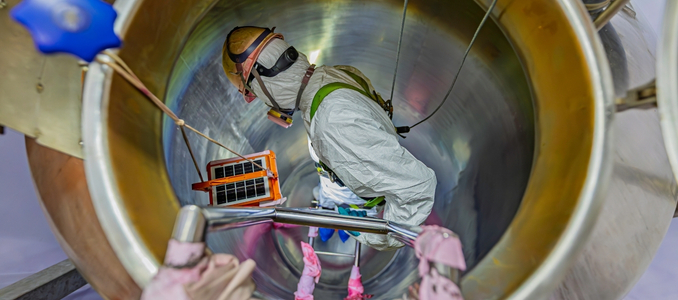
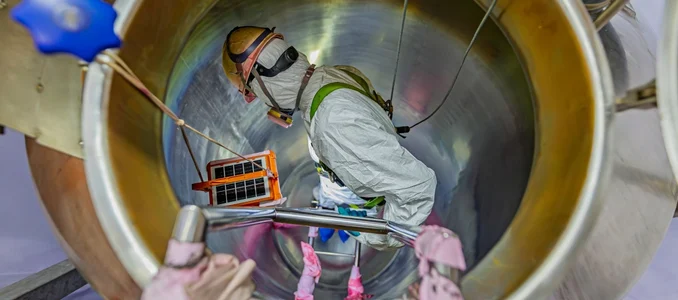
Traditionally, inspecting a large, cylindrical metal tank—such as those used in petroleum storage, chemical manufacturing, and wastewater treatment—required a laborious, multi-step process. Crews had to drain the vessel, flush out residual sludge, force massive volumes of fresh air through ventilation systems for days, and continuously monitor internal atmospheric conditions to ensure oxygen levels were safe and toxic gases were minimized. Even after these intensive preparatory steps, entering a confined space remained an inherently high-risk endeavor, requiring specialized safety harnesses, multi-person rescue teams standing by, and full personal protective equipment (PPE), including heavy respirators and specialized suits.
Square Robot’s submersible technology alters this operational paradigm fundamentally. Key elements of the achievement include:
- Zero Confined-Space Entries: Across 385 commercial and industrial tank inspections, the technology achieved a 0% human entry rate, eliminating the risk of fatalities, injuries, and near-misses associated with confined spaces.
- Sealed-System Operations: The robot operates entirely within closed tanks, bypassing the need for energy-intensive ventilation, purging, and prolonged atmospheric monitoring cycles.
- Environmental Impact: By keeping tanks sealed and bypassing the degassing phase, the system successfully contained more than 695 tons of fugitive volatile organic compound (VOC) emissions.
- National Recognition: The National Institute for Occupational SafetyH and Health (NIOSH) and the NSC recognized the technology at the 2026 NSC Safety Congress & Expo, underscoring its alignment with foundational "Prevention through Design" (PtD) principles.
Chronology: From Concept to National Recognition
The journey toward eliminating confined-space tank entries has evolved over decades, driven by advancements in robotics, material science, and computational software. While the exact timeline of Square Robot Inc.’s internal research and development reflects modern leaps in autonomous submersibles, the broader historical context highlights an industry-wide push for engineering controls over administrative rules and PPE.
The Era of Reactive Safety (Late 20th Century)
For decades, workplace safety regulations heavily relied on administrative controls and personal protective equipment to manage confined-space hazards. Occupational Safety and Health Administration (OSHA) standards mandated rigorous permit spaces, atmospheric testing protocols, and standby rescue teams. However, despite these stringent rules, confined-space incidents remained a leading cause of multiple-fatality accidents in industrial sectors, as human error, sudden atmospheric shifts, and mechanical failures frequently overcame procedural safeguards.

The Rise of Prevention through Design (2000s–2010s)
Recognizing the limitations of protecting workers after a hazard has been created, public health agencies and safety advocates championed the concept of "Prevention through Design" (PtD). Spearheaded largely in the United States by the National Institute for Occupational Safety and Health (NIOSH), PtD advocates for proactively addressing occupational safety and health risks at the earliest possible stage of product, process, or equipment design. Academic researchers and industrial engineers began exploring how remote-controlled tools and unmanned systems could keep workers entirely out of harm’s way.
Development and Deployment of Submersible Robotics (Early 2020s)
Square Robot Inc. entered the market by identifying a glaring operational bottleneck: tank inspections were costly, time-consuming, environmentally taxing, and dangerous. By developing buoyancy-controlled, magnetically tracked, and propeller-driven submersible robots capable of navigating corrosive liquids and capturing high-resolution ultrasonic and visual data, the company created a viable alternative to human entry. Engineers refined the systems to withstand harsh chemical environments, operate safely in flammable atmospheres (using explosion-proof designs), and transmit real-time structural data to operators stationed safely outside the containment zone.
The 2026 NSC Safety Congress & Expo Milestone (September 15, 2026)
The culmination of these technological advancements arrived in Indianapolis on September 15, 2026. Accepting the sixth annual Prevention through Design Award, representatives from Square Robot Inc. presented the empirical data gathered from 385 successful inspections. The milestone proved that robotic alternatives were no longer experimental novelties, but rather scalable, highly reliable industry standards capable of reshaping regulatory expectations for heavy industrial maintenance.
Supporting Data: Quantifying Safety and Environmental Gains
In the realm of industrial hygiene and safety engineering, quantitative metrics are essential for validating the efficacy of new interventions. The deployment data associated with Square Robot’s submersible system offers compelling proof of concept, illustrating how engineering out a hazard yields compounding operational advantages.

1. Eliminating Human Exposure Risks
The Occupational Safety and Health Administration defines a confined space as a space large enough for a worker to enter, possessing limited means of entry or exit, and not designed for continuous human occupancy. Permit-required confined spaces introduce specific health hazards, including toxic atmospheres, engulfment risks, and physical hazards.
By achieving zero human entries across 385 distinct tank inspections, Square Robot eliminated the following risk vectors for hundreds of workers:
- Asphyxiation and Anoxia: By avoiding oxygen-deficient internal atmospheres.
- Toxic Exposure: By eliminating direct dermal and respiratory contact with residual petrochemicals, acids, and heavy solvents.
- Physical Engulfment: By removing the need for workers to walk or maneuver on unstable sludge beds or structural floors undergoing corrosion.
- Rescue Emergencies: By removing personnel from the interior, the facility simultaneously eliminates the secondary hazard of rescue workers becoming casualties themselves—a tragically common occurrence in confined-space incidents.
2. Environmental Stewardship and VOC Containment
Industrial storage tanks, particularly in the oil, gas, and chemical refining sectors, are primary sources of fugitive volatile organic compound (VOC) emissions. Whenever a tank is opened for inspection or cleaning, the accumulated vapors inside must be vented, purged, or displaced into the atmosphere, contributing to local air pollution, greenhouse gas emissions, and regulatory non-compliance penalties.
The data reveals that Square Robot’s submersible technology successfully contained more than 695 tons of volatile organic compound emissions. By performing inspections while the tank remains closed, the system prevents the massive vapor releases associated with traditional degassing procedures. This not only protects local air quality and surrounding communities but also helps corporations meet stringent environmental, social, and governance (ESG) targets and avoid costly air-quality violations.

3. Operational Efficiency and Asset Availability
Beyond safety and environmental metrics, the data underscores a vital business argument for Prevention through Design: financial efficiency through reduced downtime.
- Traditional tank inspections require draining, cleaning, ventilating, inspecting, and refilling—a process that can take weeks, during which a high-value asset sits idle.
- Submersible robotic systems can often execute inspections while a tank remains in service or with minimal fluid displacement. This drastically cuts turnaround times, minimizing production losses and maximizing asset availability for plant operators.
Official Responses and Institutional Perspective
The annual Prevention through Design Award is a joint initiative designed to highlight practical applications of PtD principles in the American workplace. Led prominently by the National Institute for Occupational Safety and Health (NIOSH)—a federal agency charged with conducting research and making recommendations for the prevention of work-related injury and illness—the award underscores a national commitment to eliminating hazards at the drawing board.
While specific statements from individual NIOSH officials during the September 15 ceremony focused on the broader philosophy of the program, the institutional endorsement of Square Robot’s technology speaks volumes about the shifting priorities of federal safety bodies. For years, NIOSH has emphasized that relying solely on personal protective equipment is the least effective tier of the traditional "Hierarchy of Controls."
The Hierarchy of Controls ranks hazard control methods from most to least effective:

- Elimination (Physically removing the hazard)
- Substitution (Replacing the hazard)
- Engineering Controls (Isolating workers from the hazard)
- Administrative Controls (Changing the way people work)
- Personal Protective Equipment (Protecting the worker with PPE)
By achieving elimination—removing the human worker from the hazardous confined space entirely—Square Robot’s technology represents the gold standard of the Hierarchy of Controls. NIOSH’s recognition of the system signals a strong regulatory and public health desire to see engineering controls and robotics become the default baseline for industrial maintenance across high-risk sectors.
Industry analysts note that this federal validation will likely accelerate corporate adoption. Risk managers, corporate environmental health and safety (EHS) directors, and insurance underwriters are increasingly looking for verified, data-backed technologies that can lower workers’ compensation claims, reduce liability exposure, and satisfy corporate sustainability mandates.
Implications: The Future of Industrial Maintenance and Safety
The success of Square Robot Inc.’s submersible inspection system at the 2026 NSC Safety Congress & Expo carries far-reaching implications for multiple industries, signaling a permanent evolution in how heavy infrastructure is monitored, maintained, and regulated.
1. A New Benchmark for Regulatory Compliance
As regulatory agencies worldwide continue to scrutinize industrial safety records, the benchmark for what constitutes "feasible" safety technology is rising. As more companies adopt robotic and autonomous inspection tools, regulatory bodies like OSHA may begin to view human entry into unverified, hazardous confined spaces as an avoidable risk rather than a standard operating procedure. If an injury or fatality occurs during a tank inspection where a robotic alternative was commercially available and economically viable, the legal and financial liabilities for facility operators could increase significantly.

2. Expanding Horizons for Robotics in Confined Spaces
The triumph of Square Robot is expected to catalyze research and development across the broader industrial robotics sector. While submersibles have proven exceptionally effective for liquid-filled tanks, engineers are actively adapting similar autonomous principles for dry confined spaces, such as large silos, ductwork, boilers, and subterranean utility tunnels. Equipped with advanced lidar, ultrasonic sensors, and artificial intelligence-driven anomaly detection, future iterations of industrial robots will likely operate with even greater autonomy, mapping structural degradation, corrosion, and fatigue with microscopic precision.
3. Transforming the Role of the Safety Professional
Rather than replacing human workers, technologies like Square Robot’s submersible system elevate the role of the industrial safety professional and technician. Instead of donning heavy respirators and risking their lives inside toxic metal drums, workers transition into specialized roles as robotics operators, data analysts, and systems engineers. This upskilling of the workforce not only improves job satisfaction and retention in traditionally grueling industrial sectors but also attracts a tech-savvy new generation of talent to manufacturing, energy, and environmental services.
4. Convergence of Safety and Sustainability
Perhaps one of the most profound implications of the 2026 award is the undeniable link it establishes between worker safety and environmental protection. For decades, EHS departments often operated in silos, with safety teams focusing on occupational injuries and environmental teams focusing on emissions and waste. The Square Robot deployment proves that eliminating confined-space entries simultaneously prevents massive quantities of VOC emissions. This synergy between human health and ecological preservation provides a powerful, dual-benefit value proposition for corporate boards investing in next-generation industrial technologies.
Conclusion
The presentation of the sixth annual Prevention through Design Award to Square Robot Inc. on September 15, 2026, marks a watershed moment for industrial safety. By successfully completing 385 tank inspections with zero human entries and preventing more than 695 tons of volatile organic compound emissions, the company demonstrated that the most effective way to manage a hazard is to eliminate human exposure altogether.

As heavy industries face mounting pressure to improve safety records, reduce carbon footprints, and optimize operational efficiency, the blueprint established by this award-winning submersible technology points the way forward. By marrying advanced robotics with the proactive principles of Prevention through Design, the industrial sector is moving closer to a future where catastrophic confined-space accidents are a relic of the past, and worker safety is engineered directly into the infrastructure of modern enterprise.