

Silicon Valley’s Next Titan: Etched Raises $300 Million to Revolutionize AI Inference

In the high-stakes theater of artificial intelligence hardware, where Nvidia has long reigned as the undisputed king, a bold challenger has emerged from the shadows of stealth development. Etched, a San Jose-based startup founded by Harvard dropouts, has officially signaled its intent to disrupt the status quo, announcing a $300 million Series C funding round that vaults the company to a $10 billion pre-money valuation.
This latest infusion of capital brings Etched’s total funding to a staggering $1.1 billion. The round was led by venture capital powerhouse Sequoia, with significant participation from Andreessen Horowitz (A16Z), Jane Street, SK Hynix, and Diffusion Capital, alongside a suite of existing investors. For a company that only a few years ago was operating with a $5 million seed round, this rapid ascent underscores the market’s insatiable hunger for hardware specifically optimized for the exploding demand of large language model (LLM) inference.
The Core Proposition: Hard-Coding the Future of AI
Etched’s rise is predicated on a radical departure from the general-purpose GPU model. While traditional chips—most notably Nvidia’s Blackwell architecture—are designed to handle a vast array of tasks, Etched has adopted a "transformer-first" philosophy. The startup’s technical strategy centers on "burning the transformer architecture into hardware."

By tailoring the physical silicon to the specific mathematical operations required by transformers—the neural network architecture that powers models like GPT-4 and Claude—Etched claims it can achieve token throughput speeds an order of magnitude higher than current industry leaders.
"In general, we are focused on the biggest AI companies and the biggest AI clusters in the world," said Robert Wachen, president of Etched, during a recent interview at the company’s San Jose headquarters. "Our customers are buying many billions of dollars of hardware. We expect that our product will be transformative for coding, long-context processing, and long-horizon agents—the very workloads that represent the future of inference."
The market validation is already tangible. Wachen confirmed that Etched has secured $1 billion in pre-orders, a testament to the industry’s desperate need for greater efficiency in an era where AI compute costs have become a primary bottleneck for growth.

A Chronology of Ambition: From Seed to Scale
The story of Etched is one of rapid iteration and technological pivot. Founded by Gavin Uberti and Chris Zhu, alongside Robert Wachen, the trio initially set out to build a specialized accelerator that could outperform standard industry hardware.
The Early Days (2022–2023)
When the startup first garnered public attention, its pitch was simple: create an ASIC (Application-Specific Integrated Circuit) that removes the overhead of general-purpose compute. Early iterations were experimental, exploring radical ideas such as hard-coding specific model architectures directly into the silicon.
The Pivot to Flexibility (2024)
As the AI landscape evolved, so did Etched’s technical roadmap. Recognizing that the "winner-take-all" model architecture was a moving target, the leadership team realized that total hard-coding was too rigid. They pivoted toward a "new computing paradigm" that provides massive FLOPS and bandwidth capable of supporting a broader range of workloads—from multi-trillion parameter Mixture-of-Experts (MoE) models to state-space models and diffusion-based architectures.

The Era of Vertical Integration (2025–2026)
Today, the company is moving beyond the chip level. With a team now exceeding 450 employees, Etched has opened a new R&D facility in Milpitas, California, complete with a 10 MW data center and a quick-turn SMT (Surface Mount Technology) line. The company is now delivering on its promise of full-stack vertical integration, controlling every element from the ASIC design and custom packaging to the server racks and cooling infrastructure.
Technical Breakthroughs: The Low-Voltage Inference (LVI) Advantage
One of the most significant hurdles in modern AI hardware is thermal throttling. As chips push to higher clock speeds to handle massive AI workloads, they generate immense heat, forcing systems to reduce performance to avoid physical damage.
Etched’s solution is its proprietary "Low-Voltage Inference" (LVI) scheme. By running the transistors in its math engines at under half the voltage typically used by competitors, Etched achieves two critical objectives:

- Unprecedented Efficiency: The reduced voltage allows for higher FLOPS per watt, drastically lowering the energy cost per token.
- Sustained Performance: Because the chips operate cooler, they do not require thermal throttling, allowing them to run at 80%+ utilization for trillion-parameter MoE models consistently.
"The current state of affairs is that for every FLOPS I buy, I’m really getting 0.2 to 0.4 FLOPS," Wachen explained. "If every chip in the world ran LVI, we could double or triple the world’s inference capacity."
This is not a simple feat. Running at low voltage increases the current significantly, creating complex electrical challenges. Etched has solved this through a combination of proprietary fabrication techniques, custom packaging, and a board-level cooling architecture that, according to Wachen, proves that the "hard physical problem" has been successfully tackled.
Vertical Integration as a Strategic Moat
In an industry where fabless chip designers usually outsource the heavy lifting of server and rack design, Etched has opted for a "dogmatic and pragmatic" approach to vertical integration.

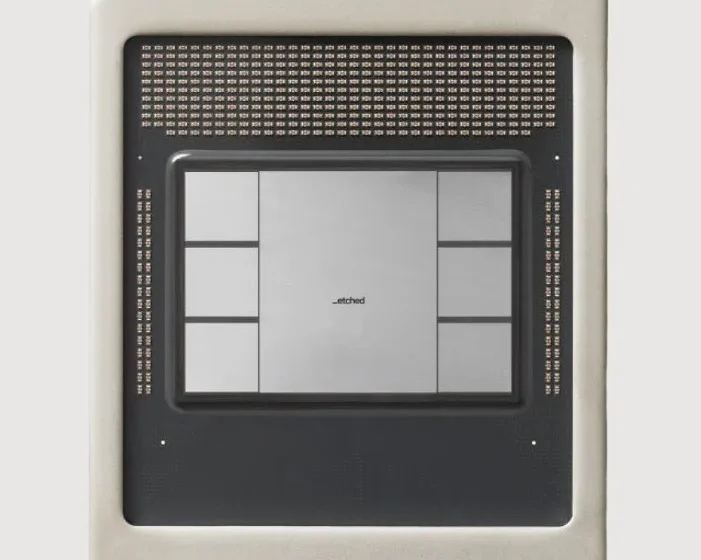
Every component—from the ASIC design to the memory subsystems and cluster-level interconnects—is designed in-house. This is not merely an exercise in control; it is a necessity for the company’s performance goals. Etched’s chip utilizes TSMC’s N4P process node and six stacks of High Bandwidth Memory (HBM), specifically chosen to ensure compatibility and scalability alongside existing infrastructure.
Furthermore, the company has developed a custom high-bandwidth interconnect that creates a low-latency, shared memory pool across entire clusters. This enables the splitting of prefill and decode stages across separate racks of hardware, a configuration that allows for massive inference throughput without the bottlenecks found in traditional, disaggregated server environments.
Official Perspectives and Industry Implications
The implications for the semiconductor industry are profound. By demonstrating that an AI-specific ASIC can outperform a general-purpose GPU in inference tasks, Etched is effectively challenging the monopoly held by legacy hardware giants.

When asked about the competitive landscape, particularly concerning Nvidia’s next-generation Rubin GPUs, Wachen remains focused on the bigger picture. "We deliberately use different process nodes and different memory technologies to enable both architectures to get to scale simultaneously," he noted.
The industry is watching closely. With racks scheduled to begin shipping to customers this summer, the transition from "promising startup" to "data center backbone" is now underway.
The Market Outlook
The $300 million investment is more than just capital; it is a signal of the institutional belief that the "AI hardware war" is far from over. Investors like Sequoia and A16Z are betting that the future of AI will not be written in general-purpose silicon, but in specialized, highly efficient, and vertically integrated hardware that can handle the massive scale of tomorrow’s intelligent agents.

As Etched moves into the deployment phase, the company faces the ultimate test: performance in the wild. If the results in their Milpitas lab hold true in production data centers, the company will have successfully shifted the industry’s trajectory. Whether or not they can sustain this momentum remains to be seen, but one thing is clear: Etched has redefined what is possible for a semiconductor startup, and in doing so, has forced the entire industry to rethink how it powers the AI revolution.
Conclusion
The path forward for Etched is defined by a commitment to extreme optimization. By ignoring the traditional boundaries of chip design and embracing the full stack, the company has positioned itself as a pivotal player in the infrastructure of the future. As they begin shipping their first racks this summer, the tech world will be watching to see if Etched’s "transformer-first" hardware can indeed deliver the order-of-magnitude leap in performance that the era of artificial intelligence so desperately requires.
With over $1 billion in pre-orders and a $10 billion valuation, the mandate is clear: for Etched, the future of AI inference is not just about faster chips—it is about a fundamental rewrite of the rules of the game.