


Racing Against the Scale: Inside Hyundai’s High-Stakes Autonomous ‘Data Flywheel’ Strategy

By Stewart Burnett
A data flywheel only closes a technology gap if it starts spinning before rivals reach an unassailable scale advantage. This fundamental truth of modern automotive software development hangs over Hyundai Motor Group (HMG) as it executes one of the most ambitious and complex autonomous driving pivots in the history of the industry.
Unveiled on September 14, Hyundai’s new "Data Flywheel" autonomous driving development system represents a comprehensive, multi-layered blueprint designed to catch up to—and ultimately contend with—the dominant players in autonomous vehicles (AVs) and advanced driver-assistance systems (ADAS). Yet, the strategy is as fraught with risk as it is rich in infrastructure, balancing a dual-track software roadmap, massive capital expenditures in high-performance computing, and a delicate dance between proprietary tech and external partnerships like Nvidia and Waymo.
As legacy automakers scramble to transition from traditional hardware manufacturers to software-defined mobility providers, Hyundai’s aggressive timeline leaves zero room for error.
Main Facts
At its core, Hyundai’s newly detailed architecture is a closed-loop system engineered to ingest real-world road data, process it through advanced artificial intelligence model training, conduct rigorous safety validation, and redeploy optimized models back to the vehicle fleet. This perpetual motion machine of machine learning serves as the foundation for Hyundai’s newly announced dual-track production strategy.
The strategy splits into two distinct development streams:
- The Nvidia-Based Track: Utilizing hardware and architecture from semiconductor giant Nvidia, these vehicles are targeted to achieve SAE Level 2+ capability in the first half of 2028, scaling up to Level 2++ by the second half of the same year.
- The Proprietary Atria AI Track: Powered by Hyundai’s in-house end-to-end system—developed in tandem with its specialized software unit, 42dot—this stack aims to reach equivalent Level 2++ capability by the second half of 2029.
The in-house Atria system runs roughly one year behind the Nvidia-backed program. While maintaining two simultaneous pathways provides Hyundai with a valuable insurance policy and a faster route to commercialization via Nvidia, it introduces significant long-term integration questions. It remains entirely unclear when, or if, Hyundai expects the two systems to reach functional parity.
However, the dual-track system offers immediate tactical benefits, notably cross-program data scaling. Telemetry and operational data harvested through the Nvidia-powered commercial fleet can be ingested directly into the Atria stack, giving the in-house development team a massive data injection long before their proprietary vehicles achieve mass deployment.
Chronology
Hyundai’s aggressive push into autonomous maturity is built on a tightly wound timeline extending from late 2024 through the end of the decade.
- Late 2024 – 2025 (Foundation & Infrastructure): Hyundai lays the groundwork for standardized sensor architecture and unifies data pipelines across its sprawling brand portfolio, incorporating Kia, 42dot, and Motional into a singular "Data Union" framework. Construction and scaling of heavy data infrastructure accelerate.
- Late 2026 (Level 4 Pilot): A localized Level 4 autonomous pilot utilizing an Atria AI-equipped vehicle is scheduled for deployment in Gwangju, South Korea. This milestone will serve as the first major real-world stress test for the proprietary software stack outside of controlled test tracks.
- Late 2026 – Early 2027 (VLA On-Road Testing): 42dot plans to transition its advanced Vision-Language-Action (VLA) models from virtual simulations to live, on-road testing, introducing language-based situational reasoning to the physical fleet.
- First Half of 2028 (Nvidia L2+): The first commercial phase of Hyundai’s dual-track strategy rolls out, deploying Nvidia-based vehicles featuring SAE Level 2+ capabilities to global markets.
- Second Half of 2028 (Nvidia L2++): The Nvidia-backed program scales up to advanced Level 2++ automated driving features, acting as the primary revenue and data-generation driver for the company’s consumer-facing ADAS ecosystem.
- Second Half of 2029 (Atria AI L2++): Hyundai’s proprietary Atria AI stack reaches equivalent Level 2++ capability, marking the theoretical convergence point where the automaker achieves functional software independence from external silicon and platform providers.
Supporting Data
Behind Hyundai’s software ambitions lies an industrial and computational footprint that few legacy automakers can rival.
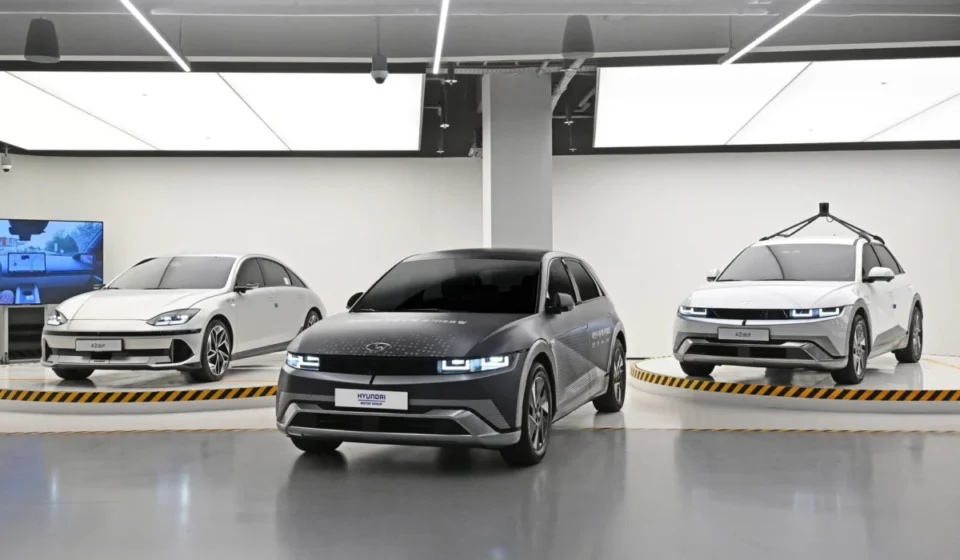
While the Hyundai Motor Group—encompassing Hyundai and Kia—sells more than seven million vehicles annually across 190 countries, the company’s data collection strategy relies on surgical precision rather than raw, uncurated volume. Rather than trying to process petabytes of mundane, uneventful highway driving, Hyundai operates a dedicated core fleet of approximately 40 specialized data-collection vehicles running continuously.
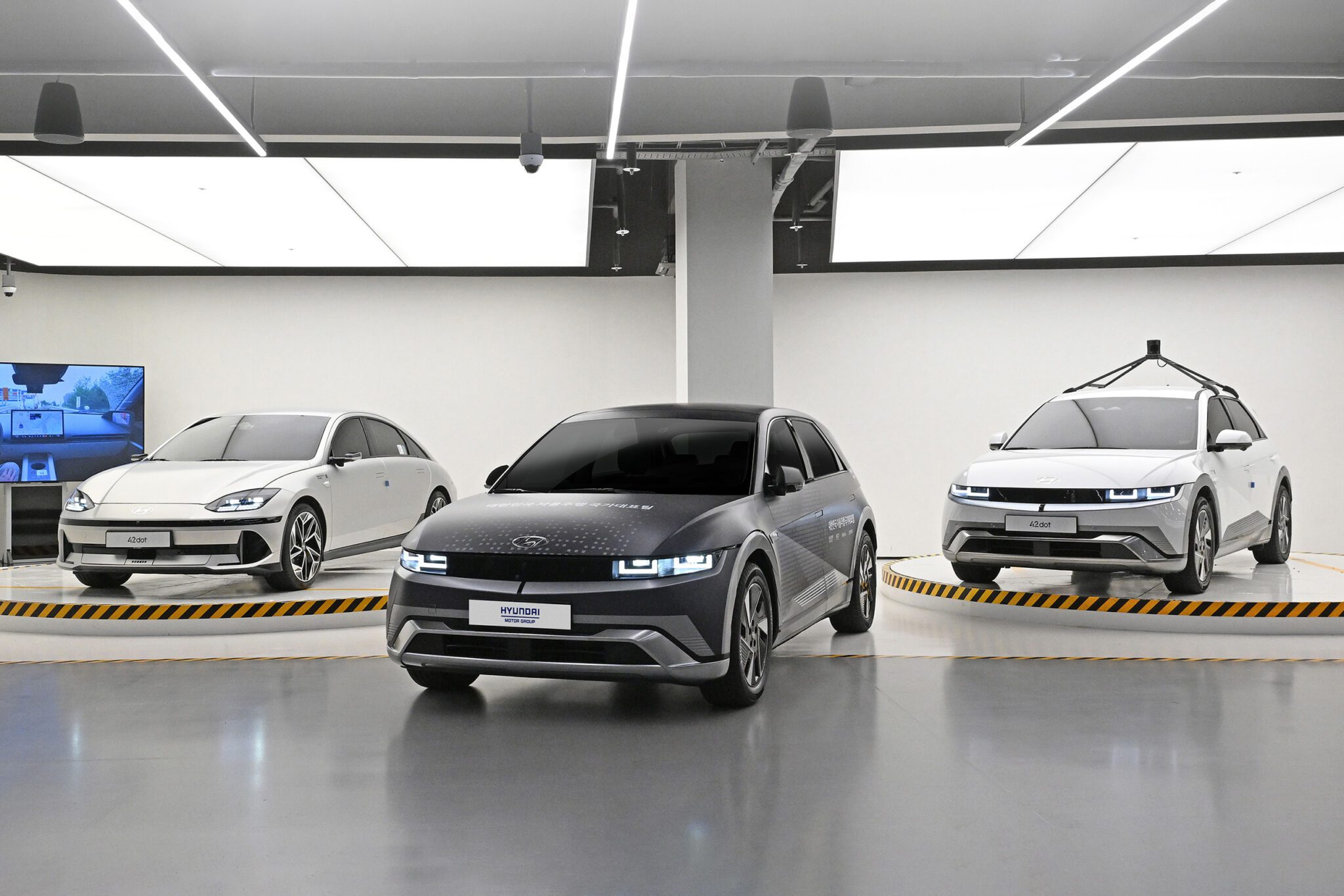
These vehicles feed a specialized data pipeline equipped with "hard example" mining algorithms. The system automatically flags and prioritizes complex, edge-case driving scenarios—such as erratic pedestrian movements, sudden lane changes, or severe weather events—ensuring that engineering teams focus their compute power where it matters most.
Infrastructure and Simulation
To process this incoming torrent of complex data, Hyundai is treating autonomous driving as an industrial compute problem just as much as a software engineering challenge:
- The Saemangeum AI Data Center: A massive 100 MW facility specifically built to house more than 50,000 graphics processing units (GPUs). This staggering amount of parallel compute power is dedicated entirely to neural network training and continuous driving simulation.
- 3D Gaussian Splatting: Hyundai’s virtual validation pipeline reconstructs raw, real-world driving logs into high-fidelity, three-dimensional digital environments. This allows engineers to safely simulate dangerous or impractical driving scenarios on servers, while simultaneously stress-testing newly trained AI models to ensure updates do not degrade existing performance parameters.
- "Follow-the-Sun" Development: To accelerate iteration cycles, Hyundai utilizes a continuous 24-hour engineering model, seamlessly handing off active development tasks between R&D teams in South Korea and the United States across time zones.
Moving Beyond Black-Box AI: Vision-Language-Action (VLA) Models
Simultaneously, 42dot is pioneering Vision-Language-Action (VLA) models. Traditional end-to-end autonomous systems rely on strict camera-to-control mapping—effectively treating neural networks as opaque "black boxes" that convert pixels directly into steering and braking commands without human-readable logic.
VLA models add a layer of language-based situational reasoning on top of conventional mapping. During preliminary testing, 42dot’s VLA system has successfully generated real-time, natural-language explanations for its own tactical maneuvers (e.g., explaining why it yielded to an occluded cyclist). If successfully deployed at scale, this radical transparency could solve one of the industry’s most stubborn compliance hurdles: satisfying regulators and insurance companies who demand auditable decision-making trails from autonomous vehicles. However, VLA remains strictly constrained to simulation environments, with live road testing slated to begin no earlier than late 2026 or early 2027.
Official Responses and Strategic Partnerships
In official announcements, Hyundai executives have emphasized that purpose-driven scale is the ultimate equalizer in the autonomous race. By establishing the Data Union framework, Hyundai has forced a standardized sensor architecture and unified data structure across its entire corporate umbrella—including Hyundai, Kia, 42dot, and autonomous joint-venture Motional. Consequently, a data point harvested by a consumer-spec Kia in Europe can be instantly ingested to train safety models utilized by a commercial Hyundai vehicle in North America.
Interestingly, Hyundai’s relationship with the broader autonomous ecosystem is not purely adversarial or strictly internal. The automaker occupies a fascinatingly pragmatic position within one of its chief competitor’s flagship projects: Waymo.
Hyundai’s popular Ioniq 5 electric crossover serves as one of the three primary hardware platforms for Waymo’s commercial robotaxi fleet, alongside Jaguar I-Pace sedans and Zeekr "Ojai" minivans. This partnership provides Hyundai with a two-fold benefit:
- Immediate Revenue & Integration Experience: It generates reliable hardware sales and deep, structural insights into high-utilization autonomous sensor suites years before Hyundai’s proprietary in-house software is commercially ready.
- Observational Advantage: It allows Hyundai to quietly study the deployment challenges, regulatory bottlenecks, and maintenance realities of scaled urban autonomy without exposing its own balance sheet to the existential financial risks absorbed by standalone robotaxi operators.
Implications
Despite its impressive computational investments, Hyundai faces immense competitive headwinds. The central dilemma of the modern software-defined vehicle remains timing.
Rivals such as Tesla (with its Full Self-Driving suite), Huawei (with its ADS platform), and Mobileye are already accumulating massive volumes of supervised, real-world end-to-end driving data today. A data flywheel only closes a technology gap if it reaches critical mass and begins spinning out self-improving code before competitors achieve an unassailable scale advantage. If Tesla or Huawei capture 90% of the market’s edge-case telemetry over the next three years, late-arriving competitors may find themselves permanently locked out of the data loop.
Furthermore, legacy automotive history is littered with expensive, cautionary tales regarding internal software transformations. Volkswagen’s plagued Cariad software division serves as a vivid reminder of how difficult it is for traditional manufacturing giants to successfully pivot into agile, high-frequency software houses.
Hyundai’s roughly one-year timeline buffer between its Nvidia-backed deployment in 2028 and its proprietary Atria AI rollout in 2029 leaves precious little room to absorb internal delays, bureaucratic friction, or integration hiccups. If the Saemangeum AI Data Center and the 42dot software division can successfully synchronize their massive computational muscle with Hyundai’s unrivaled global manufacturing footprint, the sleeping giant may yet dominate the next era of mobility. If not, Hyundai risks running hard on a treadmill of its own making—ever moving, but ultimately falling behind the curve.