


India’s electronics manufacturing landscape is undergoing a profound metamorphosis. Having successfully established itself as a global hub for smartphone assembly and finished-goods production, the nation is now confronting the structural limitations of its current ecosystem. While the industry has scaled significantly, the core challenge remains: the vast majority of value addition—estimated at a modest 18% to 20%—is currently tied to imported components and sub-assemblies. To graduate from a "final assembly" destination to a true manufacturing powerhouse, India is embarking on an ambitious, multi-pronged strategy to localize the entire electronics supply chain.
The State of Play: Scaling Beyond Assembly
In recent years, India’s electronics sector has seen explosive growth, with production value reaching nearly ₹13 lakh crore (approximately US$13.5 billion). Smartphones have emerged as the nation’s premier export, signaling a successful initial phase of the "Make in India" initiative. However, Union Minister of State for Electronics and IT, Jitin Prasada, acknowledged in a formal address to the Lok Sabha on April 1, 2026, that the current domestic value addition remains locked in the 18%–20% range.
This statistic is the catalyst for the government’s next phase of industrial policy. The objective is clear: shift the reliance away from imported semiconductors, PCBs, and specialized materials by nurturing a domestic ecosystem that can compete on both scale and technical sophistication.
Chronology of Expansion: From Gujarat to Odisha
The push for vertical integration is visible across the Indian map. Over the past several months, a wave of strategic investments has signaled that the government’s incentives—ranging from the Semiconductor Mission to the Electronics Component Manufacturing Scheme (ECMS)—are yielding tangible results.

Semiconductor Packaging and Displays
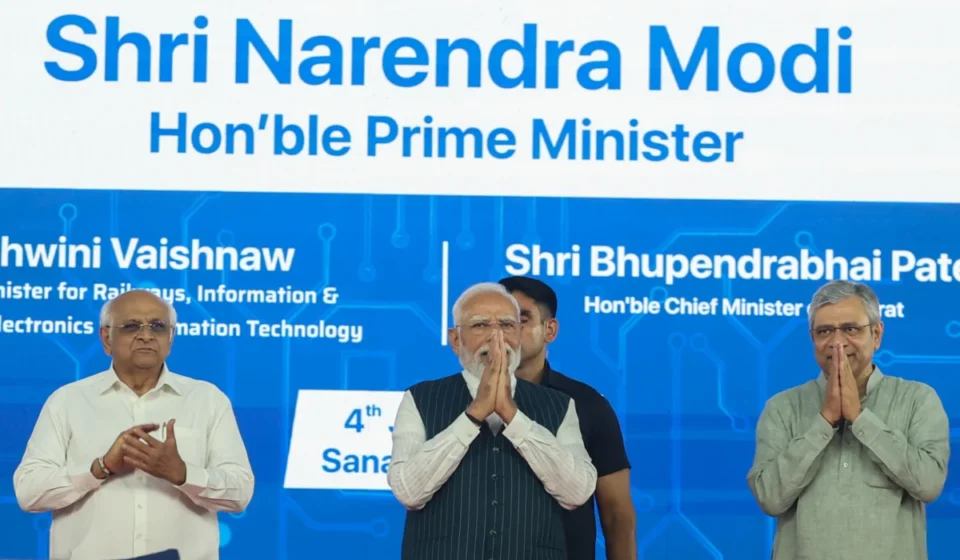
In Gujarat, the momentum is palpable. CG Semi has officially commenced commercial production at its Outsourced Semiconductor Assembly and Test (OSAT) facility in Sanand, following a capital infusion exceeding ₹7,600 crore (US$797 million). This facility represents a critical step in closing the loop on chip manufacturing, where the backend process—packaging and testing—is often a major bottleneck for global supply chains. Furthermore, the government has sanctioned a new project by Suchi Semicon in Surat (valued at ₹3,936 crore) and greenlit India’s inaugural commercial mini/microLED display manufacturing facility, helmed by Crystal Matrix in Dholera.
The Rajasthan Cluster
Rajasthan is simultaneously positioning itself as a vital node in this network. The Electronics Manufacturing Cluster (EMC) in Bhiwadi, developed by ELCINA, serves as a blueprint for localized industrial growth. With an initial investment of ₹46.09 crore supported by the central government, the cluster has already attracted commitments exceeding ₹1,200 crore. Within this ecosystem, Sahasra Semiconductors has begun commercial chip packaging operations. Their aggressive roadmap—scaling from 100 million units today to an estimated 400–600 million units within three years—illustrates the rapid growth trajectory expected of domestic players.
Advanced Substrates in Odisha
Perhaps the most ambitious move is the state of Odisha’s foray into high-tech materials. A framework agreement involving Intel and 3DGS aims to establish an advanced glass-core substrate facility near Bhubaneswar. Glass-core substrates are at the cutting edge of semiconductor packaging, essential for the high-performance chips required in AI and data centers. Securing this technology domestically represents a quantum leap in India’s manufacturing capabilities, moving the nation further upstream in the value chain.
Supporting Data: The Power of Incentives
The government’s financial commitment to this transformation is underscored by the performance of the Electronics Component Manufacturing Scheme (ECMS). Originally conceived with a target of ₹59,350 crore (US$6.2 billion), the scheme has witnessed such overwhelming private sector interest that commitments have reached ₹1.15 lakh crore (US$12.1 billion). This surging demand forced the government to revise its budget allocation from ₹22,919 crore to a robust ₹40,000 crore.

Simultaneously, private enterprise is moving to fill gaps in the PCB market. Syrma SGS, in a strategic joint venture with South Korea’s Shinhyup Electronics, is constructing a new PCB plant in Andhra Pradesh. This facility is designed to manufacture single, double, and multilayer PCBs, targeting the domestic demand that currently necessitates heavy imports.
Expert Perspective: The View from the Global Electronics Association
Chris Mitchell, VP of global government relations at the Global Electronics Association (formerly IPC), believes India’s strategy is correct in its breadth. "As important as India is today, the country seems very focused on becoming an even more important player in the electronics supply chain going forward," Mitchell noted.
However, Mitchell cautions that infrastructure and capital are only part of the equation. "I think there is a need for the country to better understand its interests relative to the production of the materials that go into electronics manufacturing," he explained. According to Mitchell, PCB fabrication—especially high-density interconnect (HDI) boards—is not merely a matter of acquiring the right machinery. It requires a deep reservoir of "tribal knowledge" and process control that can only be built through sustained operational experience.
"Learning by doing is required," Mitchell emphasized. "In countries where advanced-frontier circuit board fabrication takes place, that learning has happened over a long period of time. You cannot simply buy your way into advanced manufacturing."

Implications: Bridging the "Chasm"
The transition toward a deeper supply chain involves addressing a fundamental disconnect between design and manufacturing. Mitchell points to a recurring "chasm" where engineers designing cutting-edge products often lack visibility into the practical constraints of the manufacturing floor.
The Need for Standardization
The Global Electronics Association is currently working to harmonize standards for semiconductor testing, substrates, and advanced packaging. Mitchell argues that while policymakers often fixate on component-level packaging, system-level packaging remains an under-discussed necessity. For India to truly mature, it must integrate these international standards into its domestic workforce training and industrial protocols.
AI and the Future of Manufacturing
While AI is frequently touted as a panacea for manufacturing efficiency, Mitchell offers a tempered view. He views AI as an assistive tool for manufacturers to integrate standards more effectively, rather than a replacement for human expertise. The human element—the collective knowledge of the community—remains the industry’s most valuable asset.
Looking Ahead: Challenges and Opportunities
For India, the path forward is clear but arduous. The challenge is no longer just about volume or attracting foreign direct investment; it is about building the "soft" infrastructure of the industry:

- Material Independence: Reducing reliance on imported raw materials for PCBs and semiconductors.
- Yield Optimization: Achieving the high-precision manufacturing yields necessary to compete with established East Asian hubs.
- Design-Manufacturing Synergy: Aligning India’s strong design and software engineering talent with the realities of high-end hardware fabrication.
As India continues to add pieces to its supply chain puzzle, the focus must remain on the long-term sustainability of these projects. The current momentum, fueled by both massive state intervention and private-sector ambition, suggests that India is not just looking for a seat at the table, but is actively trying to rewrite the rules of the global electronics supply chain. By focusing on the "middle" of the chain—the components, materials, and processes—India is laying the foundation for a resilient, self-sustaining, and technologically sovereign electronics sector.