





By Ron Marshall
For eleven years, George managed the compressed air system at his manufacturing facility with a sense of quiet confidence. If you had walked up to him last spring and asked how the system was performing, he would have shrugged, offered a slight nod, and replied, “Fine.”
His plant relied on two robust screw compressors, humming along in tandem, sharing the load just as they had since the day they were installed. In the world of industrial maintenance, the prevailing mantra is often: If it isn’t broken, don’t touch it. For over a decade, George lived by that rule. Because no alarms were sounding and production was never interrupted by a lack of pressure, he assumed his energy profile was optimized. He was wrong.
The Reality of Invisible Waste
The paradigm shifted the day the audit team arrived, armed with a suite of sophisticated data loggers. These weren’t just diagnostic tools; they were the arbiters of truth for an aging infrastructure. The technicians clamped current transducers onto both machines, installed pressure transducers on the main header, and integrated a flow meter to track the system’s heartbeat over the course of a full week.
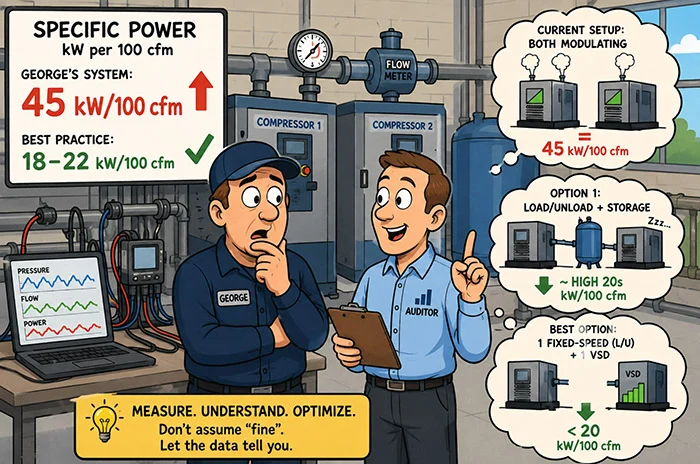
George expected a clean bill of health. He expected the audit report to confirm that his maintenance schedule was sound and his equipment was reliable. Instead, the final report delivered a number that made him pause and ask the lead auditor to repeat it: 45 kW per 100 cfm.
He didn’t need a deep dive into thermodynamics to know that number was problematic. He simply had to watch the auditor’s eyebrows arch in silent judgment as the figure was read aloud. In the industry, a well-controlled, efficient system should generally operate in the neighborhood of 18 to 22 kW per 100 cfm—sometimes even lower. George’s system was consuming more than double the energy required to deliver the same volume of air.
The Mechanism of Failure: The Modulation Trap
To understand why George’s system was bleeding capital, one must understand the specific control method he was utilizing: modulation.
Both of George’s lubricated screw compressors were set to modulate, meaning they were constantly throttling their inlet valves to chase fluctuating plant demand. While this approach keeps the compressors running and ensures a steady supply of air, it is inherently inefficient.
The fundamental flaw in modulation is that it throttles flow, but it fails to throttle power proportionally. When you choke a compressor down to half of its rated output, it doesn’t drop its energy consumption by 50%. Instead, it often continues to draw 70% to 80% of its full-load electrical power.
Metaphorically, George had been driving his facility’s air system with one foot firmly on the accelerator and the other pressed hard against the brake. The engine was roaring, the fuel was burning, but the vehicle was barely moving. Even at 2 a.m., when the plant was largely dormant and the demand for air was negligible, both compressors remained active, partially throttled, burning significant electricity while delivering almost nothing of value.
Chronology of a System Overhaul
Once the data had laid bare the inefficiency, George began the process of modeling a more logical future. He wasn’t looking for a quick fix; he was looking for a fundamental shift in how his plant utilized energy.
Phase 1: The Load/Unload Transition
His first consideration was moving to a basic load/unload control scheme. In this configuration, when the compressor is not needed to meet demand, it unloads, idles, and eventually shuts down entirely instead of strangling its own inlet. By pairing this with adequate storage—essentially a buffer tank to slow down the frequency of compressor cycles—George modeled a specific power in the high 20s. It was a marked improvement, but still far from the efficiency potential he now realized was possible.

Phase 2: The VSD Solution
The real breakthrough came when he looked at a hybrid configuration. By utilizing one fixed-speed compressor for base-loading—paired with a slightly larger Variable Speed Drive (VSD) machine to handle the trimming—the system dynamics changed entirely.
Unlike a modulating valve, a VSD does not choke the air supply; it simply slows the motor speed to match the exact demand of the plant. It acts like cruise control on a highway, maintaining a steady, optimized state rather than the stop-and-go cycle of city traffic. When George ran the numbers for this blended system, the specific power dropped to under 20 kW/100 cfm. He had found a way to deliver the exact same air demand for less than half the energy cost.
Supporting Data and Financial Implications
The financial implications of this discovery were staggering. George ran his payback calculations three times, skeptical of the results because they seemed too good to be true. Yet, the math was ironclad.
Beyond the immediate reduction in electrical utility bills, the maintenance savings were significant. New compressors optimized for their load profile would no longer be fighting their own throttle valves around the clock. Internal components, such as inlet valves and bearings, would experience less wear and tear, extending the Mean Time Between Failures (MTBF). Furthermore, local utility incentive programs for energy efficiency projects promised to offset a portion of the capital expenditure, shortening the ROI window to a point where the project became a no-brainer for the facility’s board.
Industry Expert Perspectives
Industry leaders and auditing professionals often point to the “George Scenario” as a cautionary tale for modern manufacturing. According to the Compressed Air Challenge, a collaborative group dedicated to educating facility managers, the most common error in plant management is the assumption that “no news is good news.”
“Data doesn’t care about your assumptions,” says one industry consultant. “You can go for ten years thinking a system is fine, but if you haven’t measured the specific power, you are essentially flying blind. We consistently find that plants that haven’t been audited in over five years are losing anywhere from 20% to 40% of their compressed air energy to waste.”
The official stance from energy auditing organizations is that compressed air should be treated as a utility, like electricity or water, and managed with the same level of scrutiny. If a plant manager cannot state their specific power number, they are likely paying a “hidden tax” on their production costs.
Implications for the Future of Manufacturing
The lesson George learned is not just about equipment; it is about cultural shifts in maintenance. The realization that "modulation is the enemy" changed his entire philosophy regarding site utility management. He shifted from a reactive stance—waiting for machines to break—to a proactive, data-driven strategy.
For other plant managers, the implications are clear:
- Instrument Everything: You cannot manage what you do not measure. Current and pressure transducers are inexpensive relative to the long-term energy costs they help mitigate.
- Audit Periodically: Technology evolves, and so do plant demands. An audit conducted in 2014 is likely irrelevant to the needs of a 2024 production floor.
- Training is Key: Understanding the mechanics of compressed air—from dew point management to VSD control logic—is a critical skill set for modern facilities staff.
George’s story is a wake-up call for the industrial sector. In an era where energy costs are increasingly volatile and environmental sustainability is a corporate priority, ignoring the efficiency of compressed air is no longer a sustainable business strategy. Whether you manage a small shop or a sprawling manufacturing campus, the specific power of your air system is a critical indicator of operational health.
If you are interested in learning how to measure specific power, identify control issues, and avoid the decade-long waste that George endured, industry training programs like the Compressed Air Challenge’s Fundamentals and Advanced Compressed Air Systems offer the technical foundation required to turn an energy-hungry plant into a model of efficiency.
The data is waiting. The only question is whether you are prepared to see what it says about your system.