




The engineering landscape is undergoing a profound transformation, moving away from rigid, siloed processes toward a future defined by fluid integration, artificial intelligence, and a return to the foundational principles of manufacturability. The July 2026 issue of Design World captures this pivotal moment, featuring a cover story on breakthrough developments in human-machine interfaces (HMI) that promise to redefine the capabilities of AI-driven prosthetics. Beyond the headline, this issue serves as a comprehensive roadmap for the modern engineer, navigating the complex intersection of digital manufacturing, heavy-duty electric actuation, and the enduring importance of Design for Manufacturability (DFM).
The Human-Machine Interface: A Leap in Prosthetic Precision
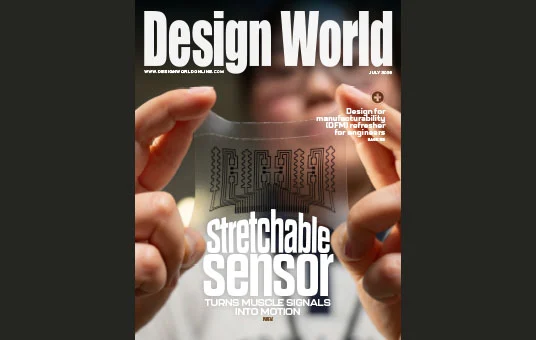
The cover feature of the July 2026 issue highlights a revolutionary stretchable sensor developed at Michigan State University. For decades, the primary hurdle in prosthetic control has been signal noise and the degradation of accuracy over time, particularly in aging populations whose muscle signals may be less pronounced.
Main Facts and Breakthrough Data
The researchers at Michigan State University have engineered a soft, stretchable sensor array capable of conforming to the human limb without restricting natural movement. By leveraging advanced materials that mimic the elasticity of skin, the sensor maintains consistent contact with muscle fibers.
In clinical testing, this technology demonstrated a staggering improvement in gesture-recognition accuracy. Older adults, who previously struggled with conventional sensors—often seeing accuracy rates hovering around 60%—achieved success rates exceeding 97% using the new AI-driven control framework. This leap effectively bridges the gap between intent and mechanical execution, allowing for fluid, intuitive control of prosthetic limbs that feels like a natural extension of the user’s body.
Implications for the Future of Prosthetics
The implications of this research extend far beyond the laboratory. By improving the fidelity of muscle-signal capture, engineers can now feed higher-quality data into machine learning models, enabling prosthetics to "learn" the unique behavioral patterns of the wearer. This represents a paradigm shift: from prosthetics that are merely tools to prosthetics that are intelligent, adaptive companions.
Chronology of DFM: From Muskets to Agentic AI
This issue of Design World takes a reflective, historical look at Design for Manufacturability (DFM). Often dismissed as a bureaucratic hurdle, DFM is framed here as the foundational "mindset" that separates visionary engineering from theoretical fantasy.
The Historical Context
The journey of DFM is traced back to the early 19th-century innovation of interchangeable musket parts. This era marked the first time engineers recognized that the design process must account for the repeatability of the manufacturing process. The narrative then moves through the mid-20th century, highlighting the seminal work of Geoffrey Boothroyd and the subsequent introduction of DFMA (Design for Manufacture and Assembly) software, which gave engineers the first quantitative tools to measure the cost-efficiency of their assemblies.
The Modern Frontier: Agentic AI
Today, the discipline has evolved into the era of AI-assisted validation. The issue explores how "agentic AI"—systems capable of autonomous decision-making within a design workflow—can flag manufacturing bottlenecks before a single piece of material is cut. However, the recurring theme among industry experts interviewed is a sobering warning: software is a tool, not a substitute for experience. The "DFM mindset" requires an intimate knowledge of the shop floor. An engineer who understands the thermal expansion of a material or the limitations of a CNC mill will always outperform one who relies solely on automated optimization.
Digital Infrastructure and Motion Systems
The July 2026 issue also provides a deep dive into the integration of motion systems within digital manufacturing infrastructures. As factories transition to "smart" environments, the complexity of managing motion components—servos, actuators, and encoders—has increased exponentially.
The Shift Toward Electric Actuation
A significant focus is placed on the ongoing transition from traditional hydraulics to heavy-duty electric actuation. In a three-part series, Design World examines the technical hurdles and the long-term benefits of this migration. Electric actuators offer superior precision, reduced maintenance overhead, and a smaller environmental footprint, but they require a sophisticated understanding of power management and thermal dynamics.
Cost Analysis of Electric Motors
One of the most requested features in this issue is the breakdown of electric motor operational costs. Many engineers focus on the sticker price of the hardware, ignoring the total cost of ownership (TCO). The article analyzes electricity consumption, downtime, maintenance cycles, and the efficiency of modern variable frequency drives (VFDs). By providing a clear framework for these calculations, the issue empowers engineers to make more fiscally responsible decisions for their projects.
Supporting Data: Automotive Sensing and Precision Measurement
The technological breadth of the July 2026 issue is bolstered by technical deep dives into automotive safety and metrology.
Millimeter-Wave Radar in In-Cabin Sensing
As vehicles become more autonomous and "living spaces," in-cabin sensing has become a critical area of R&D. The issue explains the physics of millimeter-wave radar, a technology capable of detecting heart rates, respiratory patterns, and even the presence of passengers behind heavy upholstery. This is essential for safety features such as child-presence detection and medical monitoring, providing high-resolution data without compromising occupant privacy in the way that optical cameras might.
The Fundamentals of Strain Measurement
The test and measurement section offers a foundational refresher on strain. By defining the parameters of strain—both elastic and plastic—the article serves as a guide for engineers working in structural integrity and materials testing. In an age of simulation, the ability to physically measure, verify, and correlate data with digital twins remains the gold standard of engineering rigor.
Official Perspectives and Industry Voices
Throughout the issue, experts from the Newlab Detroit ecosystem on the Michigan Central campus provide commentary on the state of the industry. Newlab has become a focal point for the convergence of physical and digital technologies, and the insights shared reflect a collaborative spirit.
"The future of engineering is not about picking a side between digital tools and physical intuition," noted one featured contributor. "It is about the synthesis of the two. We are seeing a move toward ‘agentic workflows’ where the AI acts as a partner, not a master. But the master must always be the engineer who understands the reality of the shop floor."
The consensus among the interviewed experts is that the engineering profession is undergoing a "human-centric" turn. While AI and automation are reaching unprecedented levels of capability, the demand for human expertise—specifically in the areas of manufacturing viability and material science—is higher than ever.
Implications for the Engineering Community
The July 2026 issue of Design World serves as a clarion call for engineers to re-engage with the physical reality of their designs. The primary takeaway is that while digital manufacturing infrastructures and AI-driven design tools are powerful, they are most effective when guided by the principles of DFM.
Key Strategic Takeaways:
- Embrace Human-Centric Innovation: The success of the MSU stretchable sensor project proves that the most impactful engineering often occurs at the intersection of biology and electronics.
- Cultivate the DFM Mindset: Software is a supplement to, not a replacement for, manufacturing literacy. Engineers should prioritize time on the shop floor as a core component of their professional development.
- Prioritize Total Cost of Ownership: Whether selecting electric actuators or planning a factory-wide digital transition, move beyond capital expenditure to consider the long-term operational impact.
- Leverage New Sensing Technologies: Technologies like millimeter-wave radar are expanding the definition of what a "smart" product can be; engineers should look for ways to incorporate these high-fidelity sensors into their own designs.
As we look toward the second half of 2026 and beyond, the trends identified in this issue—increased integration of AI, the transition to electrification, and a renewed emphasis on manufacturing fundamentals—will define the competitive landscape. Engineers who can navigate these shifts while maintaining a deep connection to the realities of production will be the ones who lead the industry into the next decade.
To ensure you stay abreast of these critical developments, we invite all readers to subscribe to the Engineer’s Edge, our curated newsletter that delivers deep-dive technical insights and industry analysis directly to your inbox. The path to the future is being paved today; make sure your design philosophy is built to last.