
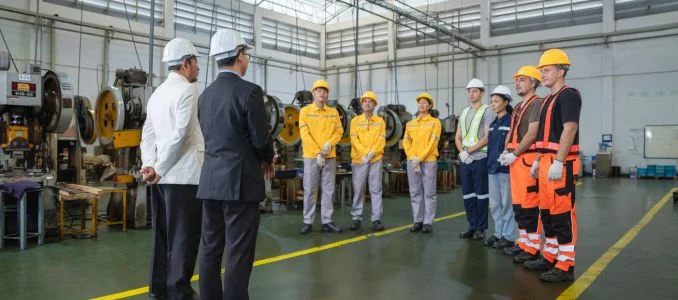





America’s Manufacturing Renaissance: Productivity, Technology, and the Record-Breaking Surge Driving U.S. Reindustrialization

Main Facts: A Historic Turning Point for U.S. Manufacturing
The United States industrial landscape is undergoing its most profound transformation in decades. Driven by a powerful combination of reshoring initiatives, unprecedented foreign direct investment, and a surge in capital expenditure, American manufacturing is expanding at a historic pace. However, as economists and industry leaders frequently emphasize, the long-term success and sustainability of this modern reindustrialization movement do not rely solely on capital deployment; they hinge on a dramatic, continuous acceleration in productivity.
Enter the International Manufacturing Technology Show (IMTS), the premier marketplace connecting the nation’s manufacturers, job shops, and technology innovators. As capital investment pours into the industrial sector, IMTS serves as the central hub where the creators of American manufacturing find the advanced machinery, innovative concepts, and vital strategic partnerships necessary to translate financial investments into tangible efficiency, operational resilience, and enduring global competitiveness.
Recent macro-level economic indicators underscore the vitality of this sector. U.S. manufacturing generates trillions of dollars in economic output annually, anchoring the broader economy. According to the U.S. Manufacturing Technology Orders (USMTO) Report, new orders for metalworking machinery reached an astonishing, record-breaking total of $3.44 billion during the first half of 2026. This figure represents a robust 36% increase year-over-year, marking the strongest first half since the USMTO program began tracking industry orders in 1998.
Complementing this machinery boom, the U.S. Census Bureau reported that new orders for manufactured durable goods increased by $3.6 billion, or 1.1%, to $339.3 billion in July, marking the fourth monthly increase in a five-month span. Meanwhile, the Institute for Supply Management (ISM) Manufacturing Purchasing Managers’ Index (PMI) registered 54.6 in August, logging the eighth consecutive month of sector expansion. ISM’s broader economic indicator has now signaled continuous growth for 22 straight months, pointing to a broad-based, resilient industrial resurgence.
Chronology: The Timeline of the 2026 Industrial Upward Trajectory
To understand how the American manufacturing sector arrived at this pivotal juncture in 2026, it is helpful to examine the chronological progression of economic data and industrial milestones that have shaped the current landscape:
- Late 2024 through 2025: Following years of pandemic-era supply chain disruptions and vulnerabilities exposed in global logistics, corporate leaders accelerated domestic reshoring strategies. Foreign direct investment (FDI) commitments accumulated rapidly, supported by federal legislation aimed at bolstering domestic semiconductor production, green energy technology, and critical infrastructure.
- January – March 2026: The year opened with exceptional momentum. The U.S. Manufacturing Technology Orders Report revealed surging demand for capital equipment, signaling that job shops and original equipment manufacturers (OEMs) were actively retooling facilities to handle new contracts.
- April – June 2026 (Q2): Official reports from the U.S. Bureau of Labor Statistics (BLS) detailed significant efficiency gains. During the second quarter, manufacturing sector labor productivity increased by 2.4%, driven by a 5.4% expansion in total output against a 2.9% increase in hours worked. Durable-goods manufacturers outpaced the broader sector, posting a stellar 3.6% productivity increase alongside a 7.3% surge in output.
- July 2026: The U.S. Census Bureau announced a 1.1% increase in durable goods orders to $339.3 billion, confirming that consumer and business demand remained strong despite broader macroeconomic headwinds.
- August 2026: The ISM Manufacturing PMI held firm at 54.6, marking nearly three-quarters of consecutive sector expansion and solidifying the narrative of a sustained industrial boom.
- September 2026 and Beyond: With aggregate U.S. investment commitments crossing the historic $11 trillion threshold—as tracked by White House economic data—the industry turns its focus toward scaling technology adoption, closing trade deficits, and maximizing workforce output at landmark gatherings like IMTS.
Supporting Data: Numbers Behind the Reindustrialization Movement
The resurgence of American manufacturing is not merely a matter of sentiment; it is quantified by hard data spanning labor productivity, capital deployment, trade dynamics, and technology procurement.
Productivity and Labor Dynamics
The BLS report for the second quarter of 2026 provides empirical proof that American factories are producing more with smarter processes. While manufacturing output jumped by 5.4%, the hours worked by the labor force increased at a more modest rate of 2.9%. This divergence highlights an increasing reliance on automation, robotics, and advanced software to boost output per worker.
Particularly noteworthy is the performance of durable-goods manufacturers. By achieving a 3.6% productivity increase alongside a 7.3% output growth, these facilities demonstrated how advanced tooling directly impacts bottom-line efficiency. Furthermore, manufacturing unit labor costs decreased by 0.3%, as robust productivity gains successfully offset rising hourly compensation packages.
Capital Investment and Macro-Scale Commitments
The scale of capital flowing into the U.S. industrial base is unprecedented. Federal tracking data compiled by the White House reveals that domestic and international companies have announced a staggering $11 trillion in U.S. investment commitments. This capital is being deployed across traditional manufacturing hubs as well as emerging technology corridors, transforming regional economies and creating long-term demand for high-tech industrial machinery.
Trade Deficits and the Reshoring Imperative
Despite this immense capital inflow, structural trade imbalances remain a formidable challenge. The United States continues to grapple with a substantial goods trade deficit, hovering around $1.3 trillion. According to Harry Moser, founder of the Reshoring Initiative, closing this gap and achieving true industrial self-reliance requires a fundamental shift in capacity.
"As a country, we need to make more things here," Moser asserts, noting that balancing the goods trade deficit will ultimately require a 40% increase in domestic manufacturing output, paired with a massive surge in both investment and total factor productivity.
Official Responses: Insights from Industry Leaders
The convergence of record capital investment, emerging technological capabilities, and supply chain restructuring has drawn commentary from some of the most influential figures in manufacturing, technology, and economic policy.
Capitalizing on the Momentum
Douglas K. Woods, president of AMT – The Association For Manufacturing Technology, which owns and produces IMTS, points to the unique confluence of economic tailwinds defining the current era.
"Economic momentum, demand for a stronger U.S. industrial base, continued reshoring and foreign direct investment, new incentives for capital investment, and the launch of cutting-edge technologies are creating one of the most exciting moments manufacturing has seen in years—and one of the most important reasons to attend IMTS," Woods says.
He emphasizes that high-demand sectors are driving this urgency across the board: "Across aerospace, defense, medical, AI infrastructure, and other high-demand sectors, manufacturers are looking for the technologies, partners, and productivity gains that will help them compete and grow."
The Reshoring Wave
Harry Moser of the Reshoring Initiative echoes this optimism while grounding it in pragmatic labor projections.
"Manufacturing is surging," Moser confirms. "Much of that strength is due to reshoring and foreign direct investment staying strong and being projected to reach a near-record 338,000 jobs announced in 2026 alone."
Moser underscores that achieving this job growth must go hand-in-hand with technological adoption to ensure that domestic facilities remain globally competitive against lower-cost overseas alternatives.
Technology as the Catalyst
For innovators and entrepreneurs on the ground, the path to reindustrialization runs directly through advanced hardware and digital integration. John “Jay” Rogers, co-founder and CEO of Haddy, emphasizes that technology adoption is non-negotiable.
"Reindustrialization depends on increasing our total productivity factor by adopting new technologies and business approaches," Rogers notes.
For independent machine shops—for whom heavy equipment represents their single largest capital expenditure—evaluating the right machinery is a high-stakes endeavor. Jim Belosic, founder and CEO of SendCutSend, an on-demand manufacturing firm specializing in custom sheet metal fabrication and CNC machining, explains how strategic equipment acquisition translates into customer value.
"By investing in the best-of-the-best CNC and fabrication equipment, we’re able to produce better parts faster, with fewer defects and less postprocessing, which ultimately lowers costs and improves reliability for our customers," Belosic explains.
Navigating the Decision-Making Process
With thousands of competing technologies, software solutions, and automation systems available on the market, navigating capital purchases can be daunting for shop owners. Industry experts stress that live events and peer networks provide invaluable guidance.
"Walking the IMTS floor shows you the technology. Presentations on the IMTS+ Main Stage, conferences, and networking events provide insight on how to make investment decisions with greater confidence and deliver lasting value," industry commentators note.
Furthermore, collaborative knowledge-sharing plays a critical role in accelerating adoption timelines. As event organizers and engineering experts frequently point out, "IMTS brings together the people that have solved these challenges before. We’ll interview these experts so visitors can learn from their experience instead of starting from scratch."
Implications: What This Means for the Future of American Industry
The convergence of $11 trillion in investment commitments, record-breaking machinery orders, and accelerating labor productivity signals that the United States is well past the early exploratory phase of reindustrialization; it is now in a period of aggressive, execution-focused expansion. However, several critical implications emerge from these trends for the future of the sector.
1. The Imperative of Advanced Automation
As labor markets remain tight and wage pressures persist, American manufacturers cannot rely on headcount expansion alone to meet rising demand. The 2.4% second-quarter productivity growth proves that automation, robotics, and advanced CNC machining are successfully bridging the gap. Future industrial growth will disproportionately reward facilities that embrace lights-out manufacturing, artificial intelligence-driven process optimization, and predictive maintenance technologies.
2. Supply Chain Resilience Through Domestic Proximity
The ongoing reshoring wave—projected to account for hundreds of thousands of newly announced jobs in 2026—demonstrates that original equipment manufacturers prioritize supply chain security, lead-time reduction, and risk mitigation over marginal labor cost arbitrage overseas. This structural shift creates a sustained, multi-year runway of domestic demand for Tier 1, Tier 2, and Tier 3 job shops.
3. Bridging the Trade Deficit via Scale and Efficiency
As Harry Moser and other trade analysts have noted, closing the $1.3 trillion goods trade deficit requires an unprecedented expansion of domestic manufacturing capacity. Achieving a 40% increase in output cannot be accomplished by building traditional factories using 20th-century paradigms. It demands continuous innovation in total factor productivity, advanced materials handling, digital thread integration, and agile manufacturing methodologies.
4. The Role of Industry Gathering Places
In an increasingly digital world, the immense capital investments required to retool American industry underscore the irreplaceable value of physical, face-to-face marketplaces. Venues like IMTS provide decision-makers with the unique opportunity to touch, test, and compare heavy machinery side-by-side, consult with leading metallurgical and automation experts, and gain the strategic confidence required to make multi-million-dollar capital investments.
Conclusion
American manufacturing stands at a historic crossroads. With robust macroeconomic indicators, record-setting metalworking machinery orders, and trillions of dollars in committed capital, the foundation for a lasting industrial renaissance has been laid. The ultimate success of this reindustrialization movement will now depend on the willingness of manufacturers, job shops, and technology providers to harness productivity-enhancing innovations—ensuring that the factories of tomorrow are faster, smarter, and more resilient than ever before.