

Every significant paradigm shift in computing history has ultimately faced the same rite of passage: the move from the laboratory bench to the server rack. The CPU, once a niche component, proliferated across the vast, climate-controlled halls of global data centers. The GPU followed a similar trajectory, evolving from a specialist graphics accelerator into the dense, power-hungry clusters that underpin today’s frontier artificial intelligence models.
Today, the Quantum Processing Unit (QPU) stands at that same threshold. The conversation has shifted decisively from asking whether quantum computers can perform meaningful calculations to asking whether they can be operated at scale, integrated seamlessly into the existing digital infrastructure that powers the modern world.
The Main Facts: Quantum as Standard Infrastructure
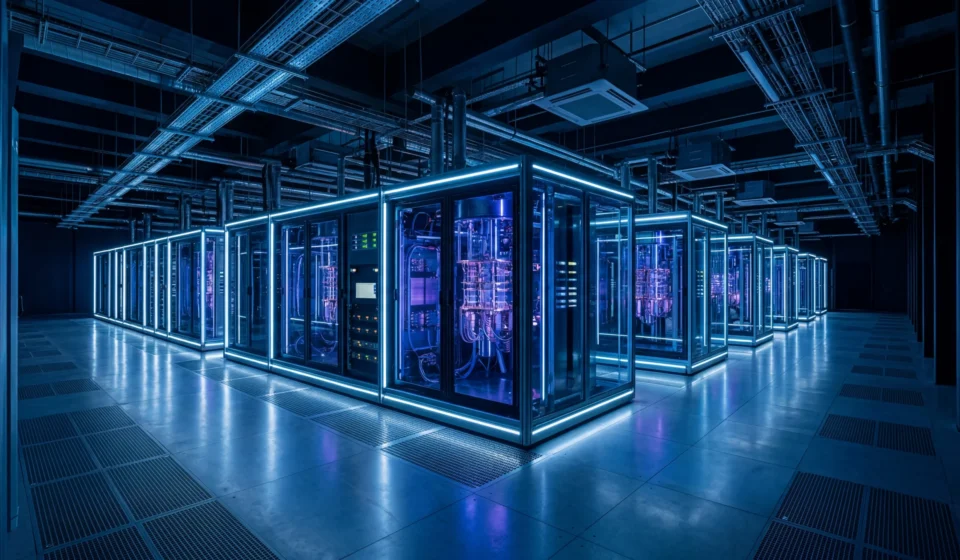
A "quantum data center" is no longer a theoretical construct; it is a facility engineered to meet the unique power, cooling, and workflow demands of quantum hardware. While some of these facilities are purpose-built from the ground up, the prevailing trend is the co-location of QPUs within existing High-Performance Computing (HPC) centers.
Modern data center operators are rigorous in their standards. Any new platform—be it a massive AI cluster or a quantum refrigerator—must conform to shared norms, including rack-mounted form factors and strictly defined power and cooling envelopes. Consequently, a QPU is now being judged against a standard industrial checklist rather than the looser, more forgiving metrics of a physics experiment.
This transition is being coordinated at the highest levels of global industrial policy. The Open Compute Project (OCP), a collaborative community dedicated to redesigning hardware for maximum efficiency and scalability, has officially moved quantum integration into the domain of data center design. Concurrently, the U.K.’s "Quantum Data Centre of the Future" program has produced a viable blueprint for hybrid quantum-classical facilities, while startups like ORCA Computing have successfully demonstrated operational quantum units running within real-world, commercial data center environments.

A Chronology of Integration
The journey toward the "quantum-ready" data center has accelerated significantly between 2025 and 2026:
- 2024: The industry begins moving away from isolated "quantum labs" toward the concept of hybrid systems.
- September 2025: OQC makes a landmark move, installing its quantum hardware into Digital Realty’s JFK10 facility in New York, effectively creating the city’s first quantum-AI integrated data center.
- Early 2026: The Royal Society publishes a seminal paper framing multi-QPU sites as the most viable path for distributed quantum computing.
- February 2026: Microsoft’s leadership publicly targets the end of the decade as the window for commercially viable, data-center-embedded quantum machines.
- Mid-2026: National initiatives, such as the EU’s Quantum Europe Strategy and the EuroHPC Joint Undertaking, move beyond policy, coupling quantum processors directly to national supercomputers like the Karolina system in Czechia.
Supporting Data: The Thermodynamics of Scale
The primary barrier to quantum adoption is not software complexity, but the harsh reality of thermodynamics. The design of a quantum facility is, at its core, a decision about temperature.
Superconducting machines—the backbone of current systems from IBM and Google—require dilution refrigerators to cool qubits to millikelvin temperatures, just fractions of a degree above absolute zero. This necessitates extreme vibration damping, electromagnetic shielding, and massive power consumption.
Conversely, trapped-ion and neutral-atom systems avoid such extreme cooling, but they trade it for ultra-high-vacuum chambers, precise laser calibration, and complex magnetic field control. Photonic systems, developed by companies like PsiQuantum, Quandela, and ORCA, represent a third path, drawing less power and capable of tapping into existing fiber-optic infrastructure.
The data supports a sobering reality: scaling quantum computing will hit resource constraints long before it hits architectural limits. A 2026 analysis from the Oak Ridge National Laboratory (ORNL) highlights a critical bottleneck in the supply of Helium-3, an essential material for cryogenic cooling. Furthermore, while cooling currently accounts for only 10–30% of an electronic load in a classical facility, it is projected to become the dominant energy cost in a quantum-enabled data center.

To mitigate this, firms like Bluefors are innovating with modular cryogenic platforms, allowing data centers to scale cooling capacity incrementally as qubit counts grow, rather than forcing a facility overhaul for every hardware generation.
Official Responses and Strategic Models
The industry is currently bifurcating into two distinct commercial models for hosting these systems:
1. The Vertically Integrated Hyperscaler Campus
In this model, a single operator owns the entire stack: the hardware, the facility, the cloud abstraction layer, and the customer relationship. IBM is the primary advocate for this approach, evidenced by its massive investments in Poughkeepsie, New York, and its expansion into Ehningen, Germany. Other hyperscalers, including AWS, IonQ, and Nvidia, are pursuing similar owner-occupier models in dedicated facilities in Pasadena, Washington, and Boston, respectively.
2. The Colocation Tenant Model
This model treats quantum as a specialized utility. The quantum company acts as a tenant, installing its hardware within a neutral-host data center owned by a specialist operator. This approach abstracts the complex cryogenics and power distribution away from the end user. OQC’s partnership with Digital Realty represents the vanguard of this approach, effectively treating quantum hardware as just another high-density server rack.
Implications: The Networked Future
The term "quantum data center" should not imply a single, monolithic campus. The most plausible path forward is a modular, distributed architecture. As the Royal Society has suggested, the near-term future lies in multi-QPU sites that are interconnected over high-speed fiber networks.

This shift has created a new industry niche: the quantum network. Nu Quantum, for instance, has recently launched a rack-mounted Quantum Networking Unit (QNU) designed for standard 19-inch data center racks. By brokering real-time entanglement between physically separate processors, the QNU allows multiple smaller quantum machines to act as a single, more powerful, and resilient unit.
The Software/Hardware Mismatch
A significant challenge remains in orchestration. As noted by Jamie Friel, compiler team manager at Oxford Quantum Circuits, there is a structural mismatch between classical HPC and quantum runtimes. HPC workload managers are designed for jobs that execute over hours or days, whereas a quantum runtime may complete in a fraction of a second. Bridging this gap is the next great hurdle for system architects.
Conclusion: Solving the Unglamorous Problems
As the decade closes, three markets are emerging: cloud-hosted quantum compute; quantum-plus-AI/HPC hybrid environments; and networked quantum data centers.
The strategic takeaway is that the decisive advantage will not necessarily accrue to the firm with the most elegant qubit or the longest coherence time. Instead, the winners will be the organizations that solve the "unglamorous" problems: the cooling loops, the power distribution, the orchestration software, and the entanglement networking.
History has taught us that industrial revolutions are rarely loud. They are built quietly, in racks and through standardized infrastructure, long before the public recognizes the shift. Quantum computing is currently in that quiet phase—the transformation of a scientific breakthrough into the standard plumbing of the global digital economy. As quantum systems move into the rack, they are not just changing the way we compute; they are defining the next generation of the data center itself.