


Showcasing Industrial Innovation: The ASSEMBLY Show Unveils 2026 New Product of the Year Nominees

ROSEMONT, Ill. — Innovation on the modern manufacturing floor rarely arrives in a single, thunderous breakthrough; more often, it is forged through a relentless series of incremental refinements, smarter software integrations, and precision-engineered automation. This philosophy takes center stage as industry professionals gather for The ASSEMBLY Show at the Donald Eett Stephens Convention Center.

To highlight the breadth of new and innovative technologies driving the sector forward, show organizers have spotlighted 24 standout nominees for the prestigious New Product of the Year awards. While these selections represent a cross-section of advancements in automation, robotics, dispensing, and testing, they are, by all accounts, merely the tip of the manufacturing iceberg. Exhibitors across the convention floor are actively solving unique assembly challenges daily, proving that the pace of engineering adaptation is faster than ever.

Main Facts: A Window Into the Future of Advanced Manufacturing
The 24 nominated products highlighted ahead of the event are those that particularly piqued the interest of ASSEMBLY magazine’s editorial team. However, the ultimate decision of who takes home top honors in each category rests not with the editors, but with the manufacturing professionals attending the show.

Running from October 27–29, The ASSEMBLY Show brings together 133 elite suppliers. The comprehensive exhibition floor features cutting-edge advancements across multiple technological pillars:

- Automation and Motion Control: High-speed transport systems and standardized robotic workcells.
- Fastening and Dispensing: Multi-spindle tightening solutions, micro-dosing flow meters, and structural adhesives.
- Robotics and End-of-Arm Tooling: Long-reach collaborative robots, miniature electric grippers, and micro vacuum pumps.
- Manufacturing Software and AI: Computer vision systems, real-time performance tracking, and natural-language AI assistants.
- Test and Inspection: Edge AI cameras, leak test systems, and modular automated test software.
Chronology: The Evolution Toward Smart, Plug-and-Play Assembly
The evolution of assembly technology over the past decade has transitioned from rigid, single-purpose machinery to highly flexible, modular, and data-driven ecosystems. The innovations featured among this year’s nominees illustrate this historical trajectory.

Phase 1: Simplifying Setup and Hardware Integration
Historically, deploying heavy-duty press systems or multi-axis automated lines required extensive manual calibration, prolonged downtime, and specialized programming. Promess Inc. is addressing this friction with its M-Series servo press and UltraPRO 2 control, designed to eliminate manual recalibration after component replacements by storing its own calibration data. Similarly, ASG’s AX-03 assembly cell arrives pre-assembled, programmed, and tested, allowing manufacturers to operationalize robotic screwdriving in mere minutes.

Phase 2: Expanding Flexibility in Automation
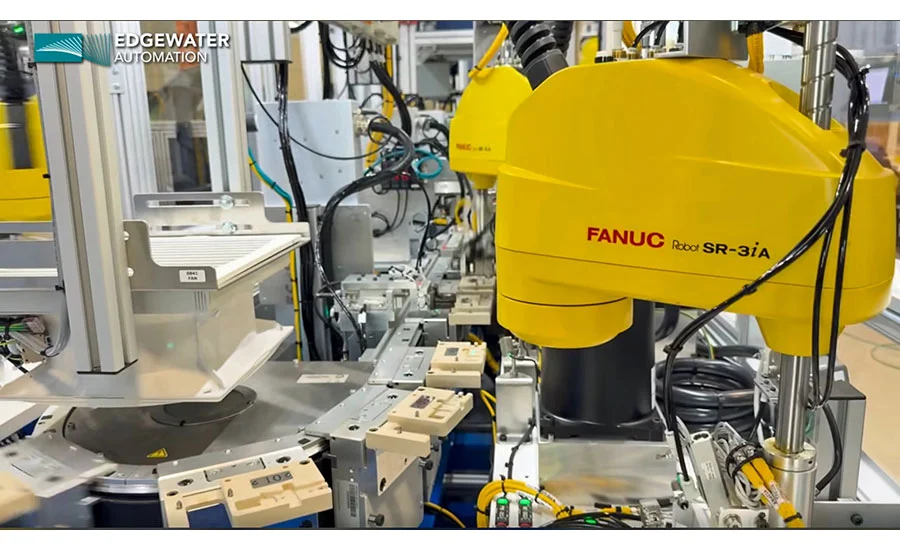
As product customization surges, assembly lines can no longer afford to be single-product bottlenecks. Edgewater Automation demonstrated this shift by designing a 21-by-14-foot automated line capable of producing two distinct variations of an automotive electrical header at a four-second cycle time. Utilizing a linear motor transport system with 12 independently controlled carriers, the machine seamlessly switches between processes—including ultrasonic welding and terminal inspection—without disrupting production flow.

Phase 3: The Integration of Edge AI and Machine Learning
The most profound shift in recent years is the infusion of artificial intelligence directly into the factory floor. Software and vision platforms no longer merely record historical output; they actively error-proof workstations in real time. Companies like Retrocausal, Almetra, and SiteVue AI are deploying computer vision systems that monitor manual and semi-automatic assembly lines, ensuring that operators never miss a step or install a component out of sequence.

Supporting Data: Innovations Across Five Key Sectors
The breadth of this year’s nominees spans five specialized categories, each addressing critical operational bottlenecks in modern manufacturing.

1. Assembly Machines and Systems
- Promess Inc. (Booth 631): The M-Series servo press features a modular cartridge design that expands across various press force ranges and torque variants, minimizing cabling and simplifying maintenance.
- Edgewater Automation (Booth 205): A flexible automated system utilizing SCARA robots, vision systems, and a linear motor transport path to assemble complex automotive electrical components.
- ASG, a Division of Jergens Inc. (Booth 323): The AX-03 preconfigured robotic screwdriving cell integrates a robot, screw feeder, and proprietary driver into a turnkey solution.
- Wolf Production Systems (Booth 1213): The SkyLine platform offers a standardized, highly adaptable laser-processing workcell that can operate standalone or integrate into pallet-transfer conveyors.
2. Adhesives, Dispensing and Curing
- Permabond Engineering Adhesives (Booth 1446): TA4551, a low-odor acrylic adhesive, forms structural bonds between nylon and metals without requiring surface primers.
- Surehold (Booth 1244): MXBON dual-curing cyanoacrylate adhesives cure instantly under ambient moisture and UV/visible light, meeting ISO 10993 standards for medical devices.
- Techcon (Booth 1410): Polypropylene side-by-side dispensing cartridges (50 and 200 mL) provide precise metering for two-component adhesives with short pot lives.
- IC Flow Controls (Booth 1217): The RS5 helical screw flow meter enables pulsation-free micro-dosing of fluid volumes ranging from 0.25 to 1 milliliter per minute.
3. Fastening Tools
- Ekatec Inc. (Booth 538): The Radansetzer pneumatic multi-spindle tool simultaneously starts and seats up to five wheel lug nuts while preventing cross-threading.
- Sarissa (Booth 123): PositionsBox Gen2 utilizes 3D real-time position tracking and laser visualization to guide assemblers through precise fastening sequences, disabling tools if an error occurs.
- Weber Screwdriving Systems Inc. (Booth 1331): The SBM25 automated insertion system handles blind rivet-nuts and bolts, featuring automatic mandrel changes and force monitoring for high-volume lines.
- Sumake North America LLC (Booth 612): The SMT-C3 smart controller monitors torque and angle curves, storing up to 1 million fastening results for Industry 4.0 traceability.
4. Robotics and Material Handling
- Epson America (Booth 331): The AX6 six-axis carbon-fiber cobot offers a 900-millimeter reach, cleanroom compatibility, and Python programming support.
- Coval Vacuum Technology Inc. (Booth 1006): The MPXS micro vacuum pump features intelligent vacuum regulation that cuts energy consumption by up to 90 percent.
- Gimatic (Booth 317): The PRP1806 pneumatic rotary gripper combines gripping and 180-degree rotation into a single, compact, maintenance-free unit.
- IAI America Inc. (Booth 1005): A miniature electric three-finger gripper designed for precise centering and variable-force handling of cylindrical loads.
5. Manufacturing Software and Test/Inspection
- TeepTrak (Booth 1318): PerfTrak connects directly to legacy or modern PLCs to track OEE, output, and downtime reasons in real time.
- Retrocausal (Booth 1137): Assembly Copilot leverages computer vision to provide live multimedia guidance and error-proofing for manual assembly operators.
- Advantive (Booth 1438): Advantive ONE introduces AIVA, an AI virtual assistant providing natural-language data access and context-aware troubleshooting.
- Almetra (Booth 913): An anonymized AI vision platform that converts raw shop-floor video feeds into structured operational metrics without extensive IT overhauls.
- ivii GmbH (Booth 939): ivii iriis edge AI camera system offers plug-and-play error-proofing and traceability for manual workstations.
- SiteVue AI (Booth 817): Uses standard operating procedures to train AI models that monitor assembly sequences and verify takt time adherence.
- ACS (Booth 801): Acselerant is a modular LabVIEW-based software platform for real-time data acquisition and control in automated test systems.
- Fukuda Co. Ltd. (Booth 1320): The MSX-7000 leak test system inspects airtightness in compact electronic components following helium bombing.
Official Responses: Industry Perspectives on Innovation
Show organizers emphasize that these nominated technologies reflect the evolving demands of factory engineers who must do more with less floor space, tighter labor markets, and shorter product lifecycles.

"The exhibitors at the show are solving unique assembly challenges every day," notes the editorial board of ASSEMBLY. "The 24 products you see here are merely those that piqued the interest of our editors, but they underscore a broader industry truth: manufacturers are increasingly leaning into modularity, plug-and-play setup, and actionable real-time data to remain competitive."

Suppliers exhibiting at the event echo this sentiment. From automated screwdriving cells that eliminate integration friction to edge-AI cameras that protect worker privacy while capturing deep productivity analytics, the consensus among developers is clear. Modern factory technology must be resilient, scalable, and—above all—user-centric.

Implications: What These Technologies Mean for the Future of Production
The integration of these 24 nominated technologies carries profound implications for the manufacturing sector at large:

- Lowering the Barrier to Automation: Products like ASG’s preconfigured screwdriving cell and Promess’s self-calibrating servo press democratize automation. Small and medium-sized enterprises (SMEs) that previously lacked the engineering bandwidth to program complex systems can now deploy advanced robotics and presses with minimal downtime.
- Bridging the Gap Between Legacy and Modern Systems: Software solutions like TeepTrak’s PerfTrak and Almetra’s AI platform prove that digital transformation does not require ripping out legacy machinery. By extracting data via non-invasive sensors and edge cameras, plants can achieve holistic OEE tracking without capital-intensive overhauls.
- Mitigating Labor Shortages Through AI Guidance: With skilled labor shortages persisting across industrial sectors, tools like Retrocausal’s Assembly Copilot, Sarissa’s PositionsBox, and SiteVue AI act as digital safety nets. By providing real-time visual prompts and poka-yoke validation, these systems reduce training times for new hires while virtually eliminating costly assembly defects.
As manufacturing professionals evaluate these innovations at The ASSEMBLY Show in Rosemont, IL, the overarching takeaway is undeniable: the future of manufacturing belongs to systems that are adaptable, intelligent, and designed to empower the human workforce.