



Hydraulic systems have long served as the heavy-duty workhorses of the global industrial landscape. From the massive force required in metal forming and plastics processing to the precision-controlled movements in automated production lines, fluid power remains unmatched for its power density, robustness, and reliability. However, as the global manufacturing sector faces mounting pressure to decarbonize and minimize operational overhead, the spotlight has shifted to the energy footprint of these systems.
The challenge lies in a fundamental industrial paradox: how to maintain the rugged, high-force capabilities of hydraulics while meeting modern, stringent energy-efficiency benchmarks. Industry leaders are no longer viewing energy consumption as an inevitable cost of doing business, but as a critical performance metric to be optimized through digital integration, advanced material science, and sophisticated control strategies.
The Evolution of Hydraulic Energy Dynamics
The Fundamentals of Energy Conversion
To understand hydraulic efficiency, one must first examine the energy lifecycle of a system. Hydraulic power is a multi-stage transformation process: mechanical energy from a prime mover (usually an electric motor) is converted into fluid pressure via a pump, transported through a network of valves and actuators, and ultimately converted back into mechanical work.
Every stage of this journey offers a potential point of energy loss, typically manifesting as heat. In the past, industrial hydraulic systems were often oversized to ensure a wide safety margin, prioritizing "fail-safe" reliability over lean energy consumption. Today, the engineering philosophy is shifting. Rather than relying on massive design margins that result in constant energy waste, designers are now leveraging precision-engineered components that respond dynamically to the actual load.
The Regulatory and Market Catalyst
The push for efficiency is not purely altruistic. It is being driven by a convergence of regulatory mandates and corporate sustainability goals. Governments worldwide are imposing stricter energy-performance standards on industrial machinery, while procurement departments are increasingly adopting "Total Cost of Ownership" (TCO) models that prioritize energy-efficient components over lower upfront costs. This shift is turning energy-efficient hydraulics into a competitive advantage, enabling manufacturers to reduce their carbon tax liabilities and operational expenses simultaneously.
Chronology of Innovation: From Constant Speed to AI-Driven Control
The development of energy-efficient hydraulics has not happened overnight; it is the result of a decades-long technological trajectory.
- 1980s – 1990s: The Era of Fixed Displacement: Early systems relied heavily on fixed-displacement pumps and constant-speed motors, leading to significant energy loss through pressure relief valves whenever the system wasn’t at peak load.
- 2000s: The Load-Sensing Revolution: The introduction of load-sensing and pressure-compensated systems allowed pumps to adjust flow based on the immediate demand of the actuator, significantly reducing "idling" energy waste.
- 2010s: The Rise of Variable Speed Drives (VSDs): VSD technology allowed electric motors to ramp up or down based on real-time demand, marking a paradigm shift in how power is consumed during duty cycles.
- 2020s – Present: The Digital Transformation: The current era is defined by electrohydraulic systems. By integrating high-speed sensors, digital controllers, and AI-driven predictive algorithms, hydraulics have moved from "dumb" power to "intelligent" actuation.
Technological Pillars of Modern Hydraulic Efficiency
Variable Speed Drives (VSDs)
VSDs have become the standard for modern power units. By controlling the frequency and voltage of the electricity supplied to the motor, VSDs allow the pump to run only as fast as the process requires. In applications with variable load profiles—such as injection molding or heavy-duty pressing—the energy savings can be substantial, often reducing power consumption by 30% to 50% compared to traditional constant-speed systems.
Electrohydraulic Systems: The "Smart" Interface
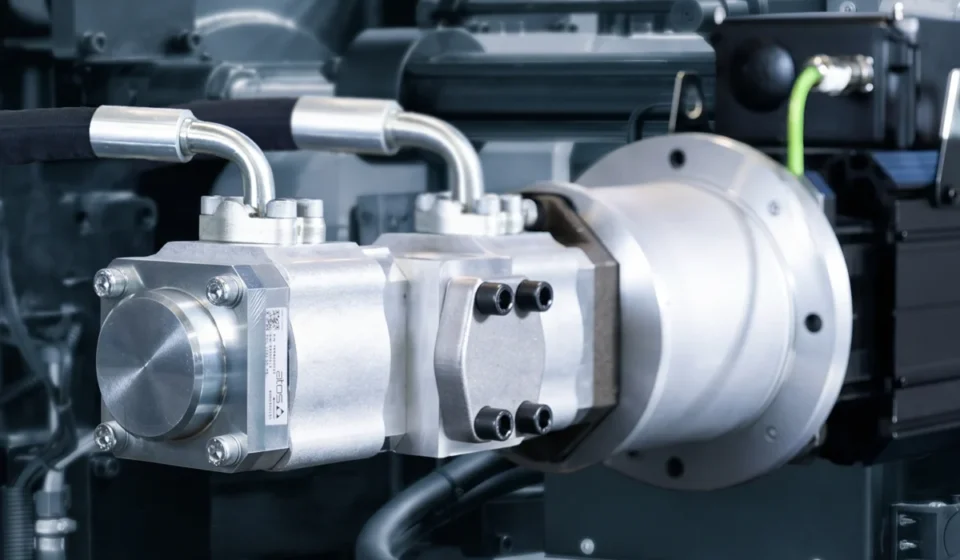
The integration of electronic control into the hydraulic architecture is perhaps the most significant advancement of the decade. Advanced electrohydraulic systems, such as the high-precision servopumps engineered by industry leaders like Atos, act as the bridge between fluid power and the digital factory. These systems utilize feedback loops that monitor pressure, flow, and temperature in milliseconds. If a system detects that a specific motion does not require maximum pressure, it instantly throttles down the output, preventing energy-wasting bypass flow.
Energy Recovery and Regenerative Circuits
Modern design is increasingly looking at the "waste" side of the equation. During deceleration phases or when lowering heavy loads, hydraulic systems traditionally dissipate energy as heat. Regenerative circuits and high-performance accumulators are now being employed to capture this energy, storing it in the form of pressurized fluid to be used in the next cycle. This circular energy approach significantly lowers the peak power draw of industrial machinery.
Supporting Data and System-Level Integration
Efficiency is not merely the result of buying a more efficient pump; it is a holistic design challenge. Modern engineering firms are utilizing sophisticated digital twin modeling to simulate entire operational cycles before a single physical component is manufactured.
- Fluid Science: Advancements in synthetic fluids have reduced internal friction, allowing for lower viscosity at high temperatures, which translates to less drag on internal components and, consequently, lower energy requirements.
- Predictive Maintenance: Data-driven insights allow for maintenance to be scheduled based on the actual health of the fluid and the performance of the valves. A system that is well-lubricated and free of internal leaks operates at its peak "as-built" efficiency for longer, preventing the slow creep of energy waste that occurs as components wear down.
Implications for the Future: AI and the Autonomous Factory
The future of hydraulics is intrinsically linked to the broader rise of Artificial Intelligence. Machine learning models are now being integrated into hydraulic control units to anticipate load requirements before they occur.
For instance, an AI-enabled press can analyze the incoming material and adjust its pressure and speed profile in real-time, optimizing the energy expended for every unit produced. This level of autonomy does more than save power; it improves product quality by ensuring the hydraulic force is always perfectly matched to the manufacturing task.
Furthermore, as the industrial sector moves toward "Lights Out" manufacturing and fully autonomous production lines, the self-diagnostic capabilities of modern electrohydraulic systems are becoming essential. By providing granular data on energy consumption, these systems allow facility managers to monitor the health of their entire energy ecosystem through a centralized dashboard.
Conclusion: The Balanced Approach
The transition toward energy-efficient hydraulics is not a rejection of traditional fluid power; it is an evolution. By embracing digital control, modular design, and regenerative technologies, hydraulic systems are proving that they can remain the backbone of industrial production while meeting the sustainability requirements of the 21st century.
The path forward requires a balanced perspective. Engineers must weigh performance, reliability, and energy efficiency, ensuring that the drive for sustainability does not come at the cost of the safety and precision that the industry demands. As hydraulic systems become smarter, more connected, and increasingly optimized, they are set to remain at the forefront of industrial innovation, powering the next generation of efficient, high-performance manufacturing.
Ultimately, the successful implementation of these technologies depends on a commitment to continuous learning and the integration of advanced diagnostic tools. As organizations train their teams to navigate the intersection of hydraulics and digital technology, they position themselves to thrive in a landscape where energy efficiency is no longer an option, but a foundational requirement for success.
This article is provided as part of a series on industrial innovation. For further insights into high-performance hydraulic components and electrohydraulic architectures, consult with industry experts at The Atos Group.