

Preventing "White Rust": Critical Water Chemistry and Maintenance Strategies for Galvanized Steel Cooling Towers

By Brad Buecker, Senior Technical Consultant, SAMCO Technologies
Published: October 6, 2026
Main Facts: The Hidden Vulnerability of Galvanized Steel Cooling Towers
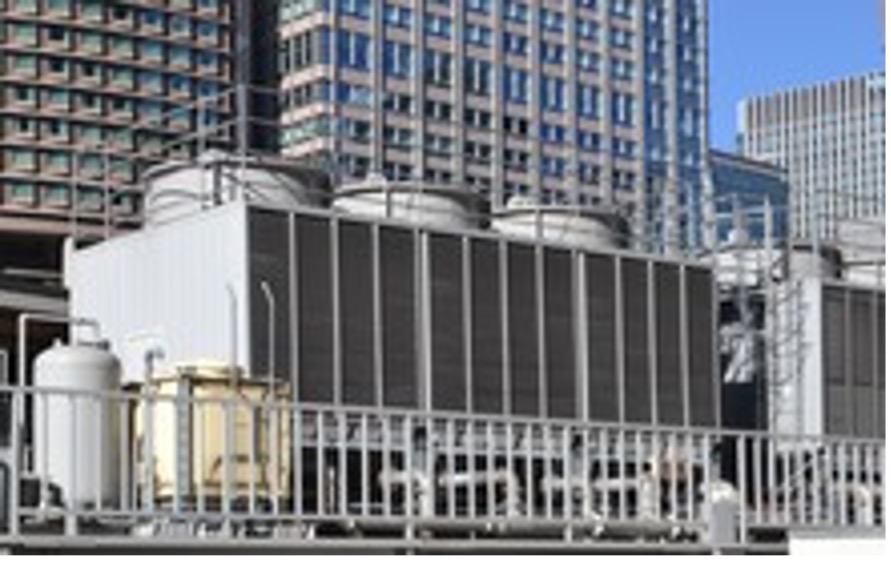
Zinc-coated, or galvanized, steel has remained a foundational material in industrial and commercial engineering for nearly three centuries. First discovered in 1732, the process of hot-dip galvanizing provides a robust protective barrier that shields underlying carbon steel from aggressive oxidative corrosion. Over the decades, manufacturing improvements have yielded tight, uniform, and highly resilient zinc layers. Today, galvanized steel is ubiquitous across industrial infrastructure, serving as the material of choice for small-to-moderately-sized cooling towers found in commercial facilities, light manufacturing plants, and specific unit operations within heavy industry.

However, a dangerous misconception persists among facility operators: the belief that galvanized steel is virtually maintenance-free right out of the box. While a newly manufactured galvanized cooling tower possesses an outer zinc layer designed to passivate over time—forming a protective surface barrier—the initial startup phase represents a moment of acute vulnerability. If these metal surfaces are exposed to unfavorable water chemistry during pre-commissioning or early operation, they will not develop the desired protective patina. Instead, they risk generating a destructive, non-protective zinc corrosion byproduct commonly known as white rust.
Left unchecked, white rust can rapidly degrade the structural integrity of a cooling tower, accelerating metal loss, perforation, and premature equipment failure. Preventing this catastrophic degradation requires meticulous project planning, precise control over water chemistry parameters, and proactive collaboration with specialized water treatment professionals.

Chronology: The Evolution of Galvanizing and the Discovery of White Rust
To understand why white rust poses such a severe threat to modern cooling infrastructure, it is necessary to examine the chronological progression of zinc coating technology and industry guidelines:
- 1732: The foundational corrosion-inhibiting properties of applying molten zinc to iron and steel substrates are formally discovered, launching centuries of metallurgical development.
- Mid-20th Century: Hot-dip galvanizing processes are heavily industrialized and standardized, leading to the widespread adoption of heavy mill galvanized (HMG) steel in commercial and industrial HVAC and process cooling applications.
- Decades Past (CTI Bulletin Development): Recognizing a high incidence of premature coating failures in newly installed systems, the Cooling Technology Institute (CTI) publishes specialized technical bulletins outlining mandatory pre-conditioning protocols and recommended operating parameters for new galvanized towers.
- Present Day (2026): Despite decades of published guidance, white rust remains a persistent challenge for plant operators. Complexities in raw water sources, shifting environmental mandates, and inadequate pre-operational planning continue to cause costly premature equipment degradation across industrial plants.
Supporting Data: Understanding Water Chemistry and White Rust Mechanics
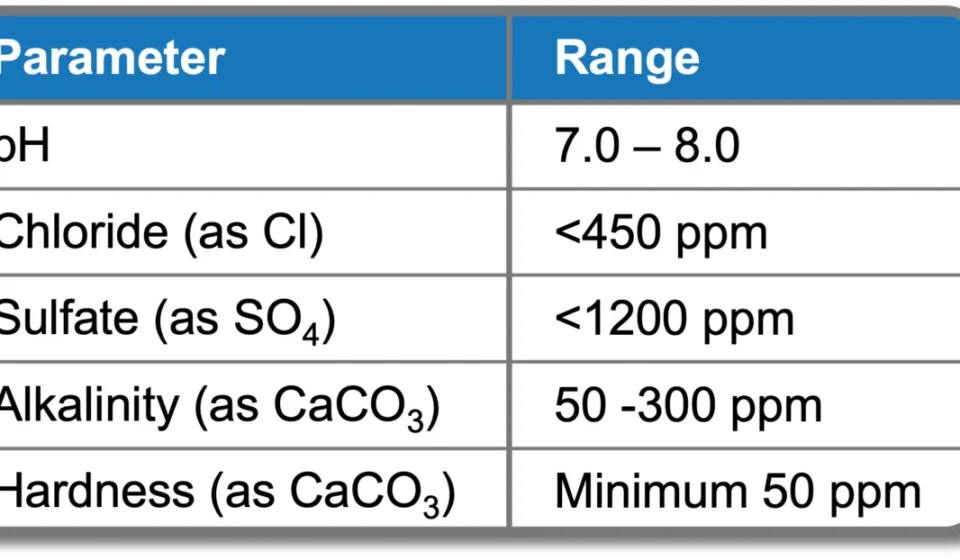
Under normal, well-managed cooling tower operating conditions, HMG steel provides exceptional corrosion resistance. When a freshly galvanized surface is exposed to neutral-pH, moderately hard water—typically defined as a minimum of 100 parts per million (ppm) calcium as $textCaCO_3$, a bicarbonate alkalinity ranging between 100 and 300 ppm as $textCaCO_3$, and a stable pH window of 7.0 to 8.0—a chemical transformation occurs.
The Chemistry of Passivation vs. Destruction
In favorable water environments, the zinc coating reacts with dissolved minerals to form a tightly adherent, non-porous surface barrier composed of zinc carbonate and zinc hydroxide, scientifically believed to follow the formula:
$$text3Zn(OH)_2 cdot textZnCO_3 cdot textH_2textO$$
This passivated film acts as a shield, dramatically slowing further galvanic corrosion of the underlying zinc coating and ensuring a long service life for the cooling tower basin and structural components.
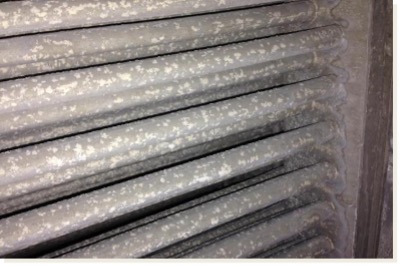
Conversely, "white rust" is an entirely different chemical manifestation of zinc carbonate. It presents as an accumulation of voluminous, fluffy, white, or waxy non-protective corrosion products. According to CTI technical literature, white rust forms rapidly when new galvanized steel is commissioned under unfavorable chemical regimes—such as water with an excessively high pH, extremely low hardness, or high concentrations of aggressive anions like chlorides and sulfates.
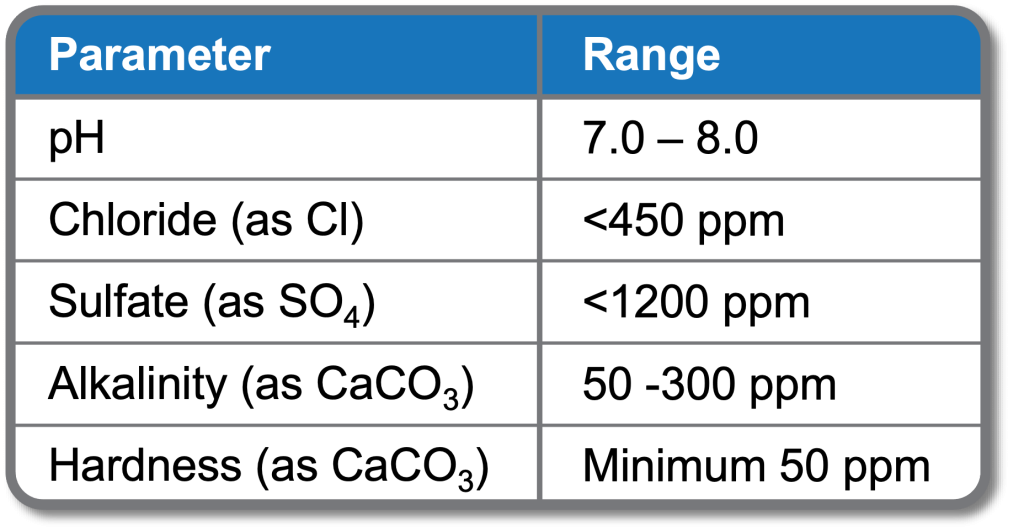
Recommended Operating Parameters
To prevent the formation of white rust and encourage proper passivation, industrial water treatment standards establish strict control limits for cooling water chemistry during initial operation:
| Parameter | Recommended Operating Range / Limit |
|---|---|
| pH | 7.0 to 8.0 (Avoid sustained levels > 8.3 or < 6.5) |
| Calcium Hardness | Minimum 100 ppm (as $textCaCO_3$) |
| Bicarbonate Alkalinity | 100 to 300 ppm (as $textCaCO_3$) |
| Total Dissolved Solids (TDS) | Maintained within facility design limits to prevent ionic aggression |
| Chlorides & Sulfates | Minimized during initial passivation phases |
When water chemistry strays outside these recommended boundaries—particularly during the critical first 30 to 90 days of tower operation—the zinc surface fails to passivate correctly, opening the door to aggressive white rust proliferation.

Official Industry Responses and Operational Challenges
Industrial bodies, including the Cooling Technology Institute (CTI) and the Association for Materials Protection and Performance (AMPP)—formerly known as NACE International—have consistently emphasized that preventing white rust is significantly easier than curing it.
Despite these clear guidelines, plant engineers frequently encounter operational hurdles that complicate passivation:
- Variable Raw Water Quality: Many industrial facilities draw makeup water from municipal sources, rivers, or wells that fluctuate widely in hardness, alkalinity, and pH. Water that is naturally soft or highly aggressive will instantly attack fresh zinc coatings unless chemically adjusted.
- Premature Heat Load Application: Cooling towers are frequently brought online to support plant startup before water treatment chemistry programs are fully optimized, automatic chemical feed systems are calibrated, or blowdown controllers are activated.
- Inadequate Pre-Conditioning: Skipping the passivation or "seasoning" phase—where chemical inhibitors are intentionally applied to build a temporary protective film while the natural zinc carbonate layer forms—leaves raw metal exposed to aggressive water matrices.
- Microbiological Fouling: Uncontrolled biological growth can create localized differential aeration cells beneath slime layers, dropping pH levels at the metal-water interface and triggering localized corrosion beneath the zinc matrix.
Implications: Long-Term Reliability and Strategic Asset Management
The implications of ignoring galvanized steel passivation extend far beyond aesthetic white deposits on a cooling tower basin. If white rust is permitted to establish itself during the early lifecycle of a cooling tower, the structural degradation can progress at an alarming rate.
- Asset Degradation and Capital Expenditure: Unmitigated white rust strips away the sacrificial zinc layer far ahead of schedule. Once the zinc is depleted, the underlying carbon steel is exposed directly to oxygenated cooling water, leading to deep pitting, localized structural failure, and the exorbitant cost of premature tower replacement or major structural rehabilitation.
- The Need for Holistic Project Planning: Preventing these failures requires bridging the communication gap between mechanical engineering design teams, water treatment chemical suppliers, and on-site plant operators. Effective technical databases and robust project planning schedules must mandate that water treatment chemistry is established before wet commissioning begins.
- Comprehensive Water Conditioning: In many geographical regions, raw makeup water requires supplemental treatment—such as softening, acid feed for alkalinity control, or specialized polymeric dispersants—to bring water quality into alignment with CTI recommendations. Furthermore, reliable biocide dosing systems must be commissioned concurrently to prevent microbiological fouling from destabilizing water chemistry.
Conclusion and Further Resources
Galvanized steel remains an exceptional, cost-effective material for cooling tower construction, provided it is treated with the chemical respect it demands during startup and ongoing operation. Facility managers and engineers seeking in-depth guidance on mitigating water-side corrosion and optimizing plant reliability are strongly encouraged to consult technical standards provided by:

- The Cooling Technology Institute (CTI): www.CTI.org
- The Association for Materials Protection and Performance (AMPP): www.AMPP.org
By prioritizing proactive chemistry management and rigorous pre-operational conditioning, plants can safeguard their cooling infrastructure, ensure optimal thermal performance, and maximize return on capital investments.