By Ahmed Rezika, SimpleWays OU Published October 8, 2026
Main Facts
The rapid evolution of humanoid robotics has captured global attention, moving far beyond simple laboratory experiments into the realm of athletic feats. In 2026, platforms like China’s Tiangong Ultra shattered human athletic boundaries at the World Humanoid Robot Games in Beijing, sprinting 100 meters in 8.86 seconds—eclipsing Usain Bolt’s historic benchmark. Yet, for industrial maintenance engineers, these headline-grabbing milestones present a stark paradox.
While watching a robot sprint across a stadium, backflip, or recover seamlessly from a fall is captivating, the industrial shop floor demands an entirely different paradigm of capability. Running 100 meters is fundamentally distinct from recognizing a loose electrical connection, securing a vibration sensor against a high-stress bearing housing, or navigating an unpredictable environment filled with grease, unmapped obstacles, and legacy machinery.
The central challenge facing modern industrial engineering is no longer whether a humanoid machine can execute a dynamic maneuver once. Instead, it is a question of reliability: Can a humanoid robotics system perform critical maintenance tasks repeatedly, adapt to unforeseen physical degradation, and intelligently recognize when a situation exceeds its operational safety limits?
Addressing this core problem requires moving past raw athletic performance. It demands an integrated training architecture that leverages advanced simulation, reinforcement learning, human-guided demonstrations, and rigorous real-world validation. As manufacturing facilities grapple with labor shortages and rising complexity, bridging the gap between digital training environments and physical shop floors has become the ultimate frontier for industrial automation.
Chronology: The Path to Industrial Autonomy
The journey toward deploying dependable humanoid robots in industrial settings has accelerated dramatically over recent years, marked by key technical breakthroughs in simulation, machine learning, and hardware deployment:
Early Foundations (Pre-2025): Humanoid development focused primarily on basic bipedal locomotion, balance control, and tele-operated manipulation. Robots required extensive, rigid programming or direct human oversight to execute even simple assembly tasks, struggling immensely with environmental unpredictability.
2025 – The Breakthrough in Sim-to-Real Vision: Researchers successfully demonstrated reinforcement learning frameworks designed for vision-based dexterous manipulation on humanoids. By integrating automated real-to-simulation tuning and visual variation, systems trained in grasp-and-reach, box lifting, and bi-manual handovers were transferred directly to physical hardware.
Early 2026 – Scaled Loco-Manipulation (The VIRAL Framework): A significant leap occurred with the introduction of the VIRAL framework. Humanoid loco-manipulation was trained entirely in simulation utilizing extensive domain randomization—accounting for shifting lighting, camera quality, material changes, and sensor delays—allowing robots like the Unitree G1 to operate continuously in complex environments without real-time fine-tuning. Concurrently, researchers advanced pixel-to-action policy transfers, enabling robots to autonomously interact with articulated industrial assets such as doors and enclosures.
Mid-2026 – Robotic Athletics vs. Physical Realities: The World Humanoid Robot Games in Beijing showcased breathtaking running and movement speeds, such as the Tiangong Ultra’s 8.86-second 100-meter sprint. However, these events also exposed critical limitations: robots routinely crashed, struggled to brake safely, and lost balance under unexpected loads (such as a 15 kg barbell), highlighting the vast chasm between executing raw movement and controlling physical consequences.
August 2026 – Real-World Online Reinforcement Learning: The introduction of advanced frameworks like HARC (Hybrid Online Reinforcement Learning for Robotic Manipulation) pushed machine learning out of static lab conditions. By utilizing centralized training and critic decomposition, robots began improving success rates dynamically during physical pick-and-place and asset-relocation routines.
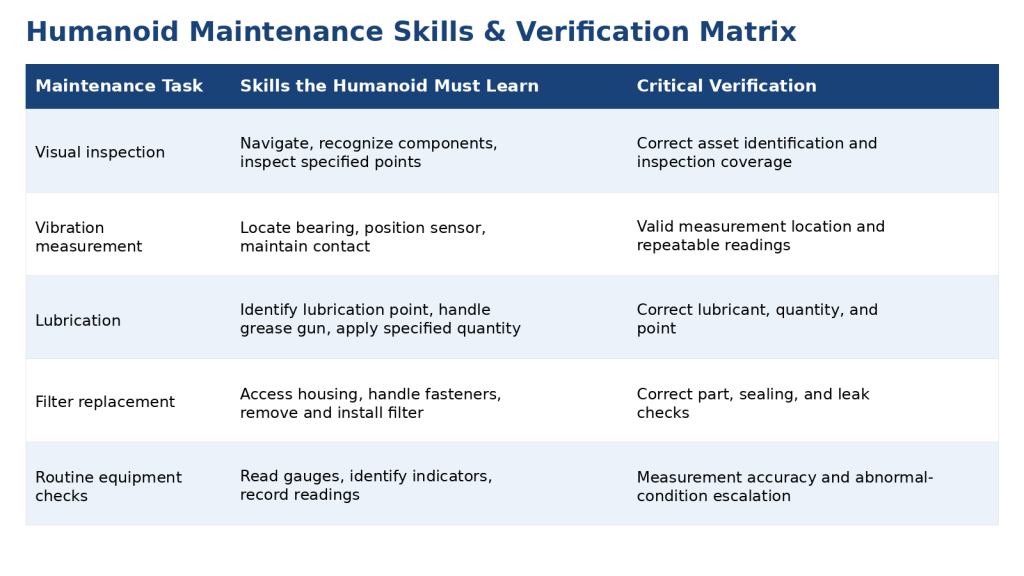
September–October 2026 – Framing the Maintenance Paradigm: Industry discussions pivot toward structured deployment matrices. Frameworks emerge emphasizing that humanoids must not be treated as autonomous generalists, but rather introduced systematically: moving from non-invasive data collection in high-risk human zones to highly supervised, tool-based physical interventions.
Supporting Data & Technical Frameworks
To understand how humanoids transition from digital simulations to trustworthy maintenance colleagues, engineers must examine the foundational methodologies driving modern robotics.
The Sim-to-Real Gap and Domain Randomization
The primary obstacle in deploying artificial intelligence to physical hardware is the sim-to-real gap—the inevitable discrepancy between how a robot performs in a pristine digital simulator and how it behaves amidst the friction, noise, and chaos of a real factory.
To bridge this gap, modern engineering relies heavily on domain randomization. Rather than building an exact, flawless digital twin of every machine in a facility, developers program simulation software to intentionally introduce chaos. Lighting parameters fluctuate, textures and surface friction coefficients vary, component dimensions shift slightly, and artificial sensor delays are injected.
Through this method, the robot does not learn: "This is how you open this exact door handle." Instead, it learns a generalized policy: "This is how you recognize, approach, manipulate, and verify this class of asset under imperfect, shifting conditions."
Reinforcement Learning and the Reward Function
Beyond copying human demonstrations, humanoids utilize reinforcement learning (RL) to discover optimal behaviors through trial, error, and feedback—much like AlphaZero mastered complex board games through self-play.
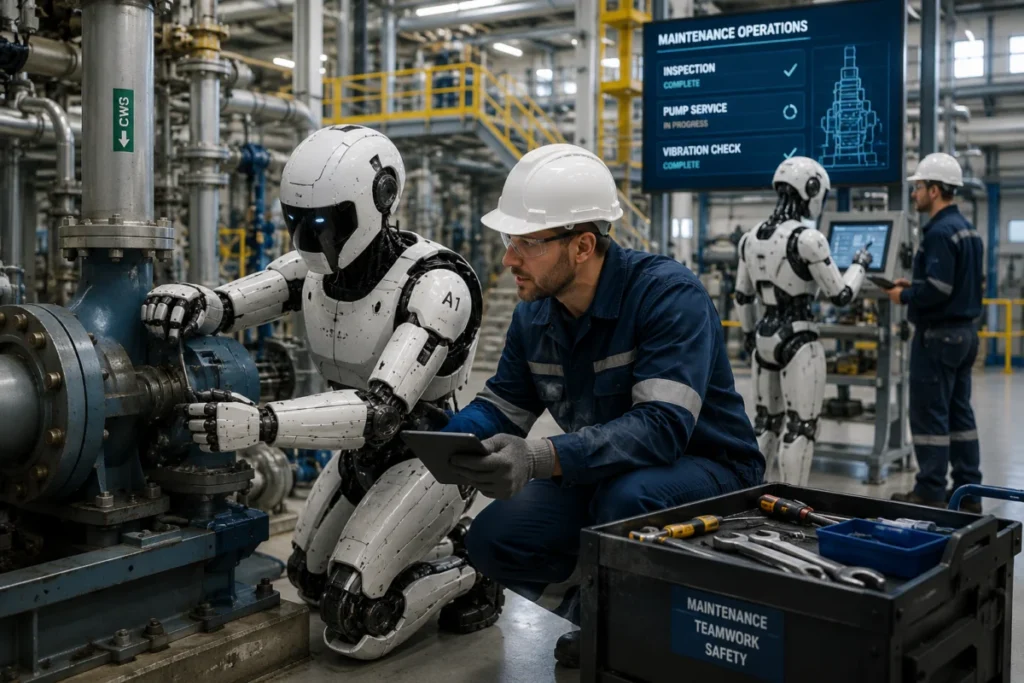
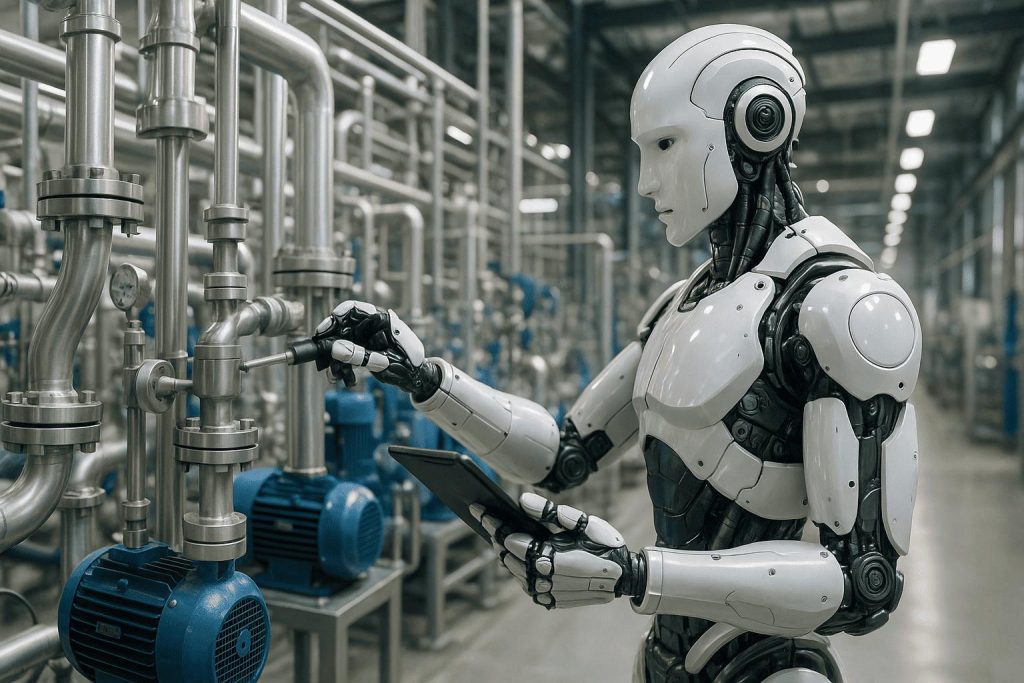
When training a humanoid to perform a maintenance task—such as placing a vibration sensor against a bearing housing—engineers construct a specialized reward function. In industrial applications, this function must fundamentally prioritize plant safety and asset integrity over raw speed. A well-designed reward structure evaluates:
Task Accuracy: Did the sensor make precise contact with the designated surface?
Equipment Protection: Was excessive, potentially damaging force avoided?
Stability and Posture: Did the robot correctly reposition its body to maintain equilibrium?
Error Recognition: Did the system detect an anomaly and halt operations when conditions became unreliable?
Key Technical Jargon Reference
Sim-to-Real Transfer: The methodology of deploying control policies developed in digital simulations onto physical robots, followed by rigorous validation against real-world operating physics.
Loco-Manipulation: The advanced capability of a robot to seamlessly coordinate whole-body mobility (walking, shifting weight) while simultaneously manipulating physical objects with its arms and hands.
Policy: The learned algorithmic decision-making rule mapping a robot’s real-time sensory observations to its immediate physical actions.
Official Perspectives & Industry Insights
As experts evaluate the intersection of robotics and industrial asset management, industry leaders emphasize that the ultimate measure of a humanoid’s success is not its resemblance to human anatomy, but its operational reliability.
Ahmed Rezika, Projects and Maintenance Manager and founder of SimpleWays OU, stresses that maintenance departments cannot afford to let artificial intelligence learn through catastrophic trial and error. While a humanoid learning to sprint or dance can safely crash or fall, a robot operating next to an energized electrical cabinet, a high-pressure steam line, or a running industrial turbine cannot be granted unmitigated freedom to experiment.
"The objective is not to make the humanoid look human. The objective is to make its behavior reliable enough to be trusted," notes Rezika. "A humanoid that completes a lubrication task in two minutes but damages a seal is not better than one that takes four minutes and completes it correctly. A robot that encounters an unexpected condition and continues blindly may be more dangerous than one that simply stops."
Consequently, industry consensus points toward a blended, multi-tiered learning architecture: Watch humans $rightarrow$ Learn from demonstrations $rightarrow$ Practice extensively in simulation $rightarrow$ Refine through controlled real-world interaction $rightarrow$ Supervise and gradually increase autonomy.
Implications for Industrial Maintenance
The integration of humanoid robotics into industrial environments carries profound implications for plant operations, workforce safety, and maintenance engineering strategies.
Strategic Task Selection
Not every maintenance routine justifies the deployment of a humanoid asset. Many diagnostic and inspection tasks are performed more cost-effectively by fixed internet-of-things (IoT) sensors, stationary cameras, drones, or wheeled automated guided vehicles (AGVs).
Humanoids become indispensable only when a workflow demands an intricate combination of human-like mobility, spatial access, and multi-tool manipulation within workspaces originally architected for human personnel. A sensible operational roadmap suggests beginning with non-invasive data collection and routine inspections in hazardous or hard-to-reach areas—minimizing risks to human workers while gathering baseline operational data.
The Irplaceability of Human Governance
Crucially, advanced machine learning policies and autonomous capabilities do not supersede established industrial safety protocols. No learned robotic policy can replace fundamental safety procedures such as Lockout/Tagout (LOTO), physical isolation verification, or legally authorized work permits.
When humanoids eventually transition to tool-based physical interventions, they will operate under strict supervisory frameworks. The vision for the next-generation maintenance technician is a collaborative colleague that knows its exact operational boundaries: executing defined tasks with precision, recognizing environmental anomalies, and intelligently yielding control to human engineers when a situation exceeds its validated competence.
By approaching humanoid integration one carefully selected task, one robust simulation, and one verified skill at a time, maintenance engineering can successfully transform spectacular robotic novelties into trustworthy industrial partners.