





Decoding the Quantum Micro-World: A New Computational Breakthrough in Spin Defect Research

In the race to build the quantum computers and ultra-sensitive sensors of the future, researchers have long looked toward the atomic imperfections found in materials like diamond and silicon carbide. Known as "spin defects," these tiny anomalies can capture, hold, and manipulate quantum information, serving as the building blocks for stable qubits. However, scientists have faced a persistent, frustrating hurdle: accurately predicting how these defects behave when energized by light.
A team of researchers at the University of Chicago’s Pritzker School of Molecular Engineering (UChicago PME) has now cracked this code. By developing a sophisticated new computational framework, the team has successfully simulated the full optical cycle of these defects, including the notoriously difficult process of "internal conversion." Their findings, recently published in Physical Review Letters, provide a definitive, high-resolution map of how quantum systems lose energy, offering a roadmap for the next generation of materials science.
The Challenge of the Quantum Optical Cycle
To understand the magnitude of this breakthrough, one must first understand the life of a spin defect. When a photon from a laser strikes an imperfection in a crystalline lattice, it imparts energy, pushing electrons into an "excited state." This is the moment a qubit is "switched on." However, this state is transient. Eventually, the defect must return to its ground state, shedding that excess energy in a process that determines how useful the defect is for quantum applications.
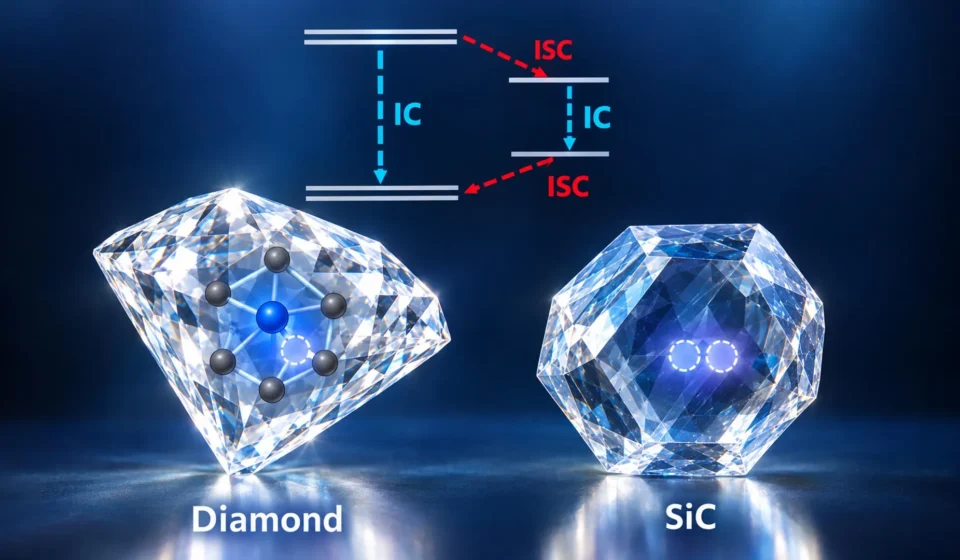
This return to equilibrium typically happens through three pathways: emitting a photon, transitioning between different spin states, or transferring energy into the vibrations of the surrounding atoms. This third pathway—internal conversion—has long been the "missing link" in quantum modeling. While the first two processes are well-described by standard quantum mechanical equations, internal conversion is computationally grueling. It requires accounting for the chaotic, microscopic dance between electrons and the hundreds or thousands of atoms surrounding them. Until now, the sheer complexity of these interactions made accurate simulation nearly impossible.
Chronology of the Breakthrough
The path to this discovery was not linear; it was the culmination of over a decade of foundational research led by Giulia Galli, the Liew Family Professor of Electronic Structure and Simulations at UChicago PME.
A Decade of Foundation (2015–2023)
Since 2015, the research has been supported by the Midwest Integrated Center for Computational Materials (MICCoM), funded by the U.S. Department of Energy. During this time, the Galli group focused on building the "WEST" simulation code—an open-source program optimized for high-performance graphics processing units (GPUs). WEST was designed to handle the complex physics of materials at the nanoscale, but it required a specific, rigorous mathematical framework to handle internal conversion.
The Mathematical Synthesis
The breakthrough arrived when Galli, postdoctoral researcher Stefano Villani, and former graduate student Yu Jin (now at the Flatiron Institute) combined their expertise. The team successfully utilized "many-body wavefunctions" to describe the excited states of spin defects. By deriving new, exact mathematical relationships, they found a way to connect individual electronic states to the collective vibrations of an entire lattice of atoms. Instead of calculating the vibration of every atom individually—a process that would freeze even the most powerful supercomputers—their framework calculates the interaction between the electronic state and the entire ensemble of vibrational configurations simultaneously.
Validation and Discovery
Once the framework was integrated into the WEST code, the team tested it against the nitrogen-vacancy (NV) center in diamond, a benchmark system in the field. The simulation perfectly mirrored recent spectroscopy measurements. With the model validated, they turned their attention to a more complex subject: the divacancy defect in silicon carbide. This led to a surprising discovery: internal conversion in silicon carbide was far more influential than previously theorized, explaining a long-standing discrepancy between theoretical models and real-world experiments.
Supporting Data and Technical Nuance
The power of the Galli group’s method lies in its ability to bridge the gap between abstract quantum mechanics and practical materials engineering.
- The Singlet-Triplet Dichotomy: In the diamond NV center, the team confirmed that for triplet states, internal conversion is a minor player in energy loss. Conversely, for singlet states, it is the primary mechanism. This confirms long-standing hypotheses.
- Silicon Carbide Revelations: The divacancy in silicon carbide presented a different profile. Earlier models underestimated the impact of internal conversion on the lifetime of the triplet excited state. The new model demonstrated that this process is a dominant factor, providing the missing variable that had previously caused theoretical predictions to diverge from empirical observations.
- Computational Efficiency: By utilizing GPUs and optimized algorithms, the team’s approach allows for the modeling of systems with hundreds or thousands of atoms—a scale previously inaccessible for this level of precision.
Official Responses and Expert Perspectives
"This internal conversion process is not only relevant to spin defects—it’s also related to processes of interest to energy technologies," says Giulia Galli. "That’s one of the reasons this work is so exciting." By unlocking the secrets of energy loss, the team has created a tool that transcends quantum computing; it has direct applications in photovoltaics, photocatalysis, and battery material research.
Stefano Villani highlights the difficulty of the task, noting, "You need to account for complex interactions between the electrons and surrounding atoms, and that’s challenging in realistic solids represented by models with hundreds or thousands of atoms."
Yu Jin, who played a pivotal role in the mathematical derivation, notes the evolution of the project: "In the past, a clear mathematical derivation and efficient algorithms were not available. The new derivation came together after years of work on the optical cycle of spin defects. We provided the missing piece of the puzzle needed to completely describe the optical cycle."
Broader Implications: Beyond the Quantum Lab
The implications of this research extend far beyond the walls of the UChicago PME laboratories.
Designing Better Quantum Hardware
The ability to predict exactly how a spin defect will lose energy allows engineers to "tune" materials. By knowing how a defect behaves in silicon carbide or diamond, scientists can create more stable, longer-lived qubits, which are essential for building quantum computers capable of error correction and complex calculations.
Revolutionizing Energy Research
Internal conversion is a fundamental process in how nature manages energy. Whether it is a leaf converting sunlight into chemical energy or a solar cell capturing a photon to generate electricity, energy loss through vibrational coupling is a primary efficiency bottleneck. The Galli group’s framework provides a new diagnostic tool for materials scientists working to minimize these losses, potentially leading to more efficient solar panels and next-generation energy storage systems.
The Path Forward: AI and Integration
Despite the success of the new framework, the researchers are not resting on their laurels. The current simulations remain computationally intensive, requiring significant supercomputing resources. The team is already looking toward the future, with plans to integrate machine learning and artificial intelligence into the WEST simulation package.
"We are working on ways to integrate machine learning into excited states calculations to further improve the efficiency of our method," Villani says.
As the team expands their investigation into spin defects in silicon—the backbone of the modern semiconductor industry—the potential for this research to impact everyday technology grows. By solving a fundamental problem in quantum mechanics, the UChicago PME team has not only advanced our understanding of the subatomic world but has also provided the tools necessary to build the next generation of high-efficiency, quantum-enabled technology. The "missing piece" has been found, and the path to a new era of materials science is clearer than ever.