





Illuminating the Invisible: How Light Field Photography is Revolutionizing Particle Physics

In the rarefied world of high-energy physics, the pursuit of fundamental truths is often a race against complexity. To observe the elusive building blocks of our universe—such as neutrinos and mysterious dark matter candidates—scientists have traditionally relied on gargantuan, hyper-segmented detectors. However, a groundbreaking collaboration between ETH Zurich and EPFL is challenging this status quo. By marrying the principles of light field photography with advanced single-photon sensors, researchers have developed a new system, PLATON, that promises to map subatomic particle interactions with unprecedented precision, all without the need for traditional, labor-intensive detector segmentation.
The Bottleneck of Modern Detection
For decades, the standard approach to tracking elementary particles has been akin to building a massive mosaic out of millions of tiny, individual tiles. In experiments like T2K in Japan or the LHCb at CERN, scientists fill vast volumes with "scintillator" materials—substances that emit flashes of light when a charged particle traverses them.
To pinpoint exactly where a particle traveled, engineers divide these scintillators into millions of tiny, isolated sections. Each section is coupled to optical fibers that ferry the precious, faint photons to sensors. While this "segmented" approach is undeniably effective, it represents a monumental engineering hurdle. Manufacturing, assembling, and maintaining millions of delicate components creates a technological and financial bottleneck that limits the scale and resolution of future experiments. As scientists seek to detect ever-fainter signals, the current path of simply "building bigger" is rapidly reaching its point of diminishing returns.
A New Paradigm: The PLATON Project
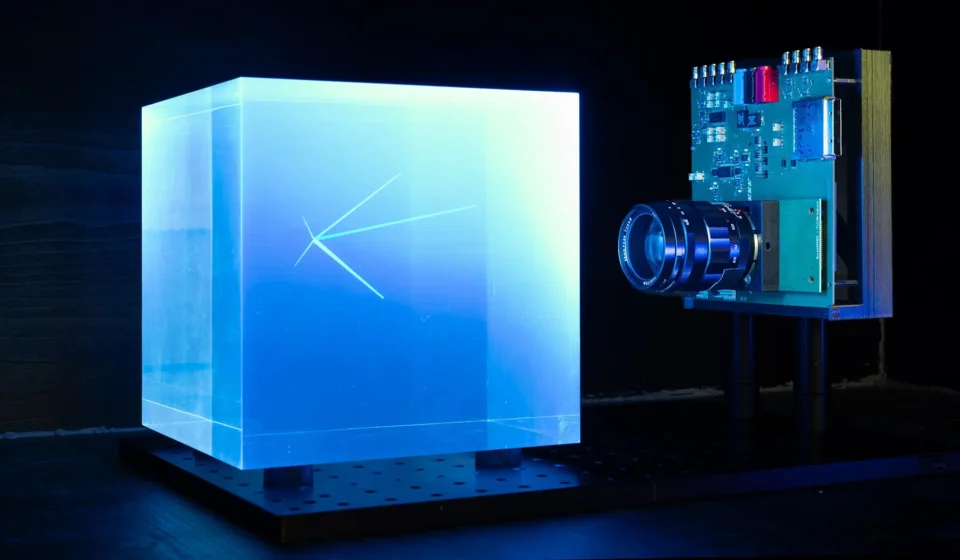
A team led by Professor Davide Sgalaberna at ETH Zurich and Professor Edoardo Charbon’s Advanced Quantum Architecture Lab at EPFL has proposed a radical departure from this complexity. Their project, PLATON (PLenoptic Advanced detector for Tracking and Other New-physics), reimagines the detector not as a mosaic, but as a singular, monolithic block of scintillator.
Instead of relying on physical barriers to track particles, the PLATON system utilizes a plenoptic camera—a technology more commonly known as "light field photography." Unlike a standard digital camera that merely flattens a 3D scene into a 2D image, a light field camera captures both the intensity and the directional vector of incoming light. By integrating a micro-lens array (MLA) between the main lens and the sensor, the system records the same scene from a multitude of angles simultaneously. When processed, this data allows for the reconstruction of a 3D light field, providing a spatial resolution that was previously thought impossible in unsegmented detectors.
Chronology of the Breakthrough
The journey of PLATON began with a fundamental question: Could we treat a massive block of material as a single imaging sensor?
- Conceptualization (2021-2022): The research team, including PhD student Till Dieminger and senior scientist Dr. Saúl Alonso-Monsalve, began investigating whether plenoptic sensors, when paired with high-sensitivity Single-Photon Avalanche Diode (SPAD) arrays, could resolve the faint, fleeting light of subatomic particle tracks.
- The Prototype Development (2023): Working with the SwissSPAD2 sensor—an ultra-sensitive device developed at EPFL—and a custom-designed micro-lens array from Raytrix GmbH, the team constructed the first proof-of-concept detector.
- Validation (2024): The team subjected the prototype to rigorous testing using a strontium-90 source to produce electrons. The findings, published in Nature Communications, confirmed that their simulations of the detector’s performance matched the real-world laboratory data, proving that even with as few as five photons, the system could successfully reconstruct a particle’s path.
Supporting Data: Precision Under Pressure
The efficacy of the PLATON prototype was tested under varied conditions, ranging from high-photon-density events down to the extreme low-light limit of five photons. The results were striking. In laboratory simulations, the system demonstrated that a monolithic block of scintillator could achieve sub-millimeter spatial resolution.
Key performance indicators highlighted in the team’s research include:
- Gated Photon Detection: By using the SPAD sensor’s ability to record photons only within defined time windows, the team successfully filtered out the "noise" of random background radiation, a perennial challenge in particle physics.
- Neural Network Reconstruction: The team introduced an AI-driven image processing method based on a Transformer architecture. Much like large language models parse the relationships between words, this neural network identifies complex patterns in the timing and positioning of scintillation photons, allowing for the reconstruction of particle interactions with high purity and efficiency.
Official Perspectives: The Path Forward
Professor Davide Sgalaberna emphasizes that the success of the first demonstrator is merely the starting point. "The results from the first prototype have been transformative for our roadmap," he noted.
The team is currently finalizing an upgraded version of the SPAD array sensor. The new design aims to provide sub-nanosecond timing for individual photons. In the previous iteration, photons were grouped into fixed windows; the upgrade will assign each photon a precise timestamp, drastically increasing the system’s tracking fidelity. Furthermore, by optimizing the camera’s field of view and light collection capacity, the researchers expect to push the spatial resolution even further, making it feasible to monitor volumes exceeding one cubic meter with the same precision currently found in systems with millions of individual parts.
Implications: Beyond the Particle Collider
Perhaps the most compelling aspect of the PLATON project is its potential for technological spillover. While its primary design goal is the detection of elusive neutrinos, the underlying technology is essentially a high-speed, high-resolution 3D imaging machine.
The Medical Frontier
The team has already filed three patents focused on the application of PLATON technology in Positron Emission Tomography (PET) scanners. Current PET scans rely on complex, expensive detector arrangements to map radioactive tracers in the body. If a monolithic detector could achieve similar or superior results at a fraction of the cost, it could revolutionize diagnostic imaging, making high-precision metabolic scans more accessible and less invasive.
A Legacy of Innovation
The history of physics is rich with technologies that transitioned from the laboratory to the public square. The World Wide Web was birthed at CERN to solve the problem of data sharing; proton therapy evolved from the specialized magnets used in particle accelerators. PLATON stands to continue this legacy. By simplifying the detector, the team is not just making physics easier—they are building a platform for the next generation of medical and scientific imaging.
Conclusion
The PLATON project represents a rare moment of "technological synergy." By combining the disparate worlds of light field photography, AI-driven image reconstruction, and single-photon quantum detection, the ETH Zurich and EPFL team has circumvented the physical limitations of current detector architecture.
As the project scales from a small, 10-centimeter cube to a full-scale, one-cubic-meter detector, the scientific community watches with anticipation. If the team’s simulations hold true, they will have successfully replaced millions of individual parts with a single, elegant imaging solution. In doing so, they have not only opened a new window into the invisible world of neutrinos and dark matter but have also provided a blueprint for future advancements in medical diagnostics and beyond. The future of physics, it seems, is not just about building bigger machines—it is about building smarter ones.